Decades of change captured in images
By Xu Lin And Yuan Hui (China Daily)
Updated: 2015-08-22
Bao Yin stares into his computer screen, carefully adjusting the colors of a photo.
"Many youngsters have absolutely no idea about what to shoot," he says. "You really need to know what it is that you want to capture; there needs to be a focus."
Bao, 59, knows a few things about that, having taken photos that capture the customs and practices of the Inner Mongolia autonomous region for more than 30 years.
Even if Bao talks approvingly of focus, there are few subjects that have not passed through his lens, whether it be the daily lives of herders, the work and antics of horses, the changes that have affected the region's environment or something else.
Something he has on the drawing board at the moment is a 100-meter-long scroll devoted to Mongolian wrestling, with various poses he captured on the grasslands, to celebrate the 70th anniversary of the establishment of the autonomous region in 2017.
"I've taken so many photos covering many aspects of the region, and want to create collections on themes such as camels and folk culture to promote our culture," he says.
Bao, a member of the Daur ethnic group, got into photography when he was about 25 in 1981, seven years before the dawn of commercial digital cameras. Just as he has watched the march of progress alter the face of the Inner Mongolia autonomous region, he has stayed abreast of the revolution in photography, and uses software to turn his photos on computer into kinds of oil painting to make them more artistic.
His entry into photography was the result of his working in the Hohhot procuratorate, where he was in charge of taking pictures of crime scenes. He often read photography magazines and gradually became consumed by the subject, he says. From 1989 he studied photography for two years at college and started touring Inner Mongolia taking pictures.
Every year he was keen on taking two weeks off work to take photos, something his employer found impossible to accommodate, so in 1998, aged just 42, he applied for early retirement so he could concentrate on photography.
When he traveled to Badanjilin desert in Erjina Banner, Alashan League, for the first time five years earlier, he says, he was attracted by the flourishing Euphrates poplars and took photos excitedly. However, as he walked into the forest, he was shocked by a vast tract of dead trees, with dried branches and leaves.
"As I photographed these dead poplars, I thought about those ancient warriors who died in battlefield but left their souls in the desert forever."
It is often said that Euphrates poplars can live for 1,000 years, he says, that even after they are dead they will stand for another 1,000 years.
For him it seemed the poplars were calling on people to save their homeland whose environment was being damaged.
So he decided to record these scenes and the sadness he felt about them in his pictures, visiting the desert every year and shooting several thousand photos.
In those early days getting from his home in Hohhot, the capital of the Inner Mongolia autonomous region, to Bayanhot town, Alashan League, heavy cameras and lenses in tow, was highly onerous. It required a seven-hour train trip, then an overnight stay, followed by two grueling days on buses. In those days, too, roads were made of gravel and dirt that often turned to mud, and sand storms in spring buried roads, forcing bus drivers to take long detours.
These days, it takes just four hours' drive from Bayanhot to the desert.
In the late 1980s, he took 20 rolls of film that cost him about nine months' salary and went on a three-day train trip to his hometown, Hulunbuir grassland, wanting to record local customs and practices, and herders' daily lives.
About a decade later, in 2000, Bao spent 40,000 yuan ($6,250) to publish a photo collection about the dead Euphrates poplar forests.
"I used black and white to highlight the cruelty of the desert and touch people's hearts," he says. "I hope it will encourage those who love nature to care about the environment wherever they are."
In 2000, too, the Erjina Banner government held the first Euphrates Poplars Festival and gave out books to experts and officials from the central government urging them to protect the trees and seeking financial support. The government then started to take measures to protect the trees such as watering and tackling desertification, and the trees eventually began to flourish.
"I go from every year to take photos and witness the enormous changes."
The annual festival draws many tourists, drawn among other things by the beauty of the trees, and it is lucrative for herders who can offer their services as drivers or guides.
Three years ago, Bao published a photo collection called Spirit in Wild that featured different horses and their owners on Inner Mongolian grasslands in four seasons.
"Capturing the expressions of animals and humans well all comes down to a split second," he says. "Horses are constantly moving, so they need to be captured at just the right time."
His grandmother used to tell him how the king of horses guarded the safety of other horses and horses that risked their lives to protect their owner, he says. Horses are the most loyal friends humans can have, he says, which is why capturing them in poignant moments on the grasslands is important to him.
"Herders used to use horses as labor and transport. But now, only a few are good enough to join equestrian competitions."
Herders on the grassland work very hard and are adept at raising animals such as horses and sheep, he says.
"The grassland itself is much the same as before, but there has been a big change in that herders are much better off than they used to be. They used to live in shabby Mongolian gers but now live in brick houses that keep warm or mobile houses that are easy to move around."
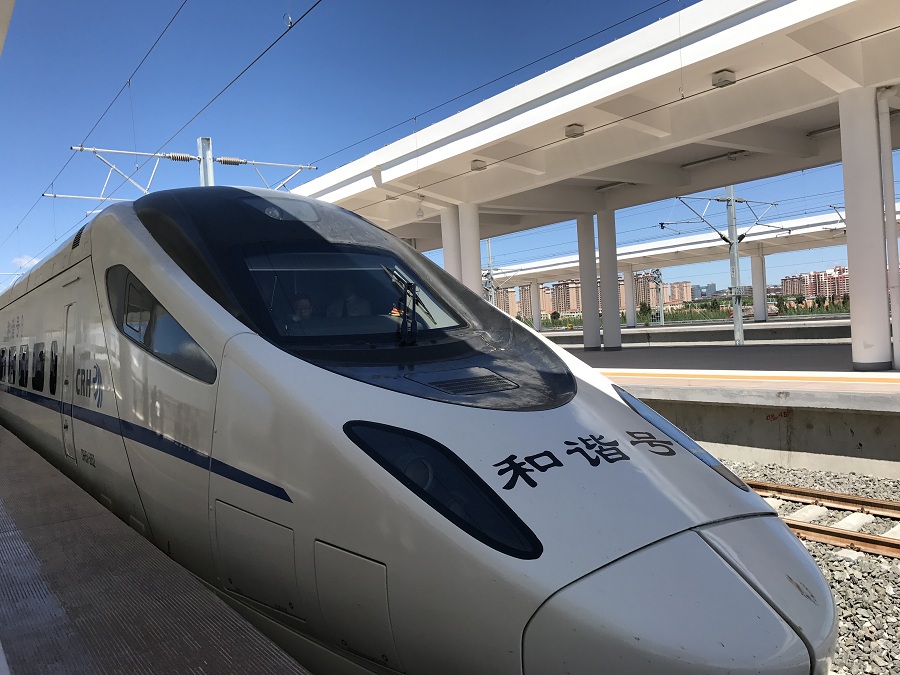
High-speed train debuts in Inner Mongolia
A bullet train departed Hohhot East Railway Station for Ulanqab marking the start of high-speed rail services using Inner Mongolia’s first newly-laid high-speed railway on Aug 3.
