Education aims to overcome region's tyranny of disadvantage
By Julius Enehikhuere (China Daily Africa)
Updated: 2015-08-21
Disadvantaged ethnic groups given greater opportunities to help close gaps
Chin Zhan, a student from Inner Mongolia autonomous region studying in Beijing, belongs to one of China's ethnic minorities.
Chin constantly reminds himself of the challenges many face in his home area, and how lucky he is.
|
A Tibetan student does an experiment supervised by a teacher at Guangzhou Health School in Guangdong province. Chen Yehua / Xinhua |

The advantages he has received as a scholarship student is one result of China's policies regarding educationally disadvantaged areas like his. He says he sees the policies as a "head start" to help bridge the gaps in educational opportunities that have existed historically.
The experience of Chin and others in the country's less-developed areas prove the saying: "If you think education is expensive, try ignorance". Policymakers in Beijing fully understand that education is essential in helping some parts of China integrate more fully with the nation.
Many of these educational advantages are conferred on residents of the country's five autonomous regions, which are areas with their own local government that are directly below the central government. Besides Inner Mongolia in the north, the regions are Xinjiang and Ningxia to the northwest, Tibet to the southwest and Guangxi in the south.
They were also created with some of the country's ethnic minorities in mind. China, the world's most populous nation, has 56 officially recognized ethnic groups, including the Han, who constitute about 94 percent of the population.
Until recent times, Tibet was a rural area of communities scattered around high plateaus, foothills and mountains of the Himalayas where, for many people, an education was an unattainable privilege that was not so relevant to their daily lives. But China's policy of a free and compulsory education has made a difference.
The establishment of a free, modern educational system from primary school to university in Tibet has been a boon to parents who otherwise could not have afforded to send their children to school.
In China, the government provides a minimum of nine years of government-funded, compulsory education. But Yixi Pingcuo, Tibet's director-general of regional development, told African journalists touring the area that China identified the special needs of some of disadvantaged areas and decided to give them a head start to bridge the gaps.

He says that, Tibet used to be a rural area backward in all things. Subsistence agriculture is the primary occupation, and herding animals is a major occupation. Some communities are nomadic. Visitors from lower regions sometimes develop altitude sickness: at 3,490 meters, the capital, Lhasa, is one of the highest cities in the world.
Different policies were needed, Yixi says, including reducing the cutoff marks for students from educationally disadvantaged areas aspiring to higher education. More schools have been established to make education easier to obtain.
Tibetans enjoy some of the most favorable educational policies in China, Yixia says, including 15 years of government-supported education for all students. The region has four universities and more than 10 other institutions of higher learning.
A visit to Tibet University shows that 80 percent of the seats are allotted to ethnic Tibetan students.
Tibetan students are generally encouraged to get their education in their home region, in part because of the special nature of the high-altitude environment, to which they are adapted, says Professor Xuan Zin of the university. That may change in the future as China continues its opening-up process, Xuan says.
Some students who spoke with the African journalists said they stayed in their region because it afforded them the chance to study subjects that could be applied to their environment.
"Our environment is peculiar to us and there is the urgent need to study it and be able to deal with the distinct and emerging issues," says Chin Cao, an environmental studies student.
We were told during a visit to the Institute of Forestry and Research of Tibet University that a lot of studies on high-altitude plants are being done. The head of the research center, Professor Dan Xian, says a lot of research has been done on soils in the region, which has little arable land.
Students from the area are encouraged to study subjects that are adaptable and useful in resolving some of the environmental challenges at high altitudes, he says.
Some problems, however, have arisen with the system to boost education in disadvantaged areas because of improprieties on the part of some educational supervisors, reports say.
In Inner Mongolia, for example, almost 1,500 non-resident students were allowed to register in high schools in the region, though many seldom attended classes, thereby blocking some students meant to benefit from the policies, reports say. Other non-residents have illegally moved their school registration and residence permits to benefit from lower college admission scores allowed for disadvantaged students.
There have been calls for reforms to ensure that the support from Beijing to educationally disadvantaged areas is properly used.
Schools in more developed provinces often have the challenge of needing to educate the children of migrant workers who have come from poorer areas to find work.
In Hebei province, just outside Beijing, 461,000 children of migrant workers were enrolled in compulsory education, bringing the enrolment figure to 1 million in the province, according to reports last year.
The province boasts of standardization of compulsory education in its public schools to guarantee that children of migrant workers enjoy equal rights.
That has quickened the development of vocational education and the building of additional higher educational institutions in the area, officials say.
Our visit also took us to vocational training centers for local residents. During a trip to one such center in Tibet, we saw over 100 people being retrained and empowered at no cost to them to become self-employed. Officials say the central government supports such programs for both youths and older residents in the region.
Gama Zunshu, 27, a Tibetan who heads one of the centers, says they have trained more than 100 people in weaving, designing, dressingmaking, animal husbandry and modern methods of farming, adding value to the culture.
"I came home to encourage the youths and the elderly to enroll and get something out of their lives instead of just searching for something to do," he says.
Officials say that if education is free, development and the bridging of gaps in such disadvantaged areas is virtually guaranteed.
The author is head of foreign operations for the News Agency of Nigeria. He is on a 10-month scholarship with the China-Africa Press Center in Beijing. The views do not necessarily reflect those of China Daily.
For China Daily
(China Daily Africa Weekly 08/21/2015 page26)
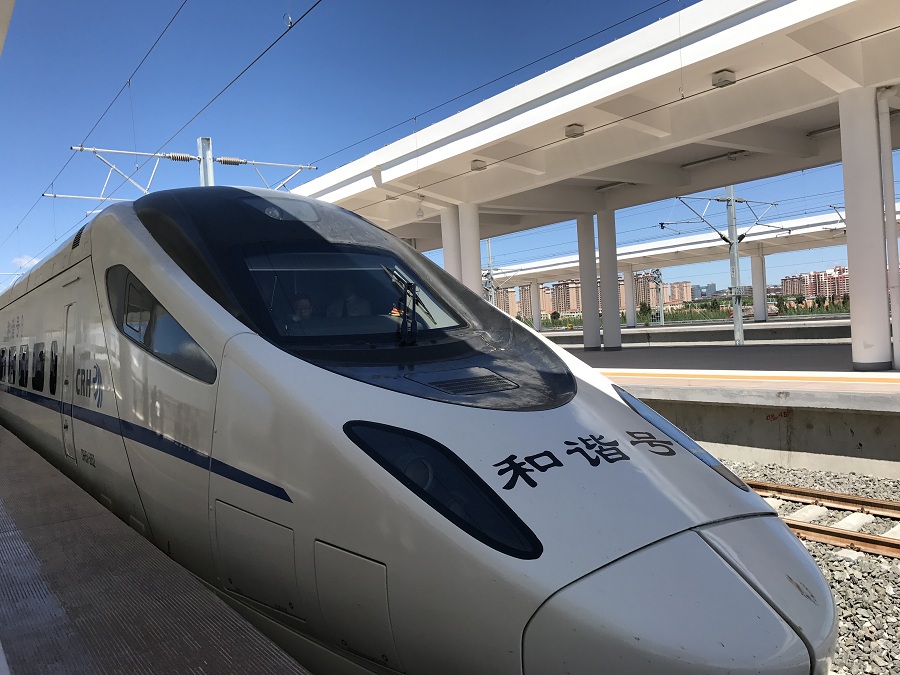
High-speed train debuts in Inner Mongolia
A bullet train departed Hohhot East Railway Station for Ulanqab marking the start of high-speed rail services using Inner Mongolia’s first newly-laid high-speed railway on Aug 3.
