Ethnic games bridging traditional sports and modern skills
By Xinhua in Ordos, Inner Mongolia (China Daily)
Updated: 2015-08-10
The 10th Chinese Ethnic Games opened on Sunday, and 6,240 athletes from all 56 ethnic groups of China will compete or perform in nearly 200 Chinese traditional sport events in the coming eight days.
The host city Ordos, which means "many palaces" in Mongolian, has made significant economic progress in recent years, with its GDP expanding from 59.4 billion yuan ($9.6 billion) in 2005 to 416.2 billion yuan last year.
The 62-year-old games serve as a get-together party for China's 56 ethnic groups and have played a key role in keeping China's multiple traditional sports alive.
In November 1953, nearly 400 athletes from 13 ethnic groups participated in the inaugural ethnic games in Tianjin, competing in weightlifting, boxing, wrestling and various traditional sports.
The first ethnic games lasted five days, attracting 120,000 spectators. They were the first multiple-sport event held in the country since the founding of the People's Republic of China in 1949.
A 29-year-wait followed before the second games were held in Hohhot, capital of the Inner Mongolia autonomous region in 1982. Fifty-five ethnic groups participated, excluding the Han.
Since 1991, the ethnic games have been a quadrennial event, featuring ethnic sports and characteristics of China's 55 ethnic minorities, which account for less than 9 percent of the country's population of 1.3 billion.
The ethnic games offer the opportunity for rural and border area residents to present their unique skills and cultures. In 2007, Tibetan athlete Dahi traveled on a train for the first time in his life after he had been selected in the Gansu delegation to attend the eighth ethnic games in Guangzhou, capital of Guangdong, one of the nation's most prosperous provinces.
The Tibetan herdsman, born on the Qinghai-Tibet Plateau, barely slept during the 36-hour trip because he didn't want to miss any of the view from the train.
"My hometown is full of snow, but here flowers are everywhere," said the father of three, recalling his first experience outside Tibet.
The games help preserve many ethnic traditions that because of modernization may no longer play a role in people's daily lives.
Single bamboo drifting, which originated in Guizhou province and once was a local means of transportation, was introduced to the games as a title event four years ago. Athletes stand on a 7-meter long bamboo pole and use a thinner piece of bamboo as an oar to glide on water.
There will be 17 title events and 178 exhibition events in the games, including races with dragon boats, or with runners on stilts or wearing board shoes.
For the first time, athletes from the Han ethnic group are allowed to participate in team events as up to one-third of a squad.
The games prioritize cultural exchange, ethnic interaction and mutual understanding more than competition, recognizing and upholding culture differences and ethnic features.
|
Athletes participate in a dragon boat race at the 10th Chinese Ethnic Games in Ordos, the Inner Mongolia autonomous region, on Sunday. Feng Yongbin / China Daily |

(China Daily 08/10/2015 page4)
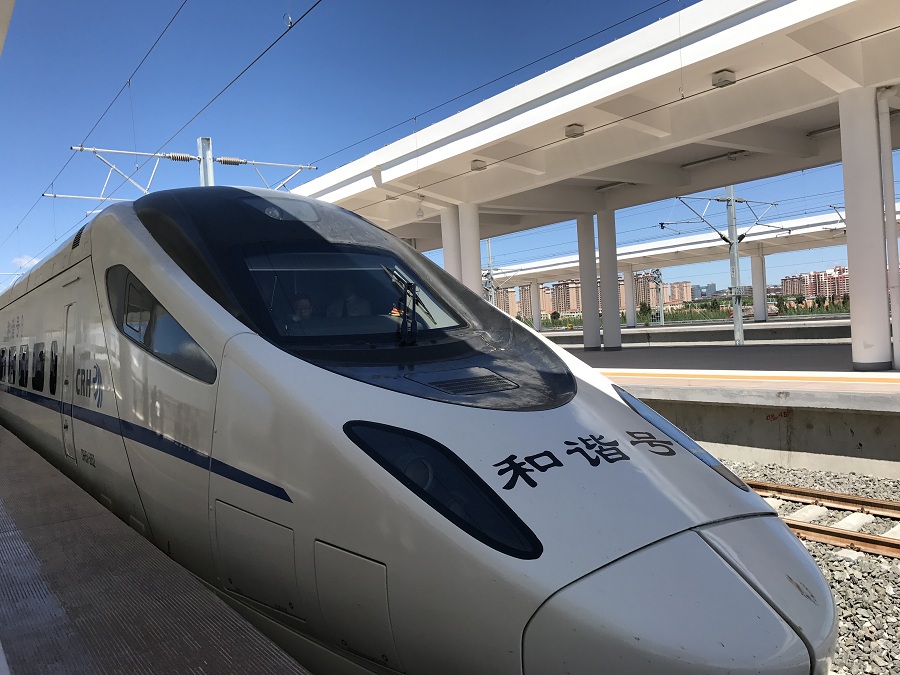
High-speed train debuts in Inner Mongolia
A bullet train departed Hohhot East Railway Station for Ulanqab marking the start of high-speed rail services using Inner Mongolia’s first newly-laid high-speed railway on Aug 3.
