Inner Mongolian Herders Switch to Tourism to Protect Grasslands
By Poornima Weerasekara in Inner Mongolia (english.cri.cn)
Updated: 2015-02-16
 |
|
Mongolian yurts set up at a campsite on the edge of the Durong grassland in Damaoqi County, which is about 160 km from the provincial capital Hohhot, photographed on February 12, 2015. Travelers who stay on the campsite can ride horses, go on off-roading trips on four-wheel drives or go fishing in the shallow rivers. [Photo/CRIENGLISH.com] |
It is part of a new local government initiative along with other private tourism companies to help Mongolian herdsmen to open up their homes to travelers. Wu Lan Hu is a herdsman turned entrepreneur. He and his clan have already set up 27 Mongolian yurts on the edge of the Durong grassland in Damaoqi county, which is about 160 km from the provincial capital Hohhot.
"I took a government loan and built the yurts on this campsite in 2013. When I started I had only 7-8 yurts, but within a year I have expanded to 27 yurts due to the support from the local government," said Wu Lan Hu.
Travelers who stay on the campsite can ride horses, go on off-roading trips on four-wheel drives or go fishing in the shallow rivers. In the peak travel season from May to November, the steppes look as green as they must have done when Genghis Khan and his armies galloped across this land. That is also the time for the traditional Nadamu festival of the Mongolians.
It is a traditional summer festival, where Mongolian herdsmen come together for horse racing, traditional wrestling and the evening ends with music and dancing.
During the travel peak last year Wu Lan Hu and his family made a profit of over 100,000 yuan ($ 16,000).
"In the peak travel period last year, I served over 5000 guests and I had to slaughter almost 60 of my own lambs, since it's a Mongolian custom to serve a whole roasted lamb to your guests. I usually raise about a 100 lamb to serve my guests with quality meat. During the peak period, other herdsmen can also sell their meat at the campsite," said Wu Lan Hu.
The campsite also employs local herdsmen as waiters, cooks and gives an opportunity for them for them to sell their traditional dairy products like dry cheese, fresh cream, traditional Mongolian cheesecake etc.
Wu Lan Hu also plans to build a small museum to showcase traditional Mongolian arts and craft.
"Earlier I was also a herdsman, I had 7000 mu of grassland, but over the years, the rainfall has become lesser and lesser, and we have faced droughts. We had to look for alternatives because we cannot only rely on our traditional way of life," said Wu Lan Hu.
According to Wang Cun Hu, Director of the community service center in Bayinaobao township in Damaoqi County, over 60 percent of the herdsmen in Inner Mongolia have been relocated into permanent settlements, mainly after overgrazing led to the degradation of grasslands. Climate change and less rainfall have also led to desertification.
But now the government gives a special subsidy to herdsmen, to encourage them to leave parts of their land fallow in order to rejuvenate the grassland.
"On one hand, the government has increased the compensation given to herdsmen to leave their land fallow. Now we give 6.5 yuan per mu of land left fallow without grazing and herdsmen are encouraged to grow grass in these areas. If you have 10,000 mu (6.7 million square meters) of grassland, each year you can earn 65,000 yuan in compensation. This scheme was started in 2008 and will go on till 2017. On the other hand the government provides training to herdsmen to start alternative businesses like operating Mongolian yurts for tourists," Wang Cun Hu said.
The government also provides tax concessions and training for herdsmen who want to switch to tourism. They also give grants to the best entrepreneurs.
This has encouraged more and more herdsmen to switch to tourism to supplement their income. For example, the number of Mongolian yurts and family-run guesthouses in the Bayinaobao area in Damu County has increased to 32 from just 7 within one year.
The local government has issued a set of guidelines and standards, for the homestead operators to follow to ensure that travelers get a quality service.
"If someone wants to host travelers at their home or in their Mongolian yurt, they need to first register with the local government. Local authorities will first ensure that these operators adhere to a set of service and sanitation standards before they are given a business license. If they do not follow the standards they will not get the government subsidy and will find it difficult to access bank loans," Ai Jing,the local government spokesperson for Damaoqi County in Inner Mongolia said.
The local government has also set a standard price. An entire house or yurt that can accommodate 4 to 5 people can be rented for about 200 yuan per night in the off-peak season. The price jumps up to 300 yuan per night in the peak season.
Encouraging herdsmen to switch to tourism is helping to preserve the fragile grassland ecosystem in Inner Mongolia. The move has reduced the frequency of violent sand storms that had swept across Inner Mongolia and had even reached as far as the capital Beijing, covering everything in a court of bronze dust in the last two decades.
"Although we've encouraged herders to reduce the size of their flocks, we don't want them the leave the grasslands. This was the land they were born in. We want to encourage them to utilize their unique skills and make a living here, while preserving their cultural heritage and their grasslands," Ai Jing said.
With time it is hoped that this form of sustainable tourism will not only help popularize traditional Mongolian culture but also stop the Gobi desert from creeping into the Inner Mongolian steppes.
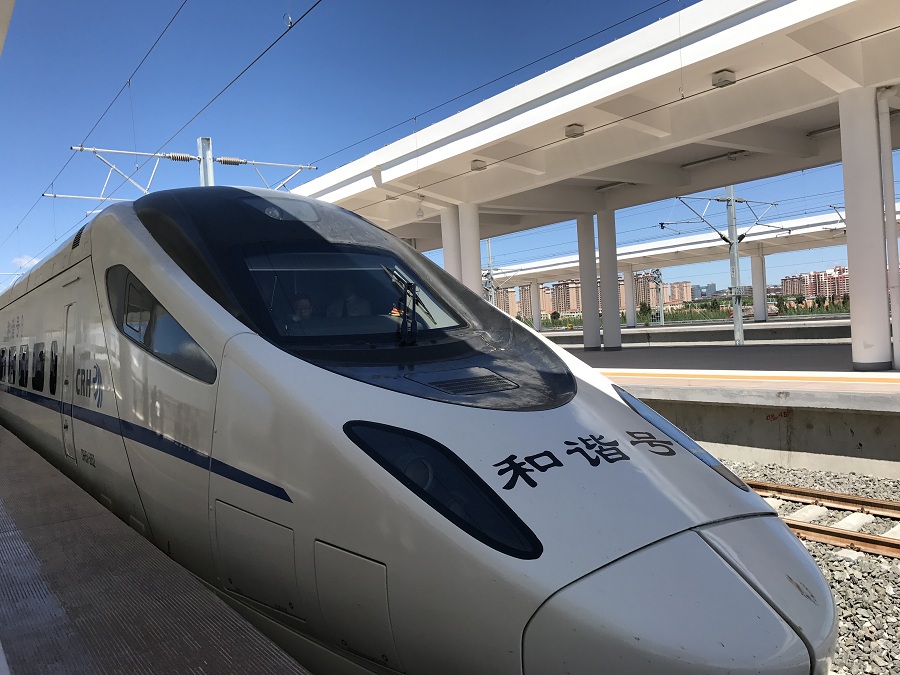
High-speed train debuts in Inner Mongolia
A bullet train departed Hohhot East Railway Station for Ulanqab marking the start of high-speed rail services using Inner Mongolia’s first newly-laid high-speed railway on Aug 3.
