Whistling meadows
By Chen Nan (China Daily)
Updated: 2014-09-22
A traditional throat-singing skill is being imparted in Beijing by Mongolian masters eager to preserve the countryside art form. Chen Nan reports. Chen Nan
At 7 am daily, lawyer Kui Jiliang puts on his designer suit to head to work in downtown Beijing. But before that, for about 15 minutes, he practices khoomei, an ancient throat-singing technique of the ethnic Mongolians and Tuvans, in which the vocalist is able to sing in two voices simultaneously.
After lunch, he also practices for a while in a corner of his office.
|
Naranbadrakh, a well-known khoomei singer from Mongolia, offers professional training in the genre in Beijing. Zou Hong / China Daily |

|
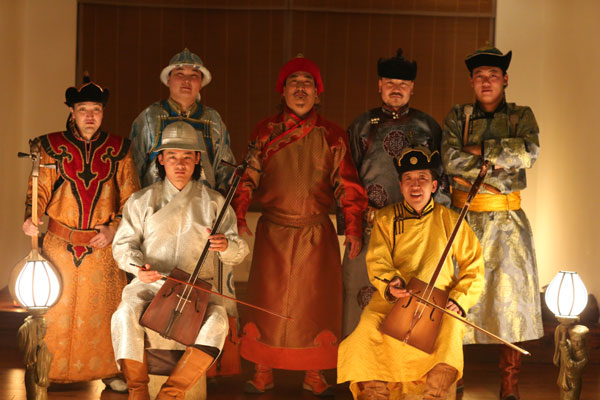
Naranbadrakh (center) and his team of performers present a Beijing concert on Sept 21. Provided to China Daily |
The 53-year-old attended a series of training classes organized by the Beijing Exchange Center of the Odsuren School of Khoomei Art in the city's 798 art zone earlier this month.
He describes the sounds of khoomei as both mysterious and touching, and says that he became obsessed with the art about five years ago when he first heard it on TV. Since then, he had been looking for khoomei lessons and performances in Beijing. Like Kui, many from China's different ethnic groups are drawn to khoomei.
But because the art form largely caters to a minority taste, Kui couldn't find any training classes until the school he attends was launched earlier this year.
"It's a rare chance to undergo professional khoomei training in Beijing. When I got the news, I applied to the class immediately," says Kui, who's a Beijing native. "It was very hard to produce the sounds. When I finally had my voice quivering and droning in the right way, I was excited."
His excitement was shared by Tian Huilan, a 50-year-old Beijing-based soprano from China Coal Mine Art Troupe, who also attended the classes. Tian first listened to khoomei from a tape of Sainkho Namtchylak, a famous singer from the Tuva Republic in the Russian Federation, and was captivated by it.
"Since the skill was taught only to male students, female performers were almost unheard of in olden times. But now a few outstanding female khoomei singers can be seen on the international stage," Tian says.
It has been quite a challenge for her to learn khoomei as throat singing breaks all the rules she has learned as a soprano.
"It's more difficult for women than men to perform the singing style, because their vocal cords are different," she says. "But the training was rewarding since it has opened my vocal range and helped me gain much strength while singing and breathing."
Naranbadrakh, a well-known khoomei singer from Mongolia, who conducted the classes, performed in a concert in Beijing on Sept 21. He has made many khoomei presentations in China since 1997 but taught here the first time this month. Five other Mongolian khoomei singers, including Battumur and Altantug, also participated in the concert titled Call of Mongolia.
The origins of khoomei are uncertain. According to Naranbadrakh, it is believed to have originated from herders' imitations of animal sounds and was later incorporated into religious rituals.
"The core of khoomei is not just to show off the skill onstage, but to feel the power of the ancient art and acquire peacefulness at heart. I think the students have gained their own understanding of the art," says Naranbadrakh, 36, who lives in Ulan Bator, Mongolia's capital.
Despite his childhood dream of becoming a professional wrestler, he started learning khoomei in 1994 from Odsuren, a Mongolian master of the form.
Odsuren also introduced the throat-singing tradition to his country's university syllabus and has taught the skill to more than 1,000 Chinese students since he first visited China in 1993.
"Khoomei is closely connected with nature and the Mongolian language. Like Peking Opera and Italian opera, despite the cultural and linguistic differences, khoomei can be enjoyed by the world's audiences," Odsuren had said in an earlier interview.
In 2011, Temur, a famous Chinese khoomei vocalist, invited Odsuren, 73, to launch the Odsuren Khoomei School in the Inner Mongolia autonomous region's capital, Hohhot. Hundreds of students from around the world have since received khoomei training there.
Tekexi, who is the younger brother of Temur, is a khoomei promoter at the Beijing Exchange Center of the Odsuren School of Khoomei Art. Besides offering training and staging performances, the center also plans to teach traditional Mongolian instruments and language.
Naranbadrakh points out that khoomei, along with its long-drawn songs and the use of matouqin, a traditional string instrument, is highly regarded in Mongolia. Khoomei is not only a national treasure protected by the government but also an art form appreciated by young Mongolians, he says.
"Khoomei has been incorporated into many musical genres such as pop, rock and rap. But the study of khoomei should be serious and solid," says Naranbadrakh, who has also introduced some pop into his old art form.
"Though most Mongolians now live in urban areas, we bear our roots in mind. We have the responsibility to take this art to more people."
Contact the writer at chennan@chinadaily.com.cn
(China Daily 09/22/2014 page22)

High-speed train debuts in Inner Mongolia
A bullet train departed Hohhot East Railway Station for Ulanqab marking the start of high-speed rail services using Inner Mongolia’s first newly-laid high-speed railway on Aug 3.
