Protect farmers against droughts
By Shenggen Fan (China Daily)
Updated: 2014-09-02
Low rainfall and scorching heat in recent months have caused severe drought in a number of China's major crop producing regions, some of which are facing the worst drought in over half a century. Concerns about China's food security dominate discussions on the drought, but a more likely threat is the drought's negative impact on the incomes of farmers, especially poor smallholders.
According to recent news reports, severe drought has hit about a dozen provinces and regions in North China and the northeast plains. For example, rainfall levels in Henan province are reported to be about 60 percent of the past two decades' average, the lowest since 1951. This is serious because Henan accounts for 10 percent of China's cereal production, including a quarter of wheat and 9 percent of corn production. Local officials estimate that recent drought conditions are responsible for economic losses of up to 7.3 billion yuan ($1.2 billion), with 97 percent of these losses suffered by the agricultural sector.
Severe drought has also been reported in Northeast China's Liaoning province and North China's Inner Mongolia autonomous region, which produce about 7 and 9 percent of China's corn. According to the Flood Control and Drought Relief Headquarters, severe drought has affected about 5 million hectares of farmland and left 1.6 million people without adequate water supply.
The Chinese government has a number of policy options to mitigate the possible threat to food security and lessen the damage to farmers' livelihoods in the short and long term. China has large corn stocks that can be released to the market. According to Food and Agriculture Organization estimates, China's corn stocks this year are 27 percent higher than the 2011-2013 average. The government bought these grains above market prices as part of its growing portfolio of interventions to protect and provide support to farmers.
Increasingly integrated international markets and trade channels are also an effective and efficient tool to offset drought-related agricultural production and supply shocks. The United States recently announced that it expects record corn and soybean harvests in the coming months. As a result, international prices of US corn fell to their lowest levels since August 2010, with current prices nearly half of their peak 2011 levels; international soybean prices too have fallen in recent weeks. China can thus benefit from the US bumper harvest to fill the gap between domestic agricultural supply and demand through imports.
In the long term, China can take advantage of its comparative advantage in labor-intensive and high value agricultural products by shifting its exports toward fruits, vegetables and aquatic products, while importing more land-and water-intensive products such as cereals and vegetable oils. Such a shift requires appropriate tools and infrastructure to provide farmers with market information, training and financial services, especially focusing on smallholder farmers.
Low-income households in rural areas have a small asset base, so shocks like droughts deliver a disproportionately harder blow to their livelihoods than urban households. In the short term, income support policies are needed to protect drought-affected smallholder farmers who are unable to access mainstream social safety networks. Such schemes need to be carefully designed, and the managing officials should be monitored and held accountable for lapses. Also, short-term social safety nets should be linked to efforts that promote long-term asset and capacity building of farmers.
Resilience strategies are needed in the long term to help farmers deal with extreme weather conditions such as floods and droughts, including adjusting sowing dates and introducing drought- or flood-resilient crops. Improving infrastructure such as irrigation systems, pumps, storm drains, rainwater collection centers and emergency shelters will increase community resilience to extreme weather events. Crop insurance programs, too, should be strengthened through yield or weather indices to help reduce the impact of natural disasters on rural people's incomes.
Moreover, the government needs to accelerate inter-ministerial integration to pool resources and information to provide a coherent, well-informed and cohesive disaster early warning system and response. Given China's booming non-farm sectors, some smallholder farmers should be supported in shifting from agriculture to non-farm sectors (both rural and urban), while others could be helped to realize their potential to undertake profitable commercial activities in agriculture.
Extreme weather events such as droughts are becoming more the norm than the exception because of climate change. Transparent, accountable and well-defined disaster management policies and institutional channels are needed to help cushion the short-term impacts of natural disasters as well as to improve access to productive resources that offer long-term opportunities to build resilience among the most vulnerable groups.
The author is director general of International Food Policy Research Institute.

(China Daily 09/02/2014 page9)
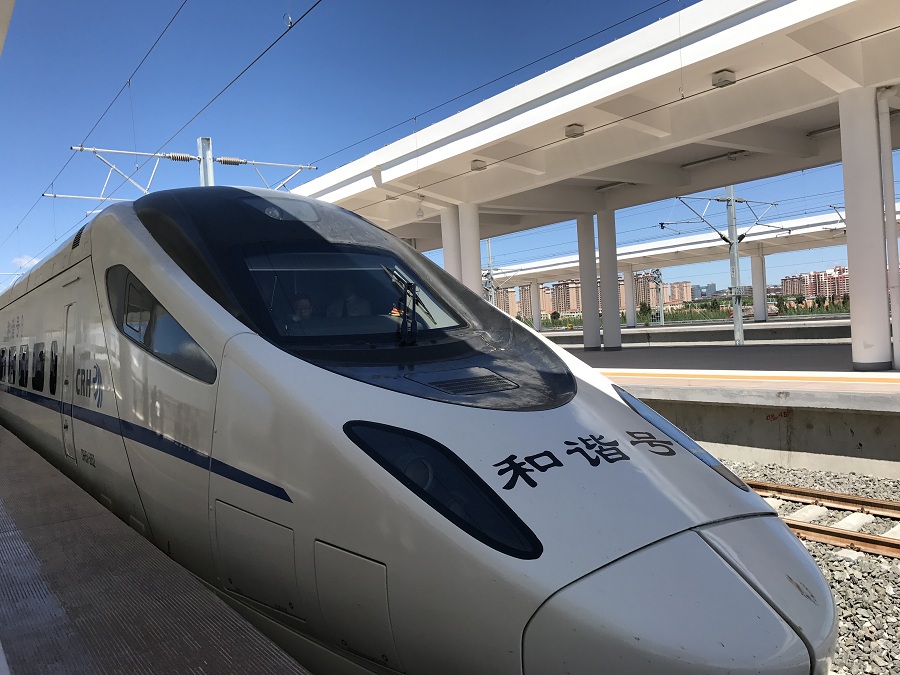
High-speed train debuts in Inner Mongolia
A bullet train departed Hohhot East Railway Station for Ulanqab marking the start of high-speed rail services using Inner Mongolia’s first newly-laid high-speed railway on Aug 3.
