Dry reality of droughts in China
By Cecilia Tortajada and Asit K. Biswas (China Daily)
Updated: 2014-08-18
From times immemorial, China has faced droughts, with some parts of the country facing the curse every two to three years. The damage droughts have inflicted on China's socioeconomic fabric was relative to their intensity and duration. For instance, the drought in 1994-95 was so intense that it caused a loss of $13.8 billion.
South and Southeast China suffered severe droughts in 2010-11. Now Henan province and the Inner Mongolia autonomous region and Northeast China are in the grip of a severe drought. Shaanxi, Hebei, Shanxi, Gansu and Anhui provinces too have been affected by drought to different degrees. This dry spell is likely to reduce China's corn production this year to less than 200 metric tons, the lowest since 2009.
The current spell of drought could have serious repercussions. Grain prices on the Dalian Commodity Exchange have already increased, which will affect government policies to keep food prices low and seriously complicate its efforts to limit cheaper grain imports to ensure food sufficiency and security.
With a bumper harvest of corn in the United States, the price of imported corn in China is already one-third less than that of the local produce. As domestic corn prices go up, feed companies are likely to opt for wheat for economic reasons, further complicating the government's efforts to curb cheaper imports. China has intensified inspections and already rejected shipments that contain the genetically modified MIR 162 corn, which though used in the US is not approved by China for import. Besides, the General Administration of Quality Supervision, Inspection and Quarantine has announced that it will toughen the import requirements on sorghum, barley and alfalfa which could be used as alternatives to make feed.
Because of droughts, China is facing a conundrum of tradeoffs between policy objectives such as providing people with food grains at affordable prices and food sufficiency. It is not the first country to realize that often these and other associated policy objectives are not compatible because of developments, such as droughts and floods, over which it has no control.
The impact of droughts is underestimated not only in China but also the rest of the world. But droughts are the world's most expensive and debilitating natural disasters, because their impact lasts longer than any other form of natural disaster. The current global annual loss because of droughts is estimated to be $6-8 billion.
Floods, earthquakes, hurricanes and tsunamis attract more attention from governments and the media than droughts because of their sudden deadly impact, which is graphic and very visible. In contrast, the impact of droughts is gradual but is felt over months and years, and even beyond a decade as happened in Australia.
Droughts are a big concern for China, because it has nearly 20 percent of the world's population but only about 7 percent of the world's water. This mismatch between people and water would not matter, not even in 2026 when China's population is expected to peak at 1.44 billion, if its water management practices were efficient. China uses more than the required volume of water for every purpose: municipal, industrial, agricultural, energy generation and resource extraction. This is not a sustainable practice, especially during droughts.
China overexploits groundwater by about 22 billion cubic meters every year. This has major implications for drought management since it steadily depletes river and lake levels, making more areas vulnerable to drought.
Nearly two-thirds of the water used in China is for agriculture. Since this cannot be sustained during droughts, the use of groundwater increases dramatically. In fact, the use of water in agriculture has been on an unsustainable path for decades. If this continues, China will have to live with droughts.
The main problem is that China manages droughts as an emergency and disaster-relief situation, which is reasonably effective in the short term, but it is not suited to managing long-term widespread droughts. A negative side of the current policy is that farmers and agribusinesses are taking unnecessary risks because they are confident that the government will bail them out during droughts. Also, technical measures address the symptoms, not the disease.
China has more than 200 million small farms, most of which don't have the capability to manage their risks. Hence, as the industrialization and mechanization of agriculture continues, China should formulate proactive policies to diversify farmers' production risks and adopt effective strategies to manage droughts.
Another problem is that many farmers grow water-intensive crops in drought-prone areas, which depletes the water sources further. To address the problem, the government must encourage farmers to grow crops that require less water.
The government also needs to lay greater emphasis on plant breeding and genetic modification to develop new varieties of crops that are drought-tolerant and saline-resistant. For example, researchers in Egypt have shown that by transferring a single gene from barley to wheat, the water requirement for growing wheat could be reduced by more than 80 percent. But countries such as China and India need to approve genetically modified crops only after appropriate research on their safety.
More importantly, China needs a vigorous domestic debate on whether it wants to achieve food self-sufficiency or food security. Food security means food affordability and accessibility both. Thanks to China's strong economic growth, an increasing number of middle-class people can afford to pay for food irrespective of where it comes from. With proper diversification of food sources, food prices in China could actually decline and make drought management more effective. And with proper innovative policies, China can tackle droughts much better in the future.
Cecilia Tortajada is a senior research fellow and Asit K. Biswas is a distinguished visiting professor at the Lee Kuan Yew School of Public Policy in Singapore, and the co-founders of the Third World Centre for Water Management in Mexico.

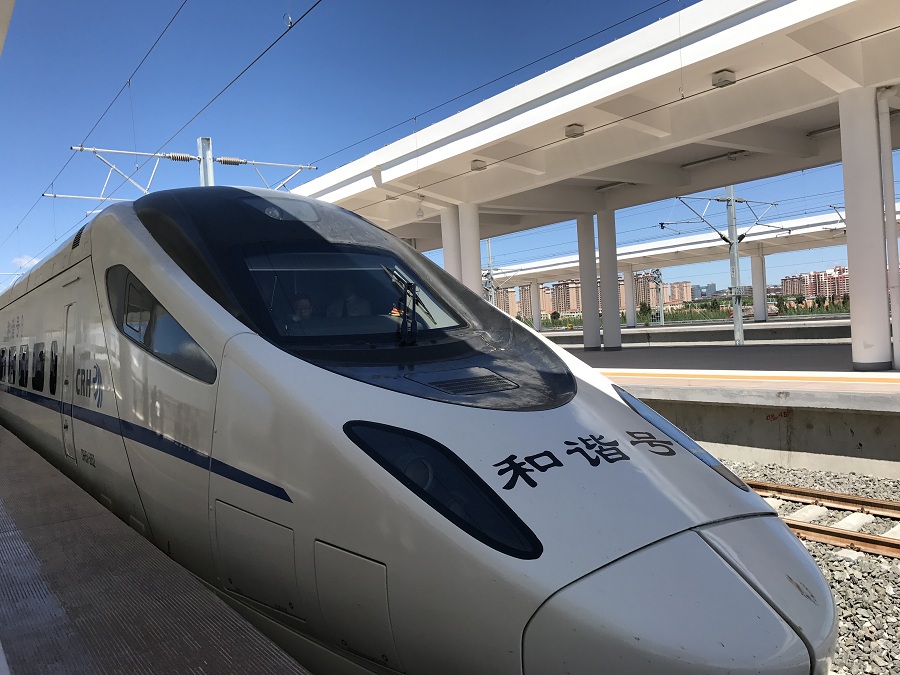
High-speed train debuts in Inner Mongolia
A bullet train departed Hohhot East Railway Station for Ulanqab marking the start of high-speed rail services using Inner Mongolia’s first newly-laid high-speed railway on Aug 3.
