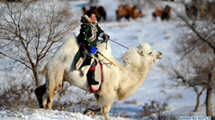
Mongolian religious dance
(chinaculture.org)
Updated: 2014-01-26
Dance Tsam
 |
|
A Tsam ceremony was held at the beginning of the year to exorcise evil. It consisted of a series of masked dances and often had a narrative content.[Photo/nmg.gov.cn] |
Historically, a Tsam ceremony was held at the beginning of the year to exorcise evil. It consisted of a series of masked dances and often had a narrative content. Tsam means masked dance. Today in Mongolia efforts are being made to revive the tradition, with elderly monks who survived persecution teaching young monks the rituals and choreography of Tsam.
While the use of grotesque masks in the Tsam dances creates an impression of going back to high antiquity, the festival is in fact a relatively recent tradition. In the rituals of the Mongolian Tsam festival, tantric and much older shamanistic traditions of dance merged in harmonious fashion. Mongolian shamanism may have owed its great vitality and dynamism to the fact that it had already absorbed all kinds of tantric elements when Buddhism first reached Mongolia. The shamanistic influence, as it manifests itself in the Tsam festival, is therefore a multi-layered phenomenon, the different strata of which cannot always be clearly distinguished from one another.
In the past, the mystery dances were of considerable significance in Mongolia. They were always accompanied by music. For these ritual dances the monks wore dance masks made of papier maché. The Tsam symbolized the battle of the gods against the enemies. In animism, the oldest form of religious belief (e.g. the Bon-religion), one believes that the whole nature is animated. Human beings and animals are surrounded by good and evil spirits.
The Mongols worship an important god of fertility, who is represented by the mask of an amiable, white-haired and white-bearded old man with waggish and cunning features. He is considered the master of earth and water. His attributes, such as white clothes and a wand with a dragonhead, are reminiscent of shamanism. He is the main figure in the Tsam mask dance, in which he appears in the role of a clown and dolt.
Mongolian masks symbolizing the actual presence of a deity never have their eyes pierced. The performers therefore had to look through the mouths of the masks, adding extra height to the performer. As the temporary residence of gods and demons, masks are like statues and treated as sacred objects. When not in use, they were stored in monasteries and worshipped in daily rituals.
Shaman Dance
 |
|
Shaman Dance is performed by shaman (sorcerers or witches) by praying to gods, sacrificing, dispelling evils and curing diseases. |
Shaman Dance is performed by shaman (sorcerers or witches) by praying to gods, sacrificing, dispelling evils and curing diseases. It is called Tiaodashen by common people. The kind of dance was popular among northern Chinese tribes, a result of primitive hunting, fishing and totem worshipping activities. In the clothes, musical instruments and dance movements of shaman today, one can find relics of primitive cultures. For example, shaman of Oroqin and Ewenki people always decorate their clothes with beast bones or teeth; their musical instrument Zhuagu (a drum that can be held in hand) is covered with beast skin and their performances imitate images of bear, hawk and deer.
In the past, to meet the demands of a hunting lifestyle, nomadic tribes lived dispersedly in yurts. Except for large carnivals (such as the Nadam Fair in Mongolia today), all dances are done within the yurt. Therefore, their dances are usually small in scale. The dance style is straightforward and bold, with few steps. But the arm actions are powerful, and the wrist, shoulder and waist move briskly. In the dance, there are images and actions of hawks, swan and horse riding, and the "Shaman Dance" originating from religious beliefs is the most common type.
The Manchu people call the Shaman Dance Tiaojiashen (inviting gods of the house) or Shaoqixiang (the banner-men invite the gods). The shaman ties a long bell to his or her waist in performance and holds a drum. Gods in charge of different sectors of people's lives are invited at the sound of drums and the bells. After each god arrives, the shaman will imitate the movements of the god. For instance, if he has invited the God of Hawk, he will imitate flying and pecking at the food on the table; if he has invited the God of Tiger, he will have to jump, scratch, spring and communicate with people on the spot; or he should play with burned incense in magical darkness, showing that the God of Golden Flower has arrived.
The Mongolian ethnic group calls Shaman Dance Bo or Bo Dance. In the past, shaman always wore a cap with a hawk-shaped ornament, a skirt with ribbons and nine bronze mirrors in his waist to show his power. The musical instrument was one-sided drums. One shaman was a major performer, the other one or two beat drums as accompaniment. The dance movements were imitation of birds, beasts or all kinds of spirits. The highly skillful one could turn round and round continuously with a multi-sided drum in hand. Such performances remain today, but dancers no longer spin that well.

Inner Mongolia People's Congress opens second session
The Second Session of the 12th Inner Mongolia Autonomous Region People’s Congress kicked off in Hohhot on Jan 15.