Andai dance
(chinaculture.org)
Updated: 2013-12-18
 |
|
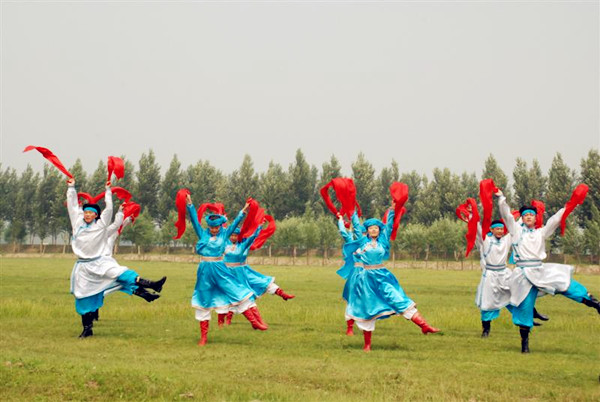
The Andai dance originated from the collective dance of the Kulun Qi in the south of the Horqin Grassland. |
Year:2006
Sort:Folk Dance
Area:Inner Mongolia
Serial No.:Ⅲ-29
Declarer:Kulun Banner of the Inner Mongolian Autonomous Region
Chinese herdsmen live on the endless plains of northern China. They are the Mongolian ethnic group. They love the grasslands, and love dancing and singing. The Mongolian people have created many kinds of dances and many kinds of music. One of the most famous dances is called the Andai.
The Andai is also called the "jumping white hawk". The Andai dance originated from the collective dance of the Kulun Qi in the south of the Horqin Grassland. At first, it was a religious dance used for praying to the gods and curing sicknesses. People would perform this dance to ask for blessings from the gods, to prevent disease, and to keep away bad luck. Over time, the dance gradually became a form of entertainment.
Traditionally, participants usually stand in a circle, singing and dancing with silk scarves in their hands. The lead dancer stamps on the ground or slowly moves sideways whileswingingsilk scarves. Although easy to perform, the Andai dance contains deep social significance.
One can never truly understand the Andai dance until one knows how it was created, how it developed and how it spread among the people.
Due to their special language system, local ecology, and historical background, for centuries most Mongolian people have embraced shamanism. In ancient times, they always participated in religious rituals (shaman powwows) presided over by a shaman to pray for happiness and good harvests. As time passed, people created rituals with different aims, and so accordingly, different titles for shaman powwows came into being. Andai was the title for powwows whose major mission was to help out or encourage young women suffering in unhappy marriages.
There was a legend about the origin of the Andai. It is said that once upon a time, there lived a father and his daughter on the Horqin Grassland. One day, the daughter, suddenly stricken by an unknown disease, lost her mind and began to behave strangely. She remained ill for a long time without any sign of recovery. One day, the father, burning with anxiety, carried his daughter on a herdsman's wooden cart to a faraway place to see a doctor.
However, when they arrived at the town of Kulun, the axle of the cart broke. At the same time, the girl's condition worsened and her life was in danger. The anxious father had no idea what to do except to wander around the cart, singing a song to express his sorrow. The wailing song drew some people from nearby villages. They couldn't help but shed tears at this sight and joined the old man in swinging their arms and wailing around the cart. To everyone's surprise, the daughter quietly rose, got off the cart, and followed the people, swinging her arms and stamping her feet with them. When people saw her, she was sweating all over, and her disease had been miraculously cured.
The good news spread and from then on, people began to follow suit and treat young women who suffered from similar diseases by dancing around them in the same manner. The dance became known as "Andai." If women were depressed because of problems in love and marriage, their families would invite the local shaman to dance the Andai to keep away disease and misfortune.. Nomusical instrumentsaccompany the Andai dance, but there are fixed rhythms and librettos. Some dance movements were improvised, and were simple and standard. Led by the shaman the dancers would circle the singer and dance around her. In this way, they tried to console the patient. They sang encouraging sentences. As the rhythm quickened, so did the pace of the dancers. The patient was stimulated and because of this, recovered.
Later the dance was used in some mass rallies, such as ceremonies to pray for rain and theNadamFairs (Nadam means game in Mongolian). It became increasingly popular and developed into a kind of group dance, which became a depiction of life and an expression of human emotion.
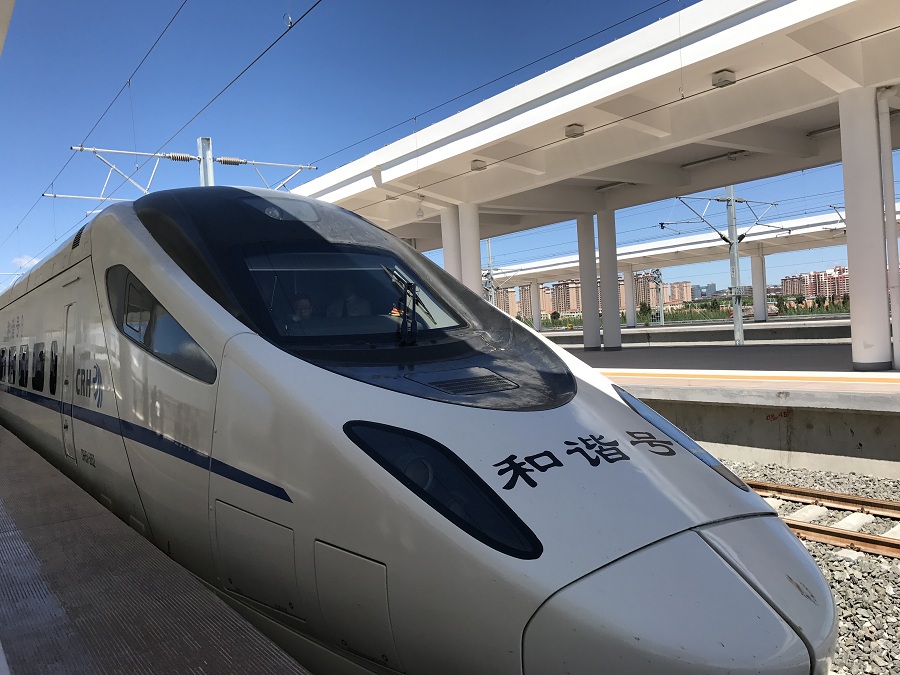
High-speed train debuts in Inner Mongolia
A bullet train departed Hohhot East Railway Station for Ulanqab marking the start of high-speed rail services using Inner Mongolia’s first newly-laid high-speed railway on Aug 3.
