Mining wasteland faces green challenge
By Wamg Kaihao (China Daily)
Updated: 2013-11-05
Reclamation trust fund
Wujiata mine is affiliated with Shenhua Group, China's biggest coal mining conglomerate. In 2011, the company launched a policy that allocates 0.46 yuan from every ton of coal it sells to the land reclamation fund.
Last year, Wujiata received 1.3 million yuan from the fund, which helped the reclamation work and introduced a greater variety of tree species, according to Zhang. He said he feels blessed because he no longer has to apply for special funding from the group every time he wants to launch a new project. He has even tried, unsuccessfully so far, to grow grapes.
"This is an old mine, so our production facilities lagged behind others, but at least we are one of the country's leaders in terms of mine reclamation," said Zhang. "The investment required is not as high as that for introducing new mining machines, but we will see results a lot faster."
Wujiata's coal reserves are likely to be exhausted by 2020, when the total reclaimed area will be 660 hectares, said Zhang, adding that he hopes the reclamation work will prevent the miners from facing a future without jobs.
"Our final goal is to make this reclaimed area an eco-tourism site to provide work for the miners and their families. Imagine it, if we can successfully establish a vineyard in the future..."
Although the municipal land and resources bureau in Ordos has encouraged operators to replicate Wujiata's example, Tao Rui, deputy director of the municipal office in charge of mine reclamation, admitted that only large businesses can afford the costs.
Some of China's major coal producers have adopted an approach similar to Shenhua's by financing land reclamation through a levy on production, but there is no uniform criterion on how much money they should donate.
"Consequently, the number of operators using these advanced methods is still very low," said Tao. "Businesses determine their own methods of land reclamation."
"Now, it will be enough if they can restore the landscape and minimize the impact on the environment. However, this rough-and-ready approach to rehabilitation should be changed in the long term."
Return to farming?A question is: If reclamation methods become mature, how much will the farmers benefit? They face a tough choice - should they return to their farmland or not?
Bai Lijun, 37, is the head of Bulianta village in Ejin Horo. About 60 percent of the village area was abandoned between 2009 and 2012 after the discovery of huge coal reserves.
"Those who didn't move out are really envious," said Bai. "Families used to earn around 30,000 yuan annually by growing corn, but every family that's moved to town has received compensation of around 400,000 yuan."
The banner government even provides each family with a free apartment, with 35 square meters of per capita living space, in town.
According to Song from the banner's land and resources bureau, in the past decade, more than 1,500 villagers or herdsmen from Ejin Horo have been relocated to the town because of mining operations.
"The government cannot replace the market," Song explained. "We used to arrange jobs for the villagers, but the process is time-consuming and the positions offered don't satisfy everyone. That's why we switched to providing cash compensation."
Bai said that few of Bulianta's relocated villagers now work, apart from a small number who have embraced opportunities in town and opened small businesses. It seems the villagers have little idea of how to handle the large sums of money they've been given.
When asked what the villagers do every day now that they have lost their land, his answer was terse. "Nothing. What else can they do other than play mahjong and prattle?
"We're really unsure about whether we will be able to cultivate the barren land, even though it will be returned to us eventually," he added.
Bai is skeptical about the current methods of land reclamation. "I guess few people would return to their farms, even if the land were fertile. Can you expect people who are used to a comfortable life to resume exhausting farm work?"
Some people still miss the old days, though. In 2011, 48-year-old Su Baorong invested 300,000 yuan to open a restaurant in his new neighborhood, but the business hasn't fared well.
He was sad that many of the villagers have no regular work. "With money, people say goodbye to their old neighbors and search for their own fortune," he said in a sarcastic tone. "Coal makes everything different; 95 percent of the people who moved from the village loaned money to invest in mines. When the price of coal plummeted, they suffered huge losses."
Su worked in a coal mine in the late 1990s, but was laid off when the mine was merged with a bigger company, leaving him reluctant to be associated with the industry again.
"I used to have well-irrigated land, which is uncommon in our village. If I have the chance to farm the rehabilitated land, I would love to do so," he sighed.
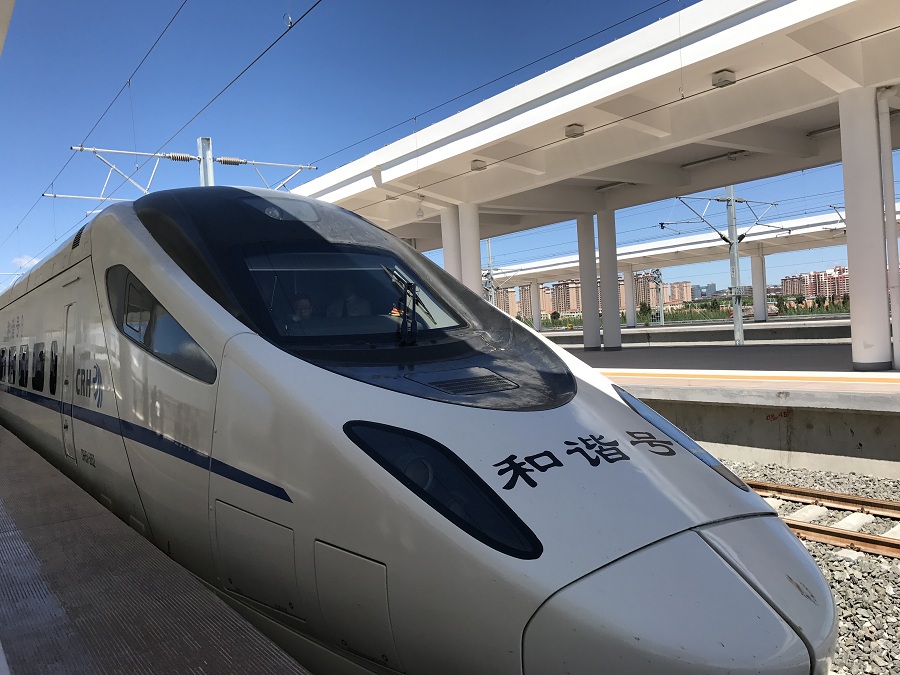
High-speed train debuts in Inner Mongolia
A bullet train departed Hohhot East Railway Station for Ulanqab marking the start of high-speed rail services using Inner Mongolia’s first newly-laid high-speed railway on Aug 3.
