River valley produces wetlands wonder
By Wang Kaihao in Ergun, Inner Mongolia (China Daily)
Updated: 2013-10-17
 |
|
Ergun Wetland turns into a colorful paradise in autumn. [Photos provided to China Daily] |
As I travel from Genhe city to Hailar district in the Inner Mongolia autonomous region's most northeast area of Hulunbuir, I manage to squeeze in half a day to explore the mesmerizing Ergun Wetland.
I generally pay little attention to the various tags given to scenic spots. But when I stand on the hill 720 meters above the sea level and look out at the panoramic view over what claims to be the "No 1 wetland in Asia", I am immediately convinced.
Covering an area of 126,000 hectares, this wetland is known for its space, but also for its astonishing views.
 |
|
Cattle graze at the vast grasslands in Ergun. |
Nature has the best color palette. Summer's end means the verdant green has given way to sparkling golden willows, bushes, poplars and birches spread along the slopes as well as both banks of the zigzagging Genhe River, which flows into the nearby Ergun River.
The Ergun River has bordered China and Russia since 1689, also the source of the Heilongjiang River (also known as Amur River). A backdrop of rolling hills is topped with layers of clouds. Everything looks like it was taken from a fairy tale.
Numerous ancient nomadic ethnic groups in northern Asia set off for the grasslands from Ergun, which is generally believed to be the origin of the Mongolian ethnic group.
Nevertheless, this scene is far from perfect in the eyes of the locals.
"You should have come one or two weeks earlier," says Li Xin, our local guide. "Some trees were still green, but some had turned yellow or red. You can see different layers of colors."
Though several areas of the wetlands look dark and have begun to wither, I am lucky enough to catch the wetland at the end of its best season which is from June to the end of September.
I walk along the wooden path to seek out different vantage points to take in this view. Several squirrels suddenly jump out of the bushes, run past my feet and disappear among the branches.
"This is a paradise for animals," Li giggles, never tired of coming up with different ways to describe her beloved homeland. She adds there are 268 varieties of terrestrial mammals living in this area.
As a crucial stop on the route of migratory birds flying from Australia to Siberia, more than 20 million birds rest or nest here every year. It is estimated that 45 pairs of red-crested cranes, one of the country's most endangered bird species, choose to rest here.
A big swan flock often includes 5,000 birds during migration season, usually in April and October.
In spite of the huge importance in terms of ecology, Ergun Wetland was little known by the rest of the country until 2000, when a natural reserve was formed, according to Yan Peiyu, deputy head of the wetland natural reserve administration office.
It was recently listed as a candidate for national wetland park status. The Chinese Academy of Sciences also plans to set up 10 surveillance stations to keep a closer eye on this wetland.
I decide to prolong my trip traveling north along the Ergun River to visit two small towns, Shiwei and Enhe, the home of 5,000 descendants of Russians who came to China in the 1910s to escape war in their homeland. But I am told transportation is not convenient after the area was hit by floods this summer.
At least, I have a reason to come to Ergun again in the future.
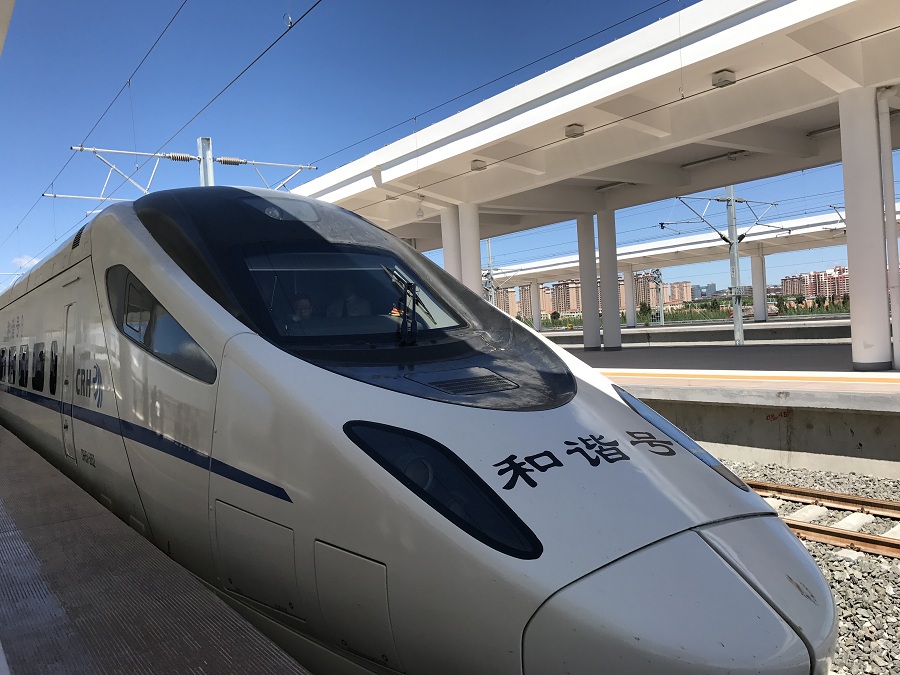
High-speed train debuts in Inner Mongolia
A bullet train departed Hohhot East Railway Station for Ulanqab marking the start of high-speed rail services using Inner Mongolia’s first newly-laid high-speed railway on Aug 3.
