An urban inferiority complex
By Wang Chao (China Daily)
Updated: 2013-09-02
|
So many urban complexes have sprung up across the country, the property market in the second and third-tier cities is at saturation point, experts said. Provided to China Daily |

Industry insider points to a problem that is bubbling under the surface
As warnings continue to be sounded about the bubble in China's housing market, real estate industry insiders are warning of another, but one that few people are aware of.
That bubble has formed in the market for urban complexes in second and third- tier cities. Urban complexes are modern developments covering large areas that usually bring together residential blocks, offices, shopping malls and entertainment facilities such as cinemas and clubs.
George Yeung, managing director in North China for Colliers International, said so many urban complexes have sprung up across the country that the market is almost at saturation point. Colliers International, based in Seattle, is one of the four biggest commercial property service companies in the world.
"If bubbles in residential properties burst, people can still sell them if the sticker price is low enough, because people always need a place to live," Yeung said. "But once the commercial property market crashes, nobody is willing to rent a shop that loses money every day, when there is no customer but accumulating rental and utility fees."
A report issued at a Chinese commercial real estate conference in Beijing this month suggested that the commercial property market in some second and third-tier cities has already shown signs of overheating. In the first half of the year, 4,496 plots of land for commercial purpose were sold, 53 percent more than in the corresponding period last year, it said.
Urban complexes account for a significant proportion of those sales. In Hohhot, in the Inner Mongolia autonomous region, more than 30 urban complexes are being built for an area whose population is only 3 million. The problems that those numbers present become clearer when you consider a rule of thumb in the industry: an urban complex can have a direct influence on about 300,000 residents, which means three or four complexes would be enough for a city with a population of 1 million.

However, mini-cities are also expensive to build: a single urban complex requires at least several billion yuan, so if it does not succeed, the results can be ruinous for investors.What makes the proposition even more challenging is that most of the property developers investing in urban complexes often have a common ambition: to attract top international brands such as Chanel and Gucci to set up shop in their complexes.
"I'm really concerned about whether China's consumption power can support the expansion of so many luxury brands," Yeung said. "Especially when the new leadership is cracking down on extravagant government expenditure. Previously, 70 percent of these top brands were bought as gifts to deal with guanxi - a term which loosely means "connections" - and I don't think the money was from the buyers' own pockets"
In addition, the property developers are in a poor bargaining position with the top brands and cannot expect them to pay top dollar to lease space, Yeung said. That is because the exclusive brands realize they have the pulling-power to draw shoppers to a mall, pulling-power the developers cannot do without. That reduces developers to the role of supplicants, willing to pay, even if begrudgingly, large sums to renovate grand stores for the most attractive tenants.
"It's just like McDonald's," Yeung said. "Wherever it goes, it brings a large crowd. So it is impossible to negotiate a good rent with it. And even if it signs a lease with you, it will not be for very long.
"But developers need to attract these brands to convince other less-influential brands. For instance, other fast-food brands will feel safe once they see McDonald's is there. Then you recoup from these brands the money you have lost to McDonald's."
Complicating matters for the developers is that even as they are trying to attract big, well-known brands for retail premises, they have to keep a close eye on how much money is coming in from the sale of residential blocks, keenly aware that the cash flow from leased office or shop space is notoriously slow. In the case of an average five-star hotel it takes more than 10 years to break even.
A typical case is Wanda Group, one of China's biggest property developers, which prefers to buy land in remote areas and build huge urban complexes. Instead of boasting fancy shops and international brands, these centers feature pleasant residential blocks with good supporting facilities.
"This strategy has been successful in quickly recouping investment," Yeung said. "But it also shows that urban complexes are still not really pulling in the kind of revenue commensurate with such big projects."
Unlike residential properties, whose prices always seem to be rising, commercial property is a lot less predictable, given the many variables that can affect the business, industry experts say. The shopping malls at the southern end of Chang'an Avenue in Beijing, which some reckon, seem fated never to enjoy good returns. That lack of optimism is borne out by facts and figures. In 2010, a high-end shopping mall, MaisonMode, from Hong Kong, closed for lack of custom; and while there are more than 30 malls in the northern stretch of Chang'an Avenue, there are fewer than 10 in the southern stretch.
Yang attributes this lack of success to a lack of convenient transport. another. But this is rarely seen in the "Many things can affect the operation of an urban complex, but the most crucial one is transport," Yeung said.
wangchao@chinadaily.com.cn
(China Daily 09/02/2013 page14)
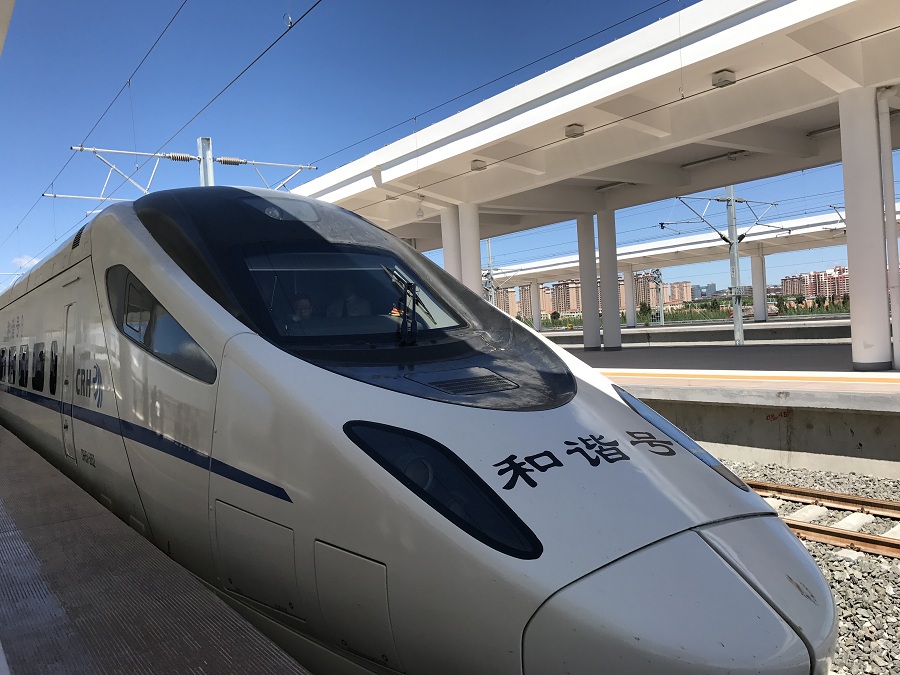
High-speed train debuts in Inner Mongolia
A bullet train departed Hohhot East Railway Station for Ulanqab marking the start of high-speed rail services using Inner Mongolia’s first newly-laid high-speed railway on Aug 3.
