|
Shi Yongxin, the controversial abbot of Shaolin Temple, is back in the media spotlight ahead of the National Day "Golden Week" holiday. The Shaolin Temple, a major tourist site in Dengfeng, Henan province, has filed a law suit against the local government on the distribution of income from the sale of tickets.
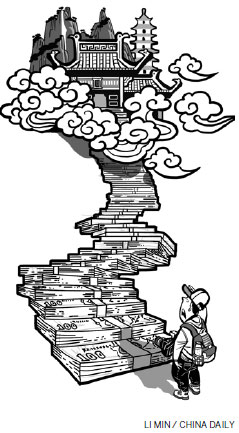
Some people have criticized the temple authorities, saying greed for money has no place in the lines of Buddhist monks. Others have supported the temple officials as the income from ticket sales is essential for the maintenance of the cultural heritage site.
The controversy is just one example that reflects the problem of the "ticket economy" in the tourism industry. Perhaps it's time for tourism sites to diversify their sources of income for better, sustainable growth, instead of relying too much on ticket sales.
Just before the "Golden Week" holiday, many scenic spots have increased their ticket prices. While Yulong Ice Mountain in Yunnan province has raised the ticket price from 105 yuan ($17.14) to 130 yuan, Danxia Mountain in Guangdong province has increased it from 160 yuan (180 yuan for holidays) to 200 yuan, forcing many people to use Internet forums to complain against the moves.
To determine a reasonable ticket price, we have to know the nature of a tourist spot. On one hand, most tourist spots rely on natural resources like sceneries, which are in essence public property. On the other, officials managing such spots have to hire a lot of people for their maintenance and upkeep, and provide services like emergency help and tour guides. For this reason - and also because the available public funds are not enough to fully cover the costs - tourist spot managements have the right to charge more for tickets. But since the ticket prices are a not a private but public affair, they have to be supervised and regulated by the people.
Given the rising Consumer Price Index, the prices of tickets too should rise to support the sustainable development of tourist spots. But the price rise should not exceed the CPI by a large margin, because that would make tourism a luxury for ordinary people and turn tourist spots into a club for the rich. Abnormally high ticket prices are like an invisible hand driving away poor people from the tourist spots.
Besides, the decision to raise ticket prices should not be made by tourist site managements alone. Perhaps transparent public hearings should be held to decide how much ticket prices should be raised.
In 2007, the National Development and Reform Commission, the country's highest planning body, issued a regulation allowing scenic spots to raise ticket prices every three years, but without setting the upper limits or recommending public hearings to decide the extent of the price rise. It is time this regulation is revised to better regulate ticket prices.
It is also time that scenic spot managements realized that higher ticket prices do not necessarily mean higher income. The success of a scenic spot depends primarily on tourist footfalls, and high ticket prices could chase tourists away.
Some volunteers have already launched online campaigns by listing the top 50 scenic spots that have raised ticket prices and asking tourists to oppose their moves. Such tourist spots should take measures to repair their public image to attract tourists back.
Scenic spots should take smart measures to increase business. For example, they can develop related service industries and benefit from their success, just like the Xihu Lake in Zhejiang province has done. The lake's management decided in 2003 to allow visitors free entry and depend on the booming business of the shopping malls, hotels and restaurants nearby to make profit. In fact, the Xihu Lake has become a successful commercial zone.
In other words, scenic spots could raise their ticket prices, but while doing so they should follow strict procedures and ensure that the increase is reasonable for ordinary people. Also, they should provide better tourist services and adopt successful business modes to increase their profits, instead of charging people more money to just enter a place.
The author is vice-director of the Tourism Research Center at the Chinese Academy of Social Sciences. The article is an excerpt from his interview with China Daily's Zhang Zhouxiang.
|