|
Porcelain did not come easily. After several thousand years of hard work, the early potters accumulated rich experience in their craft. The earliest porcelain appeared in the slave societies of the Shang and Zhou dynasties.
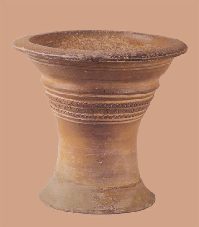
Porcelain as such was, in its initial stage, rudimentary and known now as the proto-celadon from which porcelain developed independently. Whereas pottery is porous and opaque and gives a dull sound when struck, porcelain, non-porous, translucent, and smooth-surfaced, is finer, harder, and closer-knit in texture and gives a metallic sound when struck.
Since the founding of thePeople's Republic of Chinain 1949, a considerable number of Shang and Zhou proto-celadon vessels have been unearthed in many provinces in theHuanghe River(Yellow River) valley and the middle and lower reaches of theYangtze River. These findings are different from earlier pottery made from clay paste, mainly in two aspects.
Proto-celadon used white china clay, or kaolin (an infusible white mineral earth produced in the area of Gaoling Village in Fuliang County in East China'sJiangxi Province), which is a fine, pure material suitable for making high quality porcelain.
The second difference is that the firing temperature was at least 1,200 degrees Celsius-much higher than for firing pottery, meaning that the distinction between porcelain and pottery lay in the firing of the paste.
These two changes-in the material used and in firing temperature-brought about porcelain. This Shang and Zhou proto-celadon, which basically resembled Song Dynasty (960-1279) celadon, is China's earliest porcelain, dating back to theShang Dynasty, 3,400 or 3,500 years ago.
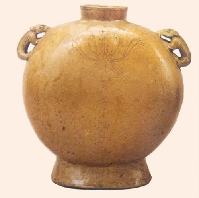
Porcelain making became steadily popular in theWarring States Period, when it began to step out of its primitive state.
Early in theWestern Han Dynastywhole sets of celadon vessels were manufactured, according to specimens of Western Han vessels that were excavated in Peixian County,Jiangsu Province. Both specimens have been displayed in the Pottery and Porcelain Hall ofBeijing'sPalace Museum. The ewers, steamers, vases, jars, tripods and boxes have a hard paste and are smooth and lustrous compared with earlier wares. The frequent discovery of Han porcelain in archaeological digs indicates that large quantities of the ware were manufactured during the period.
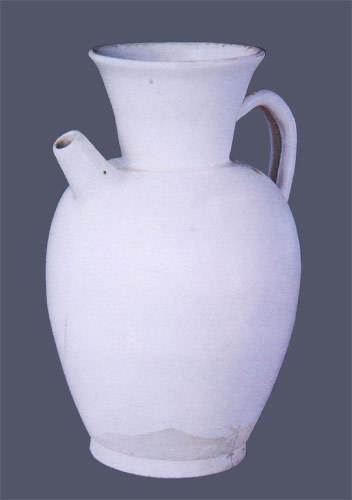
White porcelain was invented during the Northern Dynasties (386-581).
It was in the Sui and Tang dynasties that porcelain became more varied and colorful. Glaze ingredients containing different metal oxides became available to produce brilliant underglaze (pre-glaze) colors via firing.
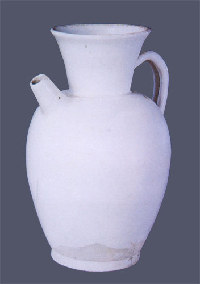
During the lateTang Dynasty, theFive Dynasties(907-960), and early in the Song Dynasty, Yue ware celadon (from the Yuezhou kilns aroundShaoxinginZhejiang Province), with a fine paste, had "the verdure of a thousandmountain peaks" and was "like dewy budding lotus flowers." The feudal ruling class monopolized this exquisite ware, known as "porcelain of secret color" (the olive-green of fine Yue ware), as tribute to the Imperial Court.
In the Song Dynasty, porcelain kilns mushroomed in different places, while porcelain schools representative of particular regions appeared. Before the Song Dynasty, porcelain was decorated by carved, incised, and impressed designs. That is, before the paste was dried, designs were carved or incised with a knife on the unglazed body or impressed with stamps for mass production and then glazed for firing.
In the Song, Liao, (916-1125), and Jin (1125-1234) dynasties, decorative designs were painted over the glaze, black designs or red and green patterns on white porcelain, with this painting on porcelain marking an entirely new stage in Chinese porcelain art.
TheYuan Dynasty(1271-1368) saw continuous new developments in the art of porcelain making which contributed to different types of famous wares.
Porcelain-manufacturing craft attained its acme in Chinese history in the Ming and Qing dynasties (1368-1911). This was shown in a tremendous variety of vessel shapes, lustrous colors, and splendid designs made possible by the fine texture of the paste, adequate firing, abundance of pigments, improvement of craftsmanship, and various social influences of the time. Apart from exquisite patterns, Ming porcelain decoration featured landscapes, portraits, and flower-and-bird and other paintings, while most of the Qing paintings on porcelain were works of famous contemporary artists or imitations of their works.

Jingdezhen in Jiangxi Province was the center of porcelain production in China during the Ming and Qing dynasties. Its kilns have contributed much to the perfection of porcelain and occupy a distinguished place in ceramic art.
China's various dynasties have seen a wealth of wares including the green Yue ware of Yuezhou, Xing white porcelain ware of Xingzhou, Ding ware in Hebei, Ru ware of Ruzhou, the celadon of Longquan in present-day Zhejiang Province, and Jingdezhen ware.
The distinctive style of each is admired in different parts of the world, for Chinese pottery and porcelain went abroad as early as in theHan Dynasty, and was exported in large quantities by the late Tang Dynasty. From North China the wares went westward along the famous "Silk Road"; from the south they were shipped by sea to neighboring Asian countries and then to North Africa and Mediterranean countries. Not until the 15th century did they reach Europe and so have the worldwide impact that provided their brilliant page in the history of world civilization.
Today, every Chinese province or autonomous region turns out ceramics with local features or in the style of the ethnic group of the area. People in the business have inherited and carried forward the fine traditions of the ancient Chinese ceramic art, thereby creating a flourishing situation in pottery and porcelain production.
|