New film exploring the culture of an ethnic group in Southwest China has gone on nationwide release. Xu Fan reports.
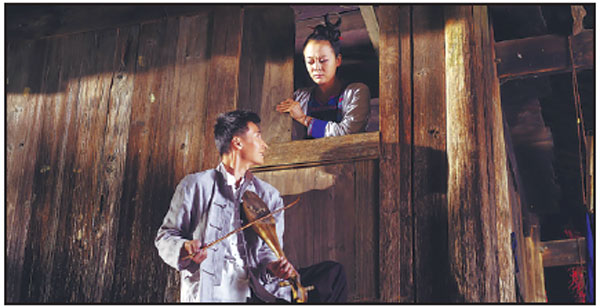
As night falls, a young man takes a wooden ladder and leans it against a closed window on the second floor of a house. Playing a guitar-like instrument, he sings romantic lyrics as his beloved looks on from the other side of the window.
This kind of wooing is not common in big cities, but for Dong people, an ethnic group that mainly lives in Southwest China's Guizhou province, it has been part of their life for centuries. And it now features in the new movie The Grand Song.
The 138-minute film, which opened across China on Nov 17, showcases Dong culture and lifestyle through a romantic story spanning several decades.
The movie is also the first of its kind to explore Dong culture since China launched a project to shoot at least one film for each of the country's 56 ethnic groups in 2014, says Niu Song, secretary-general of the China Ethnic Movies' Promotion Association.
With The Grand Song, the number of ethnic groups that have not had a movie made to record their culture has dropped to 17, says Niu.
As the main consultant on the movie, Niu believes it will help outsiders to learn more about the ethnic group, members of which are believed to be descendants of the Baiyue tribes who lived in areas south of the Yangtze River around 2,500 years ago.
The movie is named after one of the Dong ethnic group's most famous traditional art forms, a chorus performed without the aid of musical instruments.
The songs, which range from themes as diverse as the group's history to the daily routine of their lives, were inscribed in UNESCO's list of intangible cultural heritage in 2009.
The film's director Ou Chouchou and her crew toured nearly 100 villages to interview folk song masters, collecting around 1,000 songs, around half of the group's existing total.
Twenty-four songs shortlisted from 48 are showcased in the movie, with artists from the China Philharmonic Orchestra and the National Center for the Performing Arts to add accompanying music.
Ou explains the folk songs were handled in this way to widen their appeal to a younger, contemporary audience.
"A local saying goes 'rice nourishes the body, while songs nourish the soul'. Music is part of their life and reflects their spirit. I hope their songs will be heard by more people," Ou says.
But the movie, which is based on a true story, may resonate more with young people searching for true love.
With a timeline spanning around 60 years, the movie centers on a gifted Dong singer, who wants to marry her childhood sweetheart but is instead forced to become the wife of a wealthy man. After a devastating fire claims the life of her first love, the woman suffers a breakdown and edges toward the brink of insanity. In the end, her husband's decades-long care for her finally cures her broken heart.
"I didn't conceive the story. I heard about it from people involved in the project," says Ou, speaking on the sidelines of a promotional event for the film in Beijing.
Ou worked on the project over the course of six years. During one visit to interview local people, she was introduced to an elderly singer known as one of the "five golden flowers" - a reference to the then most-celebrated female singers of the Dong ethnic group who performed for state leaders in the 1950s.
The elderly lady recalled her early years, involving an unforgettable love affair with a man who stayed single after the couple were forced apart.
"Her story touched me. It's impossible to imagine that someone nowadays will wait for an entire lifetime for a love that may never be returned," says the 34-year-old filmmaker.
As a native growing up in the Qiandongnan Miao and Dong autonomous prefecture, Guizhou province, Ou was fascinated by local legends from a young age and in 2002 began to visit the remote villages scattered around the mountains there.
After she graduated from the Beijing Film Academy, Ou began to make movies about the Dong and Miao people, making her the first film director to come from either of the ethnic groups.
Her directorial debut Anayi, a 2006 movie about a Miao woman adept at embroidery, skillfully blends local customs with romance.
One of the movie's most acclaimed scenes features up to 1,000 Miao women dressed in local costume to celebrate their traditional Miao Sisters' Meal Festival, a local matchmaking event.
Close to the Sun - her second movie released in 2012 - praises the simplicity and kindness of the Miao people from the perspective of a French painter who suffers a serious illness but is rescued by the locals.
But the market for arthouse romances remains tough.
In the year leading up to its nationwide release, The Grand Song had more than 300 free screenings around Guizhou and was watched by more than 42,000 rural residents.
"We were short of financing for marketing and distribution back then. I didn't expect the movie to go on general release. It's great to see it arrive in theaters - I just hope it won't be labeled as an ethnic-themed feature," says Ou.
Contact the writer at xufan@chinadaily.com.cn
|
The Grand Song, a new movie on the Dong ethnic group, has a lot of such scenes to demonstrate its members' musical art, which was inscribed by UNESCO as an intangible cultural heritage in 2009.Provided to China Daily |
|
 |
(China Daily 11/23/2017 page19)