Chinese ethnic group's polyphonic music known to world only in recent decades
An old Dong saying goes, "singing nurtures the heart just as rice nourishes the body".
So it's no surprise the ethnic group from Southwest China's Guizhou province has always been notable for its traditional choir.
|
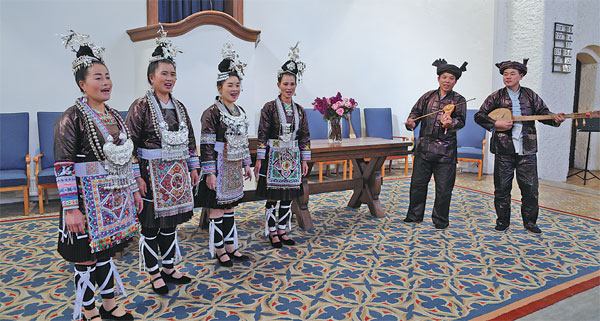
Dong Singers, a band of six members from southwestern China's Guizhou province, takes part in the International Festival of Vocal Music in Leipzig, Germany, in May. Photos provided to China Daily |
Dong Singers, a six-member vocal group from Guizhou, took part in the International Festival of Vocal Music - a cappella, held from May 7-16 in Leipzig, Germany.
During the festival, the singers - all farmers from Liping county - performed to a full house at the Evangelical Reformed Church.
The musical tradition is called kgal laox in the Dong language and known in English as "grand song of the Dong people".
"There was no amplification, and the natural reverberation in the church sounded very much like that in the mountains where the singers come from," Mu Qian, a performing art curator who organized the group's participation in the festival, tells China Daily in an e-mail.
"The audience enjoyed the music so much that the singers had to give two encores."
Mu, who is a doctoral candidate in ethnomusicology at the School of Oriental and African Studies, University of London, says the singers are more confident about their tradition after receiving positive feedback from the concerts in Leipzig.
Some scholars used to believe that polyphonic music was absent in traditional Chinese music, but with the discovery of the "grand song of the Dong people" in the 1950s, that perception changed, says Qiao Jianzhong, a professor at Shanghai Conservatory of Music.
After Germany, the band made a stop in Shanghai on its way back to Guizhou, to give a concert at Bandu Cabin, a live-house venue for music lovers in the city, and held an interactive session with students of Shanghai Conservatory of Music.
The group presented songs of love, accompanied by their traditional stringed instruments and an improvised instrument made from a single leaf.
"The songs are our way of passing on wisdom, knowledge and life experiences to others," says Wu Zaifeng, a member of Dong Singers.
"Everybody sings, right from their childhood," Wu says of his hometown.
The eldest member of Dong Singers is aged 51 and the youngest is 29. While not singing, they all work on the farmlands, cultivating rice in Liping.
Rice is harvested twice a year in the mountainous area, where terraced lands are tended to by people more often than by modern machinery.
"Singing enriches the spiritual life, which for them is as important as survival itself," says Qiao, the professor, who has studied ethnic music traditions in China for more than three decades, documenting folk melodies, lyrics and related cultural heritage.
The way Dong singers use their vocal cords is different from how formally trained singers do, and their harmony is so natural it actually grows organically from their natural surroundings, he adds.
Since the late 1970s, when the reform and opening-up of China started, Dong musicians have been introduced to the outside world. But it was not until 2002, when a group of Dong people performed at a folk music competition on state broadcaster China Central Television that their traditional singing became known all over the country.
In 2009, the Dong musical tradition was listed by UNESCO as an intangible cultural heritage in China. In addition, Chinese cultural authorities have launched a series of programs to protect the heritage.
"Many groups are frequently performing in and outside of China," Qiao says. "The band, Dong Singers, is a good example of the vitality of the tradition, with veterans singing alongside younger people."
The singers have made Dong people take pride in their tradition, he adds.
Standing in the classroom of Shanghai Conservatory of Music, the singers were dressed in traditional clothing made of hand-dyed cloth, complete with elaborate silver headwear and neck pieces.
With confidence and natural composure, they taught a piece and led students to sing with them.
The band also performed at the Festival d'Automne in Paris in 1986 and the Smithsonian Folklife Festival in Washington DC in 2014, according to Mu, the curator.
Mu has been promoting Dong music for years, and for now, he is working on a collaboration between Dong Singers and an all-female choir from Bulgaria.
"The two styles of singing share much in common and would attract wider audiences if they performed together," he says.
zhangkun@chinadaily.com.cn