In Maotai, Guizhou province, distillery Kweichow Moutai has helped improve the environment, infrastructure and advances in education, John Lydon reports.
In a time when it's common to hear about an "inevitable" conflict of interest between industry and the environment, one internationally known State-owned company has bucked the trend by staying true to its traditions and ensuring that its growth goes paired with measures to protect Mother Nature.
The town of Maotai, in Guizhou province, lies on the banks of the Chishui (Redwater) River.
|
The water of the Chishui is the most crucial factor in producing Moutai. Photos by Zhang Wei / China Daily |
In March, the current is clear and tranquil, but concrete walls that reinforce the town's northern riverbank bear testimony to the Chishui's force during the monsoon season in May and June.
Silt from reddish, iron-rich earth upstream is swept into a raging torrent that stains the walls meters above the springtime water level.
Livelihoods in this town on the riverbank have traditionally depended on the Chishui's water. Farmers irrigated their fields with it.
Merchants used the 500-kilometer Yangtze tributary, which begins in Yunnan and divides Guizhou from Sichuan province, as a highway for transporting goods.
The Chishui was once a busy waterway, with barges bustling back and forth transporting salt from Zigong in Sichuan.
Near Maotai, on the northern, Sichuan side of the river, still lie the remnants of a tow path used by bargemen to haul their vessels back upstream on their way to get a fresh load of the commodity.
But in earlier times, Maotai was just one stop along the route to the Yangtze.
It was the cottage industry of liquor-making, which gave rise to distilleries notable for the special flavor and fragrance of their product, that put the town on the map.
Two such distilleries, the Ronghe and Chengyi, were entered in 1915 under the name Maotai Brewing Co in the Panama Pacific International Exposition in San Francisco, California, the 14th World Expo.
At first, their product went largely ignored because its simple, rustic bottle fared poorly in comparison with the elegant packaging of Western competitors.
Then a member of the Chinese delegation smashed a bottle on the floor, and the sweet fragrance of the liquor wafted through the hall. Maotai Brewing Co won the gold medal.
The elements
In the early days of the new China, Kweichow Moutai Co Ltd, was created through the merger of several prominent Maotai distilleries, thus inheriting the mantle of these distinguished predecessors.
The company developed an amalgam of the recipes and techniques they had developed, which is now closely guarded as a trade secret.
It is said, however, that what makes Kweichow Moutai exceptional among Chinese liquors is not merely the technical skill of the makers, but also something about the local climate and, more important, the Chishui water and the soil on the surrounding hillsides where the sorghum is grown. These, it is thought, are instrumental in creating its distinctive fragrance and flavor.
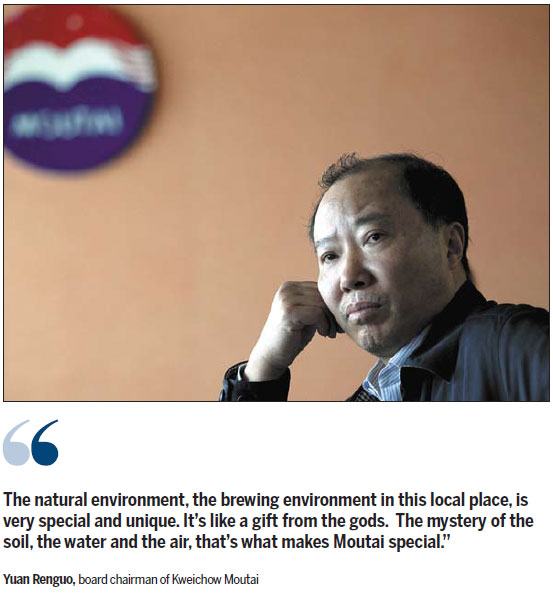
In the words of Kweichow Moutai Board Chairman Yuan Renguo: "The natural environment, the brewing environment in this local place, is very special and unique. It's like a gift from the gods.
"The mystery of the soil, the water and the air, that's what makes Moutai special."
Because of this, Kweichow Moutai watches as closely over the integrity of the local environment as it does the secrecy of its technical processes and recipes.
The river
The water of the Chishui is by far the most crucial factor in producing Moutai.
Zhou Xiangyou, the director of a Kweichow Moutai "first-step" workshop - where piles of sorghum are saturated with water, spread over the floor, and repiled, doused and spread repeatedly to aid fermentation - said in March that his group comprises 25 teams, each of which uses 600 metric tons of water per month.
"There are 21 workshops doing this, each with 25 teams," Zhou said.
That works out to 315,000 tons of Chishui water a month.
To get an idea of how much water that is, you have to know that 1 ton of water fills an area of 1 cubic meter. Now imagine a pool that is 10 meters deep, 10 meters wide, and stretches 3.15 kilometers.
Zhou said it takes 60 tons of water and 5 tons of sorghum to make 1 ton of Kweichow Moutai.
Environmental threats
In January, residents of Huaiyandong, a village on the banks of a Chishui tributary, the Yanjin River, spoke with China Daily reporters about water pollution they had witnessed in the past few years.
Chen Lin remembered that some area residents would pour domestic sewage directly into the river several years ago.
"It was not as clean as it was when I was a child," the 47-year-old said.
Over the years, Kweichow Moutai and provincial and local authorities have taken measures to protect the Chishui River from such transgressions.
Kweichow Moutai built three wastewater treatment plants on the Chishui.
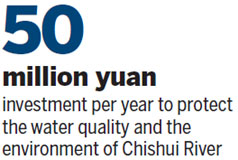
In addition, company chairman Yuan said: "To protect the water quality, the environment of this river, we started a program investing 50 million yuan ($8.06 million) each year, starting in 2014, and we will do it for 10 years continuously. That makes about 500 million yuan in all."
Local authorities began a program in which officials - such as city mayors, and district and county leaders - were appointed as "river section chiefs" who were to directly responsible for the environmental protection of the river in their area.
Renhuai, which administers Maotai, set up teams to patrol the riverbanks every morning to ensure that no company or resident illegally disposed of waste in the river, said Liu Ning-rui, chief inspector of regulatory compliance of the city's environmental protection bureau. All the paper mills in the city were closed and their workers were transferred to work as organic farmers or tour guides. Liu said that the efforts have been paying off.
"The water quality of the Chishui River has been upgraded from Level 3 (essentially, nonpotable) to Level 2 (potable). The intention is to reach the top level of cleanliness within three to five years," he said.
The soil and air
It is not clear whether it is because of the geology or biology of the local soil, but something about it makes it especially well-suited to growing the sorghum that is fermented to make the "sauce" distilled into Kweichow Moutai.
Whatever the source of this quality, the company makes every effort to protect the arable land in the area and encourage local farmers to continue growing the crop.
Over the ages, the Chishui River has carved a path for itself along crags and cliffs through hard-rock mountains in northern Guizhou.
What little arable land there is in the area has been cut into terraces lining the sides of the peaks.
Erosion a problem
To prevent erosion, the company has sponsored an annual planting activity on both sides of the river since 2005.
It also contributed more than 1 million yuan to help the local county plant vegetation on barren sloping land on the north side of the river.
It encourages farmers to keep planting sorghum by consistently paying them a higher than market price for the crop.
Yuan said: "Guizhou has millions of impoverished residents. Renhuai, where we are located, has a population of more than 650,000 and 400,000 of them are farmers. Some of the farmers are impoverished.
"To lift them from poverty, we buy the organic sorghum they planted at notably higher-than-market prices.
"Our efforts increase their personal income by about 1,000 yuan a year."
To help them cut costs and to ensure their agriculture remains environmentally friendly, the company returns the used sorghum to the farmers free of charge to use as pig feed and organic fertilizer.
"It's a recycled economy and an arrangement the farmers like," Yuan said.
The open fermentation process, where the sorghum is spread out in the workshop instead of being sealed in closed vats, is thought to improve the quality of the process by the grain's interaction with the air.
It thus becomes important, even in rural Guizhou, to block the possibility of polluted air tainting the results.
Here, too, Kweichow Moutai remains vigilant, In 2002, for example, it contributed 3 million yuan to help the Renhuai city government to move two cement plants 8 kilometers away, to prevent particulate pollution. And it is currently converting all of its coal-burning to gas-burning boilers.
While all of these initiatives benefit the company, they also make life that much better for the community - and they account for but a small fraction of the money that Kweichow Moutai contributes to improve infrastructure, advance education and other causes solely for the public good.
On that, Yuan's thinking is very simple.
"Big brands should undertake even bigger responsibilities, and development should be returned back to the local people."
Contact the writer at johnlydon @chinadaily.com.cn
|
Women work on a Moutai production line in Guizhou province. |
|
Sorghum is fermented to make the "sauce" distilled into Kweichow Moutai. |