In 1989, Taiwan architect Huang Ying-feng saw an amazing costume in Hong Kong. It was unique, with exquisite patterns in complex threads and shining silver ornaments.
It was a traditional costume of the Miao people, an ethnic group who mainly live in southwestern China.
"I was surprised by the beauty of the clothes and could not wait to see the people who made them," the 53-year-old recalls.
 |
| Huang Ying-feng's passion for the traditional costumes of the Miao ethnic group has led him to many inspiring discoveries. ZHU XINGXIN/CHINA DAILY |
In 1991, Huang visited Guizhou in Southwest China, a mountainous province famous for its karst landforms and diverse ethnic minorities including the Miao people.
Huang fell in love with the colorful culture and hospitable Miao people. He loved their ancient songs, stilted wooden houses and unique customs and festivals.
But his favorite was their unique style of dress.
Over the past two decades, Huang has traveled from Taiwan to Miao villages in the southern part of Guizhou over 100 times, collecting costumes and documenting the mysterious culture.
Huang has written several million words on the Miao people and filmed thousands of hours of footage documenting every detail of their lives and ceremonies.
 |
|
Traditional looms, once a common sight in every household, now are only used by the elderly Miao. HUANG YING-FENG/CHINA DAILY |
He has also collected about 16,000 costumes, some of which were made around 300 years ago. Some estimates have valued his collection at more than $80 million, but Huang has never sold a single piece.
Born in Taipei, Huang grew up in an isolated area surrounded by mountains. As a child he often walked into the mountains to spend time with the aboriginal tribes, known as the Gaoshan (high mountain) ethnic minority.
After graduation, Huang established an architecture firm. He helped design landmark buildings across the mainland and Taiwan, including the Shanghai Oriental Pearl TV Tower and Taipei 101 building.
In recent years, he has adapted some of the elements of the Miao people into his design. In Taipei, Huang built a museum named Changhe to exhibit his collections.
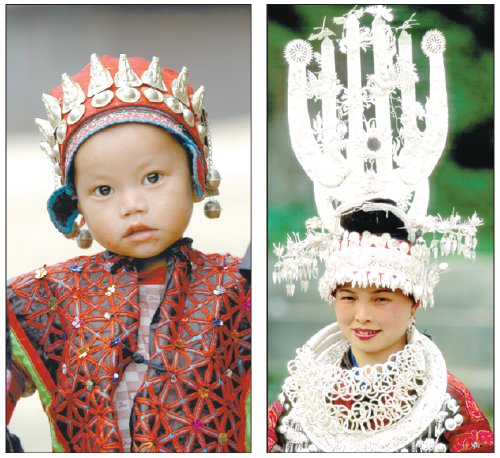 |
| Miao people, living mostly in southwestern China, are known for their unique dresses and dazzling silver ornaments.HUANG YING-FENG/CHINA DAILY |
"It is a combination of Changjiang (the Yangtze River) and Huanghe (the Yellow River)-both are cradles of Chinese civilization," says Huang.
In 2008, when the University of Hawaii Museum was holding an exhibition in Taiwan, a team from the university visited Huang's museum.
Seeing Huang's large collection of the unique costumes of the Miao people, which were well-preserved and managed by a professional team, the museum invited Huang to hold an exhibition in the United States.
Being invited to hold an exhibition at a prestigious museum in the US is a dream-come-true for most artists and collectors, but Huang initially declined the invitation.
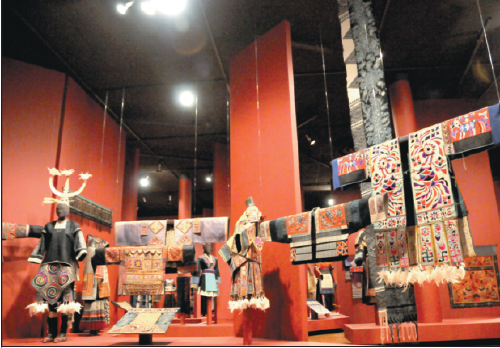 |
| A series of exhibitions held in the United States, titled Writing with Threads, showcases Huang Ying-feng's years of dedication to the research of Miao people's traditional clothing.HUANG YING-FENG/CHINA DAILY |
"I just wanted to collect the authentic costumes and record the fragile culture before it vanished," he says.
Over decades of traveling and living in the villages of the Miao people, Huang witnessed their living standards improve, especially the impact of the new motorways connecting the villages to the outside cities, offering more opportunities to young people and bringing in swarms of tourists to the villages.
Hoping the world can learn more about the Miao people, Huang agreed to hold an exhibition in the US.
From September 2008 to 2009, the costumes of the Miao people were exhibited at the University of Hawaii Museum, then New Mexico and Wisconsin.
The series of exhibitions, Writing with Threads, was a great success. The stunning costumes were seen by more than half a million visitors including a special group that moved Huang.
"A middle-aged Asian couple drove six hours in storm to see the exhibition. The moment they saw the costumes, they burst into tears," Huang recalls.
"They were two of the 300,000 Miao people who are living in the US who were transferred as refugees after the Vietnam War."
Huang's research into the culture of the Miao also led him to make significant discoveries about the migration history of the Miao.
"In old songs sung by the elderly Miao people, a gigantic animal lives in the ocean and is often seen. I assumed they were referring to a whale," says Huang.
"But how could the inland mountainous people describe whales?" says Huang. "The only reason is the ancestors of the Miao people used to live by the sea."
Huang discovered that among the archeological discoveries in Hemudu town in East China's coastal Zhejiang province, some patterns matched the ones he collected in Guizhou.
"It proved that a large group of Miao people migrated from the east coast to the mountains. In other words, they were fishermen," says Huang.
Huang says he is in a race against time to save the culture of the Miao people before it vanishes.
"Instead of learning the ancient skills and costumes of their ancestors, the younger generations of Miao prefer to live in the modern world. Many can't speak their ethnic language," says Huang.
In recent years, Huang struggled to find authentic handmade Miao costumes, which have been replaced by rough factory productions as cheap souvenirs.
But he is still optimistic about the future. "Some Miao people have realized that their culture is part of their soul."
In 2012, Huang was invited by the provincial government in Guizhou to promote folk tourism, as an expert.
"The costumes Huang collected are perhaps the most complete collection representing the history of the Miao people in Guizhou," says Fu Yingchun, director of the tourism bureau in Guizhou.
"His study is very valuable to Gui-zhou and the ethnic minorities of the region."
Huang is looking for a place in Guiyang, provincial capital of Guizhou, to build a museum. He says that he will exhibit his collection in the museum.
"Rather than saying it is a responsibility, I feel it is my good fortune to do something for the Miao people," Huang says.
Contact the writer at wangru@chinadaily.com.cn
AT A GLANCE
The Miao people can be traced back to a legend from 5,000 years ago. Chiyou, a mighty warlord, the ancestor of the Miao people, was defeated by Huangdi and Yandi, leaders of two tribes, from which the Han people are said to have descended, in a battle in Zhuolu in today's Hebei province in northern China.
After the war, the Miao people migrated several times until they eventually settled in southwestern China.
There are more than 100 subgroups of Miao people according to the differences of the colors of their costumes and locations of their villages.
The total Miao population is estimated at around 10 million, mostly living in southwestern China. Some subgroups of Miao migrated to Southeast Asian countries, such as Thailand and Laos, where they are known as Hmong.
During the Vietnam War, the CIA recruited and trained thousands of Miao people from Laos to fight against the North Vietnamese. After the retreat of the American army, Hmong people in Laos, facing the revenge of the Vietnamese, fled to Thailand and later were resettled in the United States, France and Australia by the UN Refugee Agency.