|
|

Tea plantations flourish on the fertile soil of Guizhou's mountains. Photos by Feng Yongbin / China Daily
|
|

A worker sifts through tea leaves in Meitan county, one of the major tea-producing areas in Guizhou province.
|
|

A Bouyei woman serves local food to visitors in Wanggang village in Guiyang.
|
|

Wicker baskets become canvases for these fair maidens.
|
|

Red chilies are one of the best offerings of the province.
|
|

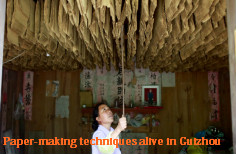
The 600-year-old paper-making craft still thrives in Baishuihe village in Guiyang.
|
Guizhou offers tourists off the beaten track a sense of hospitality, tranquility - and a splendid cuppa, Tom Clifford reports.
Guilt is a terrible thing to bring to a table. For hours our small bus had been buffeted by nature's wrath, exposed on Guizhou's mountain passes, and only the dexterity and skill of our driver kept us this side of paradise.
Rain slashed our windows in a Hitchcockian shower-scene frenzy. Our schedule had been literally washed away. Up through gorges, down into valleys, tight bends, narrow roads and white knuckles. Then relief as we descended to the flatlands.
We were on Bouyei ethnic group land and stumbled upon the village of Yinzhai, still far from our eventual destination, but craving rest and nourishment.
"Can you feed us," shouted the driver to a woman in the village kitchen.
"How many?"
"Eleven."
"Twenty minutes. Have a walk, see the village, relax," came the assured response.
Like us, the countryside was breathing a sigh of relief. Mountains looming over us appeared picturesque. The sky streaked with red hues, no longer in torment, seemed to be blushing with embarrassment at its previous behavior.
Wits gathered after a short walk, we headed for the meal but first acknowledged an old discolored poster in the main village home displaying the core principles of the Bouyei ethnic group.
"Heaven, Earth, Emperor, Ancestors, Teachers," it read. History was tapping us on the shoulder, a privilege before we sat down to eat.
Fried fish, pork, vegetables of blazing color were offered with joyous abandon to shouts of appreciative approval. And then came the guilt.
Had they enough food for the village, or were we eating them out of house and home? We were assured that the village stored its food for months in advance and had more than adequate supplies.
On hearing this, not a word was spoken for six minutes as stomachs were replenished.

Our thanks were accepted graciously as the plates were cleared. We had been recipients of a kindness to strangers. Outside, darkness had finally overcome its inhibitions and descended, ushering in a time for reflection.
For days we had been traveling through the highs and lows of Guizhou province. Its fertile soil struggles to produce on mountainous terrain, but when given a chance on the horizontal it can provide a vertical harvest for the imagination. Nothing, it seems, is beyond its capability. The usual suspects, broccoli and corn, are joined by delicate leaves for tea, tobacco and chilies to jump-start the synapses.
This is Guizhou tea country. If in doubt, look to the heavens where a laser beam cuts across the clouds from a giant teapot that dominates the skyline of Meitan town in Zunyi.
Tea, especially green tea, is growing in popularity; you could say it's a top pick.
China exported about 300,000 tons of tea last year, 30 percent of it green.
The art of picking tea is almost as sublime as its taste, and requires a surgeon's delicacy and optical prowess.
"You can never use your nail or sharp edge like a knife," one picker said. "If you do, you cauterize the cut and it turns black. Each leaf has to be torn, delicately, from the plant."
This is no job for the faint-hearted. Sweltering sun, torrential rain, the body poised to strike and then tear the fragile leaves for hours on end. Perched on mountainsides, this may be a job with scenery to die for but it asks a back-aching price.
Guizhou's mountains stand sentinel, guardians of a beauty most tourists in China never see. In rural parts of the province, far from the madding crowd, the three S's - sight, smell and sound - ravish the senses with a ferocity of lovers reunited.
Tea country has a more subtle, enchanting allure. The rolling hills are not awe-inspiring like the mountains but they are easier on the eye.
The picking season is April to October, and each plant will produce a new leaf every two weeks or so. A leaf picked in Guizhou can be in Beijing within about 40 hours but certain steps have to be taken first.
After picking it is allowed to dry naturally for a few hours, then it is stirred, not shaken, mechanically to give it shape before being shaken to dry it further. After this, it is rattled in what looks like a cement mixer to enhance its flavor.
Once packaged, off it goes for a shelf life before floating invitingly in a cup or glass.
Tea has a special place in Chinese and world history, but only now is green tea getting a bit of the global publicity it deserves.
I am a coffee lover but there are times in the day when I could be unfaithful to the bean, especially in the restful hours after 6 pm when green tea would settle the frayed nerves of a hard day's night.
The province's chili fields are no place for questionable nerves, either. Planted in the spring and picked in the autumn, each plant can produce 200 blood-red chilies. Thirty percent of chilies on sale in Beijing come from the province, shipped within 28 days of picking.
The following day, in bright sunshine, our plans were back on track.
We traveled to a paper-making village, cradled by steep granite gorges. For 600 years the village of Baishuihe in Guiyang, has been cutting and stripping bamboo, mixing it with plum juice, pulping, hanging and drying it out. The paper for ancestral offerings can also be used for calligraphy. It costs 12 yuan ($2) a kilogram. Nature's bounty.
Then onto a nearby Bouyei village that was expecting us for a meal. No guilt here while we hammered the rice, as if it was trying to emerge from the underworld, into a sticky substance, which was then peppered with seeds and eaten in small handfuls.

Maidens fair, in traditional blue costume, offered us rice wine and food. We drank, they sang. This side of paradise? The lines were blurring, we may have stepped over.
Tiny cups were raised to lips and then turned upside down to show that no alcohol remained. Both a tribute and a delightful challenge.
The table was not just groaning under the weight of food but begging for mercy, pleading for us to lighten its load. Laughter competed with birdsong. More maidens singing, more rice wine. Well into the night we stayed, unable to pull ourselves away from the incredible hospitality.
The hour of departure could no longer be denied. Farewells were exchanged with a solemnity that contradicted the previous gaiety. Handshakes seemed inadequate. Full body hugs and claps on the back were called for. Journey's end had been reached. Until we laugh together again, paradise postponed.
Contact the writer at cliffordtomsan@hotmail.com.
|