|
|
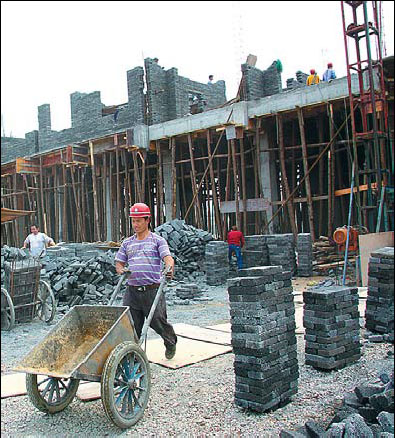
A construction site where government-subsidized housing will be built for villagers in Songtao county, Guizhou province. Huang Qiansheng / for China Daily
|
Residents living in rocky desertification areas in Guizhou province are moving to new homes with government subsidies.
The province plans to invest 3.1 billion yuan ($498 million) to relocate more than 150,000 people in 2013. The beneficiaries are expected to have more opportunities to raise their household incomes and enjoy a higher standard of living.
In Ma'an village, the Taoyuan Miao autonomous county, the relocation plans were made in 2006 after a massive landslide struck the village in 1999, destroying the arable land and leaving the villagers in extreme poverty.
Since 2006, new houses have been built with a uniform design and layout, typically 80 square meters with two bedrooms and a living room, on what has been called "Friendship Street". The area is expected to grow into a boomtown at the juncture of Guizhou and Sichuan provinces and Chongqing municipality.
In 2008, when the first group of villagers from 28 households moved in, each family needed to pay 39,000 yuan. They also got an extra 30-square-meter space to open a store.
The same package was provided to 30 households during the second round of relocation in 2011. Each family paid 50,000 yuan to move in.
So far, 80 households have relocated. The majority of the villagers, from more than 300 households, still live in their native places.
New home
Xiang Gongbin, 59, said his family used 50,000 yuan from bank loans and moved in 2008.
The loans are not paid yet, for lack of savings. The household managed to pay about 5,000 yuan a year, covering only the interest.
Xiang and his wife used to find manual work at construction sites near home to support the family.
After moving to the new house, they stopped working to look after two grandsons, both 4 years old. Their livelihood depends on money sent from their two sons, who work in other cities.
"The interest paid to the bank in these years has already amounted to a big sum. I know the longer we delay paying off the loans, the more money we will end up giving to the bank. But we have little savings, and the family needs money to keep running," Xiang said.
Xiang said he hopes a more favorable policy will lower bank interest rates to help struggling villagers.
Despite the financial pressure, Xiang said he made the right decision.
"It is much easier to get around, with buses and highways. I can find staples at a nearby store. Unlike in the past, I had to carry several bags of rice and other daily necessities from a distant marketplace to home," Xiang said.
The biggest advantage is the closeness of schools, which his two grandsons will soon attend. "There is a school within walking distance. The boys don't have to repeat their fathers' hardship by going to boarding schools at a young age," Xiang said.
Some of the homeowners have started businesses such as grocery stores, restaurants and wood processing mills. A few rent out their houses and receive 3,000 to 4,000 yuan a year.
Some, as in Xiang's family, have been migrant workers in other cities, leaving elderly parents and small children at home.
"Many were skeptical in the beginning about moving. Some hesitated because of the need to seek bank loans. Now a lot of them regret they did not make the decision to move," Xiang said, estimating his new house is now worth 100,000 yuan.
Some are simply too poor to afford a new house. They can rent farming land left by those who have moved and increase their income by tilling more land.
"The plan is not to move everyone out of the mountainous villages and all live an urban life. It is up to individual families to decide whether they want government subsidies and to live in a better house, or to continue to make a living by growing on more land," said Zhou Hailan, deputy chief in charge of a similar relocation project in Yuping Dong autonomous county, Tongren city.
Construction of new houses began in September in Yuping. Zhou said 330 households are expected to move by the end of this year.
For families that have signed up with government authorities to move, each family member receives 12,000 yuan in subsidies. A family still needs bank loans to buy a new house of 80 to 120 square meters.
Job opportunities
Two industrial parks are under construction in the meantime. One park intends to attract high-tech and environment-friendly companies. The other park includes labor-intensive factories that make garments, shoes and chemicals. One shoe manufacturer that has already started production can create 20,000 jobs, Zhou said.
These companies will give priority to hiring villagers who have moved under the relocation project, Zhou said.
Credible agricultural companies will be allowed to rent idled land from villages. For those who choose to stay, they can do the same or work for these large companies, Zhou said.
The Yuping government is trying to raise residents' living standards and help them urbanize through industrialization, Zhou said.
According to Zhou, few ethnic traditions in the Dong autonomous county have the potential to commercialize.
The county is famous for a bamboo flute made of bamboos that grow in the area. Although there is a factory that makes the instrument in Yuping, the skills are passed down within the family and kept secret from outsiders.
Officials overseeing the construction process know they will be held accountable if quality problems are found. They face daily scrutiny from villagers, who are very concerned about their future homes, Zhou said.
Poor construction quality was blamed when a secondary school building collapsed early this month in Kaili, Guizhou province, causing seven injured students to be hospitalized. People questioned why the concrete floor was so fragile and later found the floor contained not a single reinforcing steel bar, according to reports.
Zhou, the official in charge of the villagers' relocation project in Yuping county, Tongren, said he and his colleagues had been informed of the incident and warned to avoid the same thing from happening again under their watch.
Contact the writers at sujiangyuan@chinadaily.com.cn and liyao@chinadaily.com.cn.
|