Life
Heavenly grottoes
Updated: 2013-03-21By Li Yang ( China Daily )
|
The 1,500-meter high Maiji Mountain is home to an abundance of relics dating back 1,600 years ago when Buddhism was first introduced into China. Tianshui Tourism Bureau / For China Daily |

|
Three Buddha statues carved on the cliff surface are the highlights of Maiji's Buddhist heritage. Li Yang / China Daily |

The caves, Buddhist sculptures and murals on Maiji Mountain in Gansu province have survived many natural disasters throughout the centuries. Li Yang feels spiritually recharged after a visit.
Before the trip to Maiji Mountain, I was only expecting to see a wheat-stack-shaped mountain, as its Chinese name indicates.
I drove all the way to the middle of the mountain without realizing that the clumsy and dull red sand rock koppie standing in front of me was it, until I saw the stone tablet carrying its name.
Maiji nestles at the base of high rocks. Although it is less than 100 meters high from bottom to top, its elevation is 1,500 meters.
Facing a large valley to its south cliff, Maiji appears to be the commander of all surrounding mountains.
Maiji stands tall as an isolated peak. It is a red sand rock cylinder peak, rare in the region, contrasting sharply with the others.
Nature has put it in the focus of the valley.
When my eyes turned around a protruding rock, I caught sight of a large pair of feet, 3 meters wide at least, carved out of the mountain stone in a big cave.
I had no idea that I was already standing at the feet of three great Buddha statues of a five-story building's height - one Amitabha statue flanked by two bodhisattvas.
All of them wear robes and a smile, with eyes half-opened.
They were carved in the Northern Wei Dynasty (AD 386-534) and mended in Song (960-1279), Ming (1368-1644) and Qing (1644-1911) dynasties.
The tour guide told me the latest repair in 1984 found a white china bowl made in the Song Dynasty and a well-preserved booklet of Buddhist scripture in the left cheek of the Amitadha statue.
The story adds to the mysteries of the Buddha statues, making my trip more like an exploration for treasures.
The bright sunshine casts shadow on the large statue's face, and the moving shadow gives the still face different expressions.
This is the wisdom of ancient artists. They were good at making use of natural light and imagination to bring life to a still face.
Buddhism came to China through the Hexi Corridor along the Yellow River in Gansu province about 1,600 years ago, when ethnic groups from the north and the west came to central China in large migrations.
The religion born in India has gone to southeast and northeast Asia from China, despite its ups and downs.
The most popular Buddha is Amitabha, who is believed to be the chief Buddha of the Pure Land sect. Amitabha empowers all calling upon him to be reborn into his world, the Pure Land, where they receive all kinds of instruction by him and become bodhisattvas and Buddhas later.
This is the most prevalent school of Mahayana Buddhism during the first stage of Buddhism evangelization in China, when the three main Buddha statutes of Maiji Mountain were made.

There are many big holes beside the huge grotto of the three great statues, about 0.5 meters in diameter and about 1 meter deep.
It is said ancient workers first dug these holes and inserted solid tree trunks to form various working platforms, like scaffolds. The holes were also used by repairmen and painters in later times to construct their working platforms.
The climb up the stairs, passing by the great statues, felt like a walk through a museum.
On the cliff surface 50 to 70 meters above the mountain foot are scattered about 194 caves with more than 7,200 pieces of Buddha sculptures and more than 1,000 square meters of frescos remain on the inner surface of the caves.
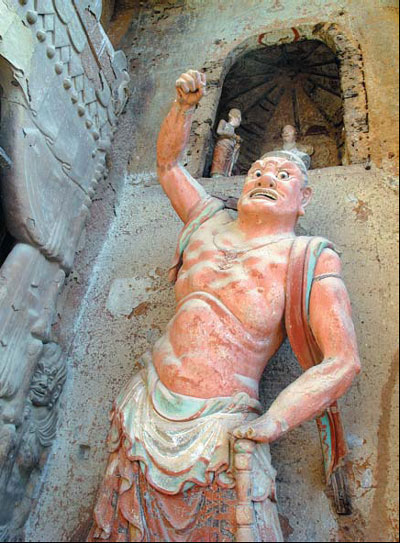
The most common pattern of the sculptures consists of a Buddha, sitting or standing, flanked by bodhisattvas and other attendants, or by monks or lay worshippers. The bodhisattvas on the Buddha's right are usually Avalokitesvara, and Mahasthamaprapta are on the Buddha's left. Pairs of dvarapala (gate guardian) or the four Heavenly Kings stand near the doorways to guard the Buddha and his entourage.
Some of the statues are as big as 5 to 6 meters tall and the caves they rest in are meters deep into the cliff. Some are only 50 to 60 centimeters tall and the caves are only as big as old-fashioned TV sets.
Some caves are lined up in good order with dozens or even hundreds of statues sculptured in the same fashion.
Although most of the paint has faded away, visitors can still verify their exquisite expressions on the face, each one different from another.
They have survived many earthquakes, natural and artificial disasters. They look alive and intelligent.
I stopped at almost every grotto to look into the cave through the guard bars. Compared with my hurried steps, all the statues demonstrate a kind of equanimity and calmness.
Although I could not see them clearly, the calmness, darkness, coolness and the sand rock smell greeted my ears, eyes and nose whenever I neared my head to the guard bars of some small caves. A mixture of inspirations filled my heart and the spiritual pull was undeniable.
Each groove on the statue today is a result of an ancient stonemason or a sculptor's delicate touch.
These caves, statues and frescos were created, maintained, or even damaged in more than 1,600 years of history.
Even if many statues are broken, leaving only remains, local people still worship them as cherished relics that can bring good luck and wisdom, as an old local woman told me at the end of my two-hour pilgrimage. She was kneeling down at the foot of the mountain praying for Buddha's protection.
With this in mind, I picked up four rocks beside my feet and put them into my backpack. They are now quietly resting on my bookshelf, and I hope they will bring me luck and wisdom.
Contact the writer at liyang@chinadaily.com.cn.
|
While the paint has faded from most of the sculptures, the expressions on their faces will delight visitors. Li Yang / China Daily |
(China Daily 03/21/2013 page19)
News