We have launched E-mail Alert service,subscribers can receive the latest catalogues free of charge

Views and Suggestions on the Economic Situation in the First Half of 2008
2008-10-16


By Ren Xingzhou, Institute of Market Economy of DRC
Research Report No. 120, 2008
In the first half of 2008, China's macro-economy maintained a rapid development on the whole, with the gross domestic product (GDP) increasing by 10.4% year on year. Nonetheless, new changes took place in some macroeconomic indices and an obvious slowdown of the growth of some industries showed up. Growth of foreign trade declined sharply; price rise remained at a higher level and the pressure of a medium- and long-term price rise intensified; uncertain and precarious factors in economic operation increased and the international economic situation allowed of no optimism. Different views on the above-mentioned new circumstances have sparked off major differences among the public in the judgment of the current economic situation, and there are completely different opinions on future economic performance. Under such circumstances, fully understanding, analyzing and judging the current economic situation is imperative to formulating the macroeconomic policies, ameliorating the macroeconomic control and coping actively with various challenges.
I. Overall Judgment: The Economy Developed toward the Anticipated Direction under the Macroeconomic Regulation in the First Half of 2008
During the first half of 2008, China's GDP reached 13.0619 trillion yuan, up 10.4% from a year earlier, down 1.8 percentage points year on year. Of this growth, GDP increased by 10.6% in the first quarter, down 1.1 percentage points from a year ago, and 10.1% in the second quarter, down 2.5 percentage points year on year. In the face of such a growth, those who have adopted an optimistic attitude maintain that the factors supporting the rapid economic growth have not radically changed; while others argue that although the economic growth remained at a faster pace, the growth fell considerably, boding a risk of economic downturn. It can be seen from the analysis that although the economic growth declined by 1.8 percentage points in the first half of the year as compared with the same period of last year, it maintained a steady and fast growth, with the growth being not only much faster than the current world average (The World Bank has predicted that in 2008 the world economy will grow by 2.7%, down 1.0 percentage point from a year ago), but being also higher than the average growth speed of 9.8% that was recorded over 30 years since China's reform and opening up, breaking roughly even with China's average annual growth rate of 10.6% during this round of economic growth cycle (2002-2007), and the current growth has been realized at a rate of more than 10% based on the ever-increasing economic aggregates and bases. To sum up various factors, it can be said that during the first six months the national economy developed by and large toward the anticipated direction under the macroeconomic regulation and some positive changes appeared in economic operation, showing the policy effects from the macroeconomic control.
Firstly, factors causing an excessively fast and overheated economic growth have been evidently crippled. The central economic working conference held at the end of last year thoroughly analyzed the conspicuous problems in China's economic development over recent years and set forth the macroeconomic task of "Two Prevents" for 2008. One of the "Two Prevents" is to prevent the economic growth from an excessively fast growth to an overheated one. By adjusting and implementing a number of macro-control policies, the economic growth declined rationally in the first half of the year and the excessively fast growth of the fixed asset investment slowed down. During 2002-2007, the fixed asset investment of the whole society always maintained a rapid growth, up an average 26.3% annually (Figure 1). In order to bring the excessively fast growth of the fixed asset investment under control, China has carried out the policies of encouraging growth in some sectors and discouraging it in others over recent years, devoting major efforts to readjusting the investment structure. Since 2008, China has further increased investment in agriculture to give impetus to the steady growth of agriculture and has taken strict control over the investment in industries obsessed with surplus capacity, high energy consumption and high waste emission so as to hold the excessively fast rise of investment in check. These measures have achieved anticipated good results. During the first half of the year, the fixed asset investment of the whole society reached 6.8402 trillion US dollars, up 26.3% year on year, accelerating 0.4 percentage point over the same period of the previous year and, after allowing for the price rise in fixed asset investment, actually up around 16%, being about 6 percentage points lower than the same period of last year. The investment structure improved, with the investment in the primary industry accelerating 32.0 percentage points year on year; the investment in the tertiary industry increased by 26.2%; the investment in central and western regions of China grew notably faster than in China's eastern provinces.
Secondly, the driving forces for the economic growth have changed positively. During the first half of 2008, the consumption demand across China increased fast, with a total of 5.1043 trillion yuan worth of retail social consumer goods being realized, up 21.4% year on year, accelerating 6.0 percentage points from a year earlier and, after allowing for the price rise, actually up 13.5%, being still a high growth (Figure 2) and contributing more and more to the economic growth. Growth of exports in foreign trade declined, with the exports in the first half totaling 666.6 billion US dollars, up 21.9%, down 5.7 percentage points; imports were valued at 567.6 billion US dollars, up 30.6%, accelerating 12.4 percentage points; the trade surplus amounted to 99 billion US dollars, with 13.2 billion US dollars less than from a year ago. It can be seen from the first half of 2008 that the pattern of the economic growth excessively depending on investment and net exports is changing and that the difference between the increase of fixed asset investment in cities and towns and the increase of the total retail volume of social consumer goods shrank by 4.9 percentage points as compared with the same period of last year. The demand structure is shifting as well toward the anticipated direction under the macroeconomic control.
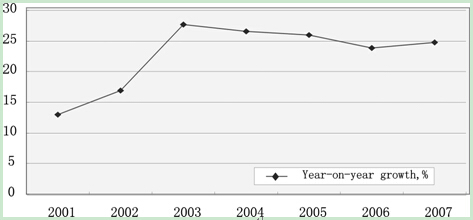
Figure 1 Year-on-year Growth of the Fixed Asset Investment in Cities and Towns during 2001-2007
Source: National Bureau of Statistics.

Figure 2 Actual Year-on-year Growth of the Total Retail Volume of the Social Consumer Goods between the First Half of 2007 and the First Half of 2008
Source: National Bureau of Statistics.
Thirdly, the growth of money supply has declined and the newly increased loans have reduced. At the central economic working conference held at the end of last year, the Central Government has adjusted the monetary policy into a tight one in order to fulfill the macroeconomic task of the "Two Prevents". By the end of June, the broad money supply increased by 17.4% year on year, accelerating 0.3 percentage points over the same period of last year; the narrow money supply increased by 14.2%, down 6.7 percentage points; the balance of the Renminbi loans at the financial institutions increased by 2.4525 trillion US dollars as compared with the beginning of the year, with a decrease of 89.9 billion yuan from a year ago. In the first half, the deposit reserve ratio at the financial institutions was raised by 5 times to 17.5%.
Fourthly, the agricultural production has developed steadily and the financial revenue has continued to grow considerably. The yield of the summer grain crops all over China has been increased for five consecutive years by 3.04 million tons over last year, up 2.6%; while continuing to grow substantially in recent years, the nationwide financial revenue maintained a growth of more than 30% during the first half of the year;the industrial products saw a good production and sales, with the production and sales rate reaching 97.7%, up 0.2 percentage point year on year; from January to May, the industrial enterprises above the designated size across China realized a profit totaling 1.0944 trillion yuan, up 20.9% year on year; the situation of employment turned out good, in the first half of the year, the newly-added employed people in cities and towns across China reached 6.40 million, fulfilling 64% of the whole year's target; 2.82 million laid-off workers were re-employed, fulfilling 56% of the whole year's target.
…
If you need the full text, please leave a message on the website.