We have launched E-mail Alert service,subscribers can receive the latest catalogues free of charge

Urbanization Problems in China and the Relevant Cause
2007-12-10


Zhang Junkuo, Liu Feng, Gao Shiji & Hou Yongzhi
Since reform and opening up,with the rapid development of the economy,urbanization in China has been carried forward by leaps and bounds and has brought about great successes. The proportion of urban population in the national total increased from around 18% at the beginning of the reform and opening up to approximately 44% in 2006,up 26 percentage points in 28 years,with an annual increase of 0.93 percentage point. Particularly in recent years, urbanization in China has shown a momentum of accelerated development,and the urbanization rate increased from 30.5% to 44% during the 10 years from 1997 to 2006,with an annual increase of 1.35 percentage points, indicating that each year about 17 million people on average moved from rural areas to urban areas.
Nevertheless,urbanization in China is still facing some problems and contradictions,which restrain the sound development of urbanization. There are various reasons for the cropping up of the problems and contradictions in the course of urbanization,some are related to the present conditions and some are connected with the past development;some are policy-based and some are based on Chinese characteristics. But after all, the root cause lies in the systematic mal-practices, some of which are longstanding issues related to the system.
I. Problems with China's Urbanization
1. The relatively lagging development of urbanization
(1) The urbanization level is lower than the average level of the countries at similar development period. In 2006,China's urbanization rate was 43.9%,lower than the average level of 55% of the countries whose per-capita real incomes were roughly equivalent to that of China. At the same time,although the overall economy in China was growing faster than in some developing countries,in comparison with the urban population growth rates of those countries in time of rapid economic growth,the average annual urban population growth rate of China was relatively low(See table below).
(2) The urbanization level is nominally high. According to the present statistical standard,although many people are brought into the statistics of urban population,they are not virtually involved in urban life due to the restriction of the household registration system and the lack of public services,without receiving benefits from the fruitful results in modern urban civilization. Strictly speaking,these people are not regarded as the urbanized population. And China's urbanization level will become even lower if this part of people is excluded.
Urban Population Growth during Rapid Economic Development (%)
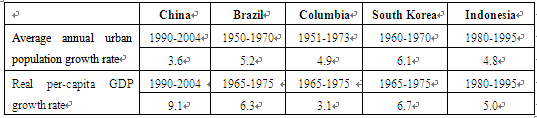
Data:The Chinese Economic Research and Advisory Programs:Urbanization in China,Policy Issues and Policy Selections to Be Faced, 2007.
(3) Land urbanization is faster than population urbanization. According to statistics,the constructed urban areas in China rose from 20,200 square kilometers in 1996 to 32,500 square kilometers in 2005,with an annual increase of 5.4%,being evidently higher than the urban population growth rate of 4.4% during the same period,and the role of the cities and towns in absorbing population was not brought into full play,whereas the land shortage in China was further worsened. At the same time, some cities blindly sought grandeur and exoticism, showing great eager to build grand squares, spacious streets, sizable lawns, luxurious office buildings and garden-style factories, etc.,which not only gave rise to the excessively extensive use of land resources, but also resulted in the improper use of public properties and funds, being not in conformity with China's national conditions and characteristics.
2. The conspicuous structural contradictions with urbanization
(1) The scale and structure of cities and towns are irrational and the number of cities is big while population scale is relatively small. Compared with other countries in the world,China is obviously short of big cities with a population of one million to twelve million or so(See figure below). As a result, the scale benefits of the cities cannot be brought into full play, thus restricting the cities' population-absorbing capability, the enhancement of productivity and the improvement of the quality of economic growth. Although the scale of such cities as Shanghai, Beijing and Guangzhou is big enough,the recent researches suggest that the scale of many cities at the prefecture level has only reached half of their due scale.
(2) The urban economy is still away from being specialized. It can be seen from the experience of the developed countries in urbanization that the market mechanism will lead the local employment to get centralized into an industry or into some industries with internal relations so as to make full use of the economies of scale in production. Generally speaking,cities in moderate or small scale tend to be highly specialized(such as the production of iron and steel, automobiles, textiles and other products), while major cities have a preference for developing hi-tech, commercial and financial service industries. However, due to financial reasons, some major cities in China are reluctant to shift the manufacturing industries outwards in the course of economic structural readjustment,which has not only obstructed the manufacturing industries from getting centralized toward small and medium-sized cities according to the economic rationality, but has also checked the upgrading of the major cities' own specialization and their industrial structures.
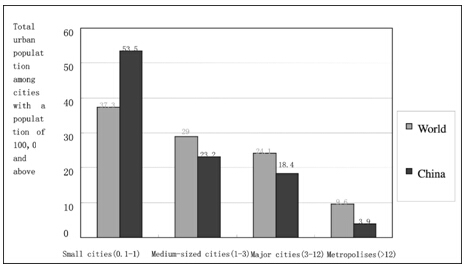
Population Proportion in Cities of Different Scales among Cities with a Population of 100,000 and above in 2000
Data:The Chinese urban population data are from the population census in 2000 and were provided by Du Yang from the Chinese Academy of Social Sciences.
3. The poor bearing capacity of the cities and towns with incomplete functions and the ecological environment under great pressure
(1) The comprehensive bearing capacity of the cities is not strong. The urban land utilization rate in China is not high and the density of most cities is on the low side, particularly the urban employment density. In countries where land resources are scarce, such as Japan and South Korea, the intensive use of land with high density is mainly adopted for urban construction. The Japanese government prescribes that the capacity rate of the first-class residential quarters should be 0.5~2.0, that of the ordinary residential quarters be 1.0~4.0, that of the industrial areas be 2.0~4.0 and that of the business quarters be 4.0~10.0. The employment density of the major cities in the world such as the employment density of the central business centers is all around 50,000~100,000 persons/km and that of New York reaches as high as 240,000 persons/km2. In China, urban structures are featured mainly by low buildings and the stereoscopic urban land spaces are not fully utilized, therefore, the role of the urban spaces in accommodating people and conducting economic activities cannot be brought into full play. According to the calculation by the Ministry of Land and Resources in 2002, the average capacity rate of the cities in China is only 0.33, whereas the capacity rate of the cities in developed countries is usually 2.0 and above. The low intensity is a waste of land resources, which is seriously not in line with China's actual situation of more people and less land.
(2) The urban functions are incomplete and unmatchable. The places providing job opportunities are far away from residential quarters, and there is a discrepancy between the development of urban infrastructure facilities(including communications)and the planning and development of land utilization. The infrastructure construction in some cities, such as the underground pipeline networks and the environment harnessing, is quite lagging, being not in a position to meet the need for the rapid development of urbanization. The road traffic networks are incomplete and imperfect. Not only have the traffic jams become the common issues in major cities, but they are also easily found in the medium-sized cities. Construction of the overall urban disaster prevention systems is generally poor and the urban public emergency system facilities are imperfect and incomplete. All these have prevented the urban functions from being brought into play and have added to the traveling and social operational costs.
...
If you need the full context, please leave a message on the website.