We have launched E-mail Alert service,subscribers can receive the latest catalogues free of charge

Rural Circulation System: Current State, Problems and Policy Suggestions Cheng Guoqiang
2007-07-18


The rural market is China's most extensive market with the greatest potential. Rejuvenating rural circulation and boosting the rural market are vitally important to increasing peasant income, guiding rural consumption and maintaining steady development of agriculture and the rural economy. This is also an important part of the effort to build a new socialist countryside.
I. Current State of China's Rural Market Circulation
Thanks to the reform, opening up and development for nearly 30 years, China's rural areas are moving from a natural economy to a modern one. As the transition from the planned economy to the socialist market economy has been largely completed, market mechanism has gradually become a decisive factor for rural resource allocation. A new rural circulation system, involving multiple levels, multiple types, multiple channels and multiple players, has been formed. The effort to build a rural market system has made major headway.
First, the rural market has been expanding in scale. Since the beginning of reform and opening up, China has scored leapfrog development in the structure of rural consumption and the level of rural market consumption has been on the rise. In 2005, the total volume of retail consumer goods at or below the county level reached RMB 2.2 trillion yuan, which was a 21-fold growth over 1978, the first year of China's reform and opening up, or a 1.5-fold growth over 2000, the last year of the 9th Five-Year Plan (close to the 1.8-fold growth of the total nationwide retail consumer goods over the same period). The expansion of the rural market has played a positive role in promoting the sustained rapid growth of the national economy. It is a market that has the greatest potential to stimulate domestic demand and promote a new round of economic growth in the future.
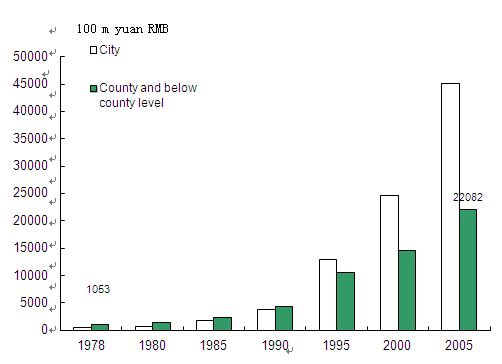
Chart 1 Retail volume of consumer goods at the city level and at and below the county level in China
Second, the modes of trading and the forms of circulation industry have gradually improved. Currently, China's rural areas have both the traditional trade markets and also the general markets, specialized markets, wholesale markets and futures markets. Modern modes of circulations such as chain operation, distribution and e-commerce and new forms of circulation industry such as mini-market and convenience store have begun moving from the urban to the rural areas. 1. The trade of farm products has spread from the traditional trade markets to modern modes of circulation as specialized wholesale, order-based marketing, auction and futures trading. General markets, specialized markets and e-commerce for farm products have also developed rapidly. By the end of 2005, China had 539 general markets for farm products, each having an annual turnover of more than RMB 100 million yuan. Their total turnover reached RMB 241.2 billion yuan or up 6.1 percent over 2000. 2. The chain distribution of agricultural capital goods has had a strong momentum of development, with distribution, direct selling, supermarket, general agency and general distribution being thriving. At present, China has nearly 1,000 enterprises, which operate over 30,000 chain stores engaged in selling agricultural capital goods. They have created an environment for peasants to buy these goods conveniently, safely and economically. 3. While small stores, grocery stores, mom and pop stores and other traditional methods continue to dominate rural circulation of consumer goods, chain operation, supermarket, convenience stores and other new forms of circulation have begun moving to the rural areas. The "rural market project1" launched in 2005 by the Ministry of Commerce is aimed to transform the rural mom and pop stores and commission stores and to establish standard "rural household stores" featuring chain operation and centralized distribution. In 2006, a total of 2,287 enterprises nationwide carried out this experiment in 1,817 counties. In all, 160,000 rural household stores were established across the country, involving a combined regional and corporate investment of about RMB 11.7 billion yuan, offering 650,000 jobs, boosting rural consumption by RMB 60 billion yuan and benefiting 140 million peasants. The systems of supply and marketing cooperatives are also using modern modes of circulation to transform their traditional operating networks in the rural areas, by establishing nearly 100,000 self-owned or joint-invested chain stores or distribution outlets. About 50% of the retail of consumer goods has been included into the chain operation and distribution systems.
Third, the rural market players have witnessed a diversified pattern. Peasant brokers, household marketers and rural circulation cooperatives have become the main forces in the circulation of farm products. Statistics indicate that currently China has over 20,000 rural cooperatives engaged in buying and selling farm products and 6 million rural brokers engaged in trading farm products, offering technical service and providing information. Agricultural capital goods are being operated by diverse market players and through diverse circulation channels. They include the capital goods companies established by the supply and marketing cooperatives, the enterprises producing agricultural capital goods, the "three centers" in the rural areas (the center for plant protection, the center of soil and fertilize and the center for agro-technology extension) and the self-employed business households.
II. Prominent Issues Existing in China's Rural Market Circulation
Overall, the rural circulation system in China is still unsound, the mode of rural circulation is outdated, and the modern rural circulation systems are still weak. They are grossly unable to meet the needs of expanding rural consumption, developing modern agriculture and building a new socialist countryside.
First, the gap between the scales of urban and rural markets continues to widen. In 1978, the retail volume of consumer goods in urban areas totaled RMB 50.5 billion yuan, accounting for 32.4% of the country's total retail volume of consumer goods. On the other hand, the retail volume of consumer goods at or below the county level totaled RMB 105.3 billion yuan, or 77.6% of the country's total. Rural retail of consumer goods was the main force to boost the growth of the national economy. But as the Chinese economy developed rapidly, the urban market expanded rapidly in scale. In 1995, urban retail of consumer goods surpassed that in the rural areas. The gap between the scales of urban and rural markets was 1.2 folds. In 2005, the gap further widened to 2 folds (Chart 2). In that year, the rural population, which accounted for two-thirds of the country's total population, bought only one-third of the retail consumer goods nationwide. In the long run, this gap in scale will continue to widen as industrialization and urbanization advance in China. The small scale of the rural market and the inadequate rural consumption will growingly become a profound contradiction and pose a fundamental problem to China's new round of sustained economic growth.
...
If you need the full context, please leave a message on the website.
1The "rural market project" is designed to provide government support to encourage the enterprises engaged in urban circulation to extend their modern circulation networks to the rural areas. One, various types of large and medium-sized circulation enterprises are encouraged to directly invest in building and transforming "rural household stores" in the pilot counties and cities. Two, various types of large and medium-sized chain-operating enterprises are encouraged to build and transform the rural household stores by accepting small enterprises as members. Three, various types of small and medium-sized enterprises are supported to establish regional distribution centers at or below the county level. The state provides funding support such as direct subsidies and discount loans to enterprises when they build and transform rural household stores and distribution centers. By building or transforming rural household stores, the "rural market project" aims to gradually popularize chain operation in the rural areas and uses modern modes of circulation to transform rural grass-roots commercial outlets. By so doing, modern rural circulation networks, that are led by urban stores, rely on town and township stores and are based on village stores, will be established to meet the production and living needs of the peasants and to improve the rural consumption environment.