We have launched E-mail Alert service,subscribers can receive the latest catalogues free of charge

A Study on China’s Process of Marketization
2002-12-13


Wang Quanbin
Research Report No 112, 2002
How is the process of China’s marketization after over two decades of reform? Has China become a country with a market economy? After analyzing the relevant studies both in China and abroad, we can come to a conclusion that China now is by and large a country with a market economy.
I. Concept and Measuring Methods
There are two interpretations of marketization. The first refers to an evolution of economic system, in which the market mechanism plays a constantly growing role in a country’s allocation of economic resources. The second refers to a change of economic system, in which the resources of a country in reform or transition are allocated by market instead of planning. To put it simply, the former refers to a marketization in the sense of development, while the latter refers to a marketization in the sense of reform or transition.
Of course, China’s marketization process has the elements of marketization in the sense of development. But more importantly, the process is a marketization mainly in the sense of reform. International comparison generally classifies the marketization of a country in reform or transition more in the sense of reform and that of other countries more in the sense of development.
Measuring the process of marketization must first of all set the perspectives of study according to the specific interpretation of marketization. Then a set of indicators should be designed and tabulated to work out a general index. The indicators can be in relative and absolute terms, and hence the relative and absolute indexes. The main difference between various measuring methods lies in the design of indicators and the method of tabulation. This study uses absolute indexes, with percentage points indicating the degree of marketization.
The measuring methods also depend on how to interpret marketization and, in the final analysis, on the practice of reform and the progress of marketization. A comparison of various methods measuring the process of marketization reveals that the design of indicators has become more and more detailed and the scope they cover has become increasingly extensive. This phenomenon is in itself a reflection of the constant deepening of China’s economic restructuring and the continuous advance of its marketization process.
II. General Judgment
First, with the deepening of reform, China has been advancing in the direction of marketization and the degree of marketization has become increasingly higher. This is a common conclusion even though there are different methods of measurement (see table 1). Therefore, marketization has been the direction of the economic reform over the past two decades.

Note: a. The index range is 0-100%. The larger the index value is, the higher the degree of marketization becomes. b. The index range is 0-10. The larger the index value is, the higher the degree of marketization becomes. c. The index range is 1-5. The larger the index value is, the lower the degree of marketization becomes. The original index values were generally two years different from the time when reports were made. So the years should be adjusted by two years accordingly.
Second, a general consensus is that the degree of China’s marketization now is more than 50 percent (see table 1). This is an indication that the market mechanism has been playing a leading role in the country’s economic life and the country has become a market economy from a planned economy.
Third, the process of China’s marketization is uneven. The degree of marketization differs in different sectors and different regions. Specially, the degree of marketization in the exchange of general commodities is relatively high, and that in the exchange of production factors is relatively low. The degree of marketization in the financial sector is the lowest. The process of marketization in the eastern region is faster, while that in the west region is slower.
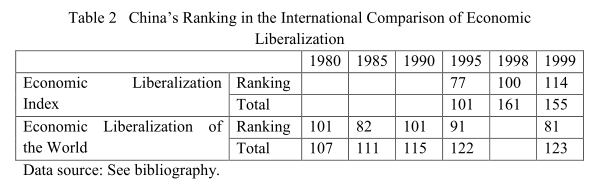
Fourth, in international comparison, the degree of China’s marketization is considerably lower than that in the developed countries and regions, at the middle level among the countries in the process of reform and economic transition, and higher than that in some major developing countries. China’s ranking has been in an upward movement (see table 2). This is another indication that the degree of China’s marketization has been rising since the beginning of reform and its achievements in the market-oriented economic restructuring have been recognized in the world.
III. Specific Analyses
(1) Marketization of the exchange of general commodities
Mark pricing of commodities is a key to the marketization of the exchange of general commodities. In 1979, state pricing accounted for about 97 percent of the total commodity retail sales, 92.6 percent of the total purchase of farm and sideline products and 100 percent of the total industrial production factors sales. Correspondingly, market pricing respectively accounted for 3 percent, 7.4 percent and 0 percent. We can see that commodity prices were set at that time according to a typical planned pricing mechanism. Therefore, the degree of marketization was very low. By the year of 1990, market pricing accounted for 53.0 percent, 51.6 percent and 36.4 percent of the total commodity retail sales, the total purchase of farm and sideline products and the total production factors sales. After the goals for a socialist market economy were set in 1992, price setting was liberalized at an accelerated rate. The above indexes rose rapidly to 93.2 percent, 81.8 percent and 73.8 percent respectively. Later on, market pricing continued to assume growing proportions. In July 2001, the central government decided to further liberalize the setting of commodity and service prices, limiting government pricing to only 13 categories from 141 categories in 1992. It was estimated that after this price liberalization, market pricing would account for more than 90 percent of the purchase and circulation of farm products and production factors. At present, with the exception of a few important commodities vital to the national economy and people’s livelihood, a few products characterized by resource monopoly and some services, the prices of all the rest have been liberalized and regulated independently by market. This is an indication that a pricing mechanism based on market regulation is already in place.
...
If you need the full context, please leave a message on the website.