|
More than 90 percent of the 27,708 (by 1990) Achangs live in Longchuan, Lianghe and Luxi counties in the Dehong Dai-Jingpo Autonomous Prefecture in southwestern Yunnan Province. The rest live in Longling County in the neighboring Baoshan Prefecture.
The Achangs speak a language belonging to the Tibeto-Burman Austronesian of the Chinese-Tibetan Phylum. Most Achangs can also speak Chinese and the language of Dai minority. Their written language is Chinese.
Their ancestors once lived in the valleys of the Jinsha, Lancang and Nujiang rivers in northwestern Yunnan Province. Some of them moved to the west of the Nujiang River where they gradually evolved from hunters to farmers. During the Tang and Song dynasties (618-1279), the Achang area was controlled by Yunnan's Nanzhao and Dali principalities. During the Ming and Qing dynasties (1368-1911), the Achangs were ruled by Achang hereditary chiefs appointed by -- and accountable to -- the imperial court. Before 1949, feudalism was the dominant economic form in the areas where the Achangs lived -- Dai chiefs were the feudal lords; most landlords were Hans; and Achang landlords were few.
Liberation came for the Achangs in early 1950. Two years later, Achang autonomous districts were established one after another. Beginning in the autumn of 1955, a gradual land reform abolished feudal land ownership in the Achang area. Also abolished were feudal privileges, taxes and usury.
The Achangs are famous for their rice cultivation and ironware. Local industries, built up from nothing, are centered around the Lianghe area. Under the Han influence, the Achangs generally practice ancestor worship. Most Achangs on the Sahu area believe in Hinayana, a branch of Buddhism.
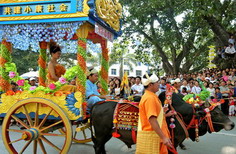
The Splashing Water Festival, the Closing Door Festival and the Opening Door Festival are important festivals related to their religion. The Woluo Festival is the most important festival of the Achang people, which comes in the fourth day of the first month on the lunar calendar. During the festival, people of all ages come together, dancing and singing all day and night. Other traditional festivals include the Torch Festival, the Flower Watering Festival and the Spring Festival, etc.
|