|
The Lisu ethnic group numbers 574,856 people (by 1990), and most of them live in concentrated communities in Bijiang, Fugong, Gongshan and Lushui counties of the Nujiang Lisu Autonomous Prefecture in northwestern Yunnan Province. The rest are scattered in Lijiang, Baoshan, Diqing, Dehong, Dali, Chuxiong prefectures or counties in Yunnan Province as well as in Yanyuan, Yanbian and Muli counties in Sichuan Province.
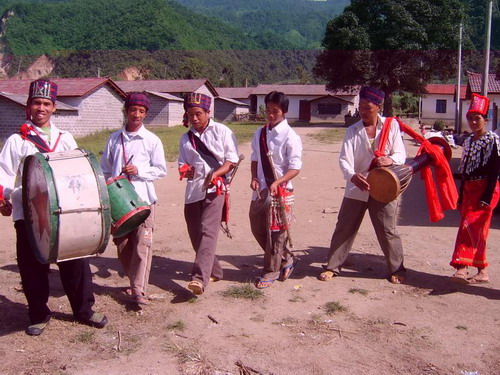 |
| Lisu people are dancing. |
The Lisu language belongs to the Chinese-Tibetan Phylum. The Lisu people altogether used three languages, one created by the western missionaries, one created by the Lisus, and the third, a new alphabetic script created in 1957, which is widely used among the Lisu people today.
Lisu minority is an ancient people, whose name first appeared in the Tang Dynasty (618-907). According to historical records and folk legend, the forbears of the Lisu people lived along the banks of the Jinsha River. In the mid-16th century, most Lisu people moved to the reaches of Nujiang River. The lived in mountains and made a living on primitive agriculture and hunting. By 1950s, the remnant of the clan system could still be found among the Lisus in the Nujiang River valley. There were more than a dozen clans there, each with a different name, including Tiger, Bear, Monkey, Snake, Sheep, Chicken, Bird, Fish, Mouse, Bee, Buckwheat, Bamboo, Teak, Frost and Fire. The names also served as their totems. Within each clan, except for a feeling of kinship, individual households had little economic links with one another.
The Lisu people divides a year into ten months, based on their natural calendar. Their traditional festivals include the New Year Festival, the Knife-Pole Festival, the Mid-autumn Festival and the Harvest Festival.
The Knife-Pole Festival on Feb 8 in the Chinese lunar calendar aims to memorialize a Han hero who taught the Lisu people how to make knives and is the exclusive and traditional festival of the Lisu ethnic group. On that day, various activities including "Climb Knife Pole" and "Dive into Fire Sea" will be held. The Knife-Pole Festival absorbs the spirits of the Lisu people, and is a royal and luxuriant celebration.
|