Following the 2010 first publication of the Report of "The Economic Contribution of the Copyright-Based Industries in China (2004-2006),"the National Copyright Administration of the People’s Republic of China (NCAC) again published the update of 2007-2009 on June 22nd of this year during the Diplomatic Conference on the Protection of Audiovisual Performance of the World Intellectual Property Organization (WIPO) and the 4th China International Copyright Expo. The Report shows that the value-added of copyright-based industries in China and its share in national GDP have maintained a continuous growth, with the industry’s value-added accounting for 6.55% of the GDP in 2009. This is especially true for the core copyright industries which show a more rapid growth, with value-added accounting for 3.5% of the GDP in 2009.
Ⅰ.Research background
It is reported that "The Economic Contribution of Copyright- Based Industries in China" is a major research project continuing on a yearly basis which is conducted by the Chinese Institute of Publishing Science (CIPS) commissioned by NCAC. Since 2007, NCAC and WIPO have begun to cooperate and entrusted CIPS to conduct the first study on the economic contribution of copyright-based industries in China. The objective of the study was to survey the economic contribution of the copyright-based industries in China between 2004 and 2006; the results were published by NCAC and WIPO both in Chinese and in English. It has profound influence and was highly praised by experts both at home and aboard. The project has been conducted three times since 2007.
Hao Zhensheng, Director of CIPS, said to China IP magazine, "The Project was first conducted by NCAC and WIPO in joint effort. WIPO not only provided financial support, but also invited experts from the U.S. and Singapore to give technical instructions. In the following two studies, the project team kept contacting and communicating with these experts. During the surveying period, the project received support from many administrative departments, including the National Bureau of Statistics of China, the General Administration of Customs, the Ministry of Industry and Information Technology, etc."
Hao Zhensheng also indicated that though they have made non-conclusive achievements in the first study, this Project was the first of its kind in China, therefore it had limitations due to restrictions on statistics collection and other related aspects. Consequently, NCAC had listed the Project on the long-term and important agenda, and entrusted CIPS to conduct the research of the economic contribution of copyright-based industries in China from 2007 to 2009.
"The second and third studies were based on the study of 2004- 2006. The project team investigated, calculated and analyzed the statistics of the economic contribution of copyright-based industries in China in 2007-2009 and made vertical comparison with the statistics concluded in the first study. It showed that copyright has exerted great impact on China’s economic growth, and the innovation activities based on copyright system are significant to economic development," said Hao Zhensheng.
ⅡThe economic contribution of the copyright-based industries in China in 2009
According to Yu Cike, President of the Management Division of NCAC, copyright-based industries are those which relate in whole or in part to copyrightable works or other protectable matters in the processes of creation, production, manufacture, performance, broadcast, communication and exhibition or distribution and sales. These industries can be classified into four groups according to WIPO: (1) the core copyright industries, for example, books, newspapers, electronic books, audio-visual products, computer software, games, animation, photograph and music; (2) the interdependent copyright industries, for example, television, computer, instruments, camera, paper and copier; (3) partial copyright industries, for example, textiles, furniture, toys, porcelains and architectures; (4) non-dedicated support industries, for example, general distribution and retail, transportation and internet industry, etc.
Based on the above definition and classification, it is obvious that the copyright-based industries are not brand new industries but a collection of several copyright-based industries of the national economy. The common characteristics of these industries are that they co-exist on the basis of the copyright system, their developments are closely related to copyright protection, and copyright has played a significant role in these industries. The study of copyright-based industries started from legal concepts, and measured the economic influence of copyright system from an industrial perspective.
The Project has concluded the following statistics of the economic contribution of copyright-based industries in China in 2009:
The industrial value-added worth reached 2,229.798 billion yuan, which was 6.55% of national GDP. Among them, 1192.804 billion yuan were from core copyright industries which accounted for 3.5% of the national GDP.

Diagram I states the composition of the industrial value-added portion of Chinese copyright-based industries in 2009.
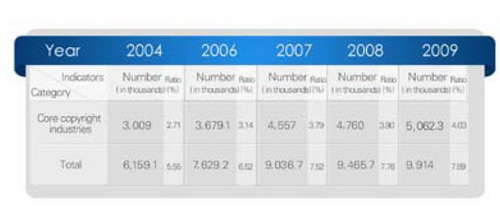
In 2009, the employment of copyright-based industries was 9.9914 million which accounted for 7.89% of the total national employment. Among them, the employment of the core copyright industries was 5.0623 million or 4.03% of total national employment.

Diagram II states the composition of the employment among copyright-based industries in China in 2009.
In 2009 the total value of commodity export for customs of the Chinese copyright-based industries was 210.317 billion USD or 17.50% of the total national commodity export for customs. Among them, the export value of the core copyright industries was 4.116 billion USD or 0.34% of the total export value of China.

Diagram III states the composition of total value of export goods from Chinese copyright-based industries in 2009.
Vertical comparison from 2004 to 2009
Comparing with the survey result of 2004-2009, the following conclusions can be made:
1.Industrial value-added
The industries’ value-added of copyright-based industries and the proportion it took in GDP of the year have continuously increased. The proportion of 2004 was 4.94%, while the number increased to 6.39% and 6.55% in 2006 and 2009 respectively.
The industries’ value-added of the core copyright industries and the proportion it took in GDP of the year witnessed a more rapid growth by comparison with other industry groups, the proportion of 2004 was 2%, while the number increased to 3.06% and 3.50% in 2006 and 2009 respectively (the statist

ics of digital publication was included except 2004).
Table IV states the change of value-added of the copyright-based industries from 2004 to 2009.
2.Employment
The employment of copyright-based industries and its proportion of total national employment have increased continuously. It was critical in increasing employment opportunities. The proportion was 5.55% in 2004, and the number increased to 6.52% and 7.89% in 2006 and 2009 respectively.
Table V states the employment change of copyright-based industries from 2004 to 2009.

3.Export value
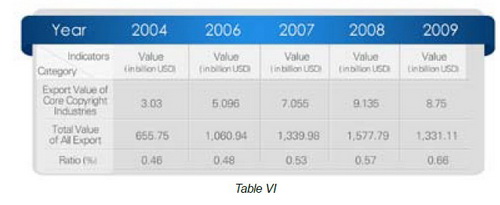
The total value of commodity export of the copyright-based industries and service export value of the core copyright industries continued to increase. Meanwhile, their proportions in the total commodity export value and the service trade export value of the year kept growing as well.
Export value of the commodity of interdependent copyright industries had dominated the overall commodity export value of copyright-based industries of the year. The consistently remained kept above 90% from 2004 to 2009, showing that manufacture export was still primary in export of copyright-based industries.
The commodity export value for customs of the core copyright industries and service trade export value as well as the proportion they accounted for the total national commodity export value and for the national service trade export value respectively were low. The export value of the core copyright industries (including commodity export and service trade export) accounted for less than 1% of the total national commodity export for five years. However, the ratio kept increasing continuously, e.g. from 0.46% in 2004 to 0.66% in 2009.
Table VI indicates the export value of the core copyright industries from 2004 to 2009.
IV. Horizontal Comparison between China and the U.S.
Currently, there have been more than 40 countries and regions around the world that have conducted similar research projects. Compared with these countries, though the industry value-added of the copyright-based industries in China is relatively high, the core copyright industries are still of average quantity. There is a significant gap between China and the most advanced countries in copyright-based industries, e.g. the U.S.
The industrial value-added of the copyright-based industries of the U.S. in 2009 was 1,562.67 billion USD (9,896.58 billion yuan), which accounted for 11.07% of its GDP, while for China, it was 2,229.798 billion yuan—less than a quarter of the number of the U.S., and accounted for 6.55% of China’s GDP.
Table VII is the comparison on industrial value-added of the copyright-based industries between China and the U.S.
In 2009, the employment of the copyright-based industries of the U.S. was 10.8148 million, which accounted for 8.27% of total national employment, while for China these two figures were 9.914 million and 7.89% respectively.
Table VIII is the comparison on employment of the copyrightbased industries between China and the U.S.
The export of copyright-based industries of China still mainly focuses on manufacturing, and the export value of core copyright industries of China lagged far behind the U.S. The export value of core copyright industries of China in 2009 was 8.75 billion USD which only accounted for 0.66% the total export of the nation. While for the U.S., the total overseas sales amount (129.1 billion USD) of some important core copyright industries such as recording, movie, computer software and non-software publishing (including books and newspapers) were apparently higher than other major industries such as aircraft, agricultural products, food, motor vehicles and pharmaceutical goods.
ⅣConclusion
According to Yu Cike, based on this research and the comparison between other countries, the aspects of the survey show that the following two conclusions may be reached:
1.An overview of the development of Chinese copyright-based industries
The survey showed that the economic contribution of Chinese copyright-based industries from 2004 to 2009 increased continuously. The core copyright industry enjoyed a more rapid development than other industrial groups, especially the software and database industry, digital publishing industry and advertising service industry.
The economic contribution of industrial value-added to Chinese copyright-based industries is high, however, the contribution of core copyright industries lagged far behind developed countries. The proportion of the value-added of core copyright industries in GDP of the year is only half of the U.S. In Particular the export value of the core copyright industries should make more progress.
2.The development environment of copyright-based industries in China
As can be seen from the above statistics, the copyright-based industries have been playing a more and more important role in Chinese economy; this is inseparable with the Chinese government who has attached great importance to IP in recent years. Governments and units of various levels have taken positive measures in promoting the creation, utilization, protection and administration of copyright which could be reflected in the following aspects:

a.IP has been included in China’s national strategy
In recent years, the Chinese government has attached great importance to IP. IP, including copyright, is no longer only restricted on the legal system level, but has been included in China’s national strategy. According to "The Outline of the National Intellectual Property Strategy" published by the State Council in 2008, by 2020, China will become a country strong in creating, utilizing, protecting and administrating IP.
b. Copyright legal system has been gradually improved in the network environment
Targeted on solving the new problems of copyright protection in the network environment, the State Council published "Regulation on the Protection of the Right to Network Dissemination of Information" (Regulation) in May 2006, and the Regulation was fully implemented in July 2006. In the meantime, China signed two important WIPO treaties; namely, the WIPO Copyright Treaty (WCT) and the WIPO Performances and Phonograms Treaty (WPPT). The Diplomatic Conference on the Protection of Audiovisual Performances, which concluded successfully in Beijing not long before, indicated that the Chinese government valued copyright protection highly in the environment of new technology.
c. Combining legislation with administration, copyright supervision in China has made remarkable achievements
A distinctive feature and advantage of China’s copyright protection is the combination of legislation and administration. Copyright administrative departments at all levels continue to enhance cooperation and communication with legislation departments, and gradually improve the internal file and transfer system. By combining legislation with administration, and launching more vigorous campaigns to combat piracy, the copyright protection level has been significantly improved, which has created a favorable environment in establishing and regulating the industry order, while providing a nice market and legislation environment for the healthy development of copyright-based industries.
d. The frameworks of copyright public service system and social service system have been established
After years of development, China’s copyright social service system has been established, it consists of the Copyright Society of China, the Copyright Protection Center of China and the collective management organizations of copyright protection on music, audio and video, literal works and photography. Meanwhile, a favorable interaction mechanism has also been formed, in which the governments conduct supervision and administration, social communities protect rights for themselves, enterprises operate business in accordance with the law.
e. The increasing public awareness in copyright protection leads to the establishment of a copyright protection society
Along with the deepened implementation of copyright systems and the massive publicity and activities related to copyright, copyright awareness of Chinese public has raised. NCAC has carried out a number of activities to promote copyright protection, the public show their respect to copyright, become more aware of piracy and act in accordance with law. An environment of protecting copyright with self-consciousness is being formed.
f. The development mechanism of copyright service industry is under continuous innovation
After years of practice, for the copyright administrative departments at all levels, their development blueprints of the copyright service industry as well as their service awareness are clearer, while their service methods are more mature. NACA makes continuous innovation in various aspects including developing copyright model cities, units and parks promoting the successful experience of some localities, and encouraging international copyright communication and discussion. Meanwhile, copyright departments at all levels are vigorously promoting development of copyright-based industries. Beijing, Shanghai, Guangdong and Sichuan have done researches and publicity works on the economic contribution of copyright-based industries which have made positive achievements.
ⅤProject result and follow-up work
WIPO published the "National Studies on Assessing the Economic Contribution of the Copyright-Based Industries" (Creative Industries Series No.5) reports at the end of 2011. In the series of reports, the first one was "The Economic Contribution of Copyright-Based Industries in China," which was the first joint effort between NCAC and WIPO. According to Hao Zhensheng, recently NCAC and CIPS have published the report "The Economic Contribution of Copyright-based Industries (2007-2008)" after they published the first report.
(Translated by Emily Tan)