For a long time, scientific research staffs have been labeled as “scientific geeks.” However, inventor Luo Haiyong subverted this image completely with his personal charisma.
New enthusiasm of “scientific geek”
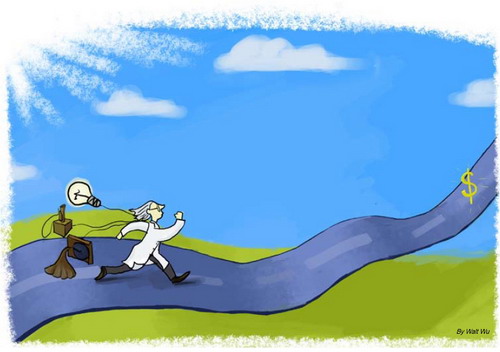 |
| R&D staff: patent transfer |
From the first patent auction held by the Institute of Computing Technology (ICT) of Chinese Academy of Sciences (CAS), to the upcoming second patent auction, inventor Luo Haiyong has had deep feelings. In the first patent auction, one of his patents applicable to greenhouse environment monitoring sold at the price of 240,000 yuan without a reserve price. “A successful patent transaction in an auction means our scientific researchers’ work was appreciated and will promote our future work,” said Luo Haiyong excitedly, although the auction took place two years ago. Patent auctions are not a mature concept in China yet; however, the exploration has not been stopped by the lack of direct experience. Bearing this in mind, ICT started the first patent auction in December, 2010. The company has made joint efforts with technology transfer organizations, IP service agencies and auction companies to increase patent transactions through the use of auctions. For patent inventors, auctions serve both as a challenge and an opportunity to prove their innovative abilities.
Patents differ from traditional bidding items because patents are intangible; they are intellectual products which can “neither be seen nor touched.” Obviously potential bidders will never fully understand the potential value of a patent within a couple hours by simply attending an auction. Therefore, effective communication between inventors and bidding enterprises beforehand, in the preliminary stage of the auction, is one of the key points to a smooth transaction.
According to Luo Haiyong’s introduction to his approach to the patent auction, he himself had made many contacts with the bidding enterprises over the patent he sold in the first patent auction. This kind of communication helped bring the R&D staffs down to earth and take the first step towards commercializing the R&D products. “Unlike the past transactions where R&D staffs only needed to summarize their research results into written materials, the transfer of the technology products (via auctions) requires a better recognition of our work. It also facilitates communication by providing a platform by which we can increase awareness in advance of transferring our products,” said Luo Haiyong.
The “double effect” innovation mode
As a national scientific research institute, ICT should also take responsibility for promoting social and economic development. However, technological products can only process broader values when they are put into practical use and generate social and economic benefits. Therefore, ICT encourages inventors to get rid of the dull written work and devote themselves to the transfer of their inventions to technology because the value of scientific research lies chiefly in serving the industry, promoting the development of the national economy and generating social and economic benefits, rather than academic papers.
To promote the transfer of patent inventions and inspire the researchers to “carve out” their own niche, ICT has hammered out relative policies. Instead of claiming all rights to service inventions, which gives people the common impression that innovations belong solely to the Institute, ICT awards the inventors portions of the profit generated from the sales to stimulate them, increase their awareness of patent transfer, and promote the transfer rate as well.
Luo Haiyong is a beneficiary of the first patent auction. According to him, impassivity has governed the overall scientific research environment and working atmosphere for years. Ever since ICT came up with the idea of encouraging the inventors to “carve out” a niche, they have been given a broader development space. Through patent auctions the inventors are able to transfer their inventions into productive forces, the feeling of achievement is greater than that received from the completion or publication of papers. In addition to economic benefits, the rewarding system also creates an invisible competition among the fellow researchers, which inspires them to bring forth new ideas and accelerate the transfer of their patents. It was revealed that when ICT was providing followingup services to the company that purchased Luo Haiyong’s patent, they began to partner over another patent concerning remote monitoring. The cooperation marks the powerful combination of scientific research and industrial practice.
“Clear path” for patent transfer
During the patent transfer process, protecting the interests of both the inventor and the purchasing enterprise is a point of focus all parties are attentive of. With respect to building the awareness of IP protection, Luo Haiyong summarized his own experience of transformation: “Patent transfer keeps the research staffs from concentrating solely on their projects. Inventors were encouraged to build up the awareness of protecting their own research results bit by bit and cooperate with professional IP agents to work out IP protection strategies, which not only cleared the path for patent transfer on the inventors’ side, but also paved the road to purchasing and using on the enterprises’ side.”
At present, research staffs are also focusing their efforts on how to present their intangible intellectual products in tangible forms, which could be understood more easily by enterprises or buyers. In 2011, ICT held the 3rd Internal Technical Innovation Contest. In order to summarize the experience of the first patent auction (2010) and paveal the road for the coming second patent auction, the organizers came up with new rules totally different with the former contests: competitors are required to focus on patents, and present them in tangible forms. The winning items in the contest will become the priority choices for the second patent auction of ICT. Luo Haiyong himself has prepared three items up for bidding at the auction. To date, many Chinese enterprises have contacted him to obtain the informational materials about the patent that he has prepared in advance so that they are informed when the auction takes place.
Patent auctions allow the inventors to participate in the practical process of a patent transfer. How much they actually achieve in the coming second patent auction will hopefully be closely related to their preliminary work.
(Translated by Moncia Zhang)