

In July of this year Wang Zhonglin, a foreign academician of the Chinese Academy of Sciences and director of the Beijing Institute of Nanoenergy and Nanosystems, won the “Nobel Prize for Energy”, more formally known as the Eni Award, the highest award in the energy field. The award ceremony was held at the Quirinal Palace in Rome.
 |
|
The awarding ceremony of the Eni Award took place at the Quirinal Palace in Rome [Photo provided to chinadaily.com.cn] |
The Eni Award is the most authoritative and prestigious award in the world's energy field. Together with the Turing Award for computing, the Fields Medal for mathematics and the Wolf Prize it is known as one of the highest awards in the natural sciences. Wang is the only Chinese scientist to have received this honor to date.
 |
|
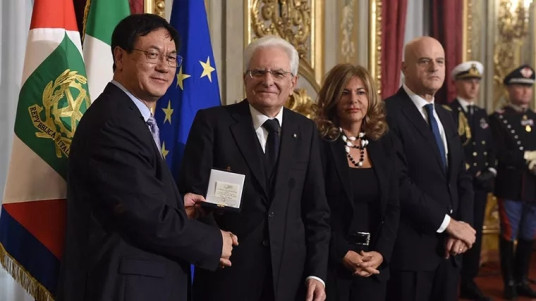
Italian President Matarella awards a medal to Wang Zhonglin [Photo provided to chinadaily.com.cn] |
Wang is an internationally recognized leader in the field of nanoscience and technology. He is ranked first in terms of the global nano-field H index and academic influence. According to the June public data of Google Scholar, Wang's academic papers were cited more than 116,500 times, and his H factor reached 207.
 |
|
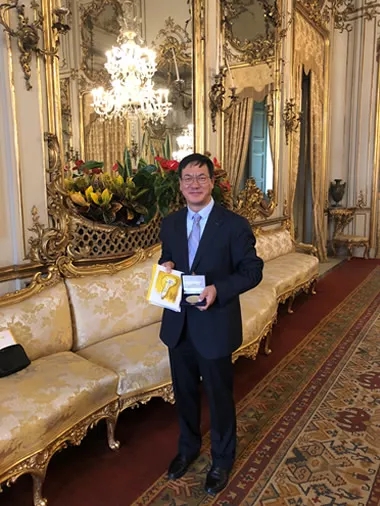
Wang Zhonglin has won seventeen international major awards [Photo provided to chinadaily.com.cn] |
Wang is a Fellow of the European Academy of Sciences, Dean of the School of Nanoscience and Technology of the Chinese Academy of Sciences, Professor of the Board of Directors of the Georgia Institute of Technology Lifetime School, Tenured Highwater Chair Professor at the Georgia Institute of Technology and a member of the American Physical Society, the Scientific Development Association, the Materials Society, the Ceramic Society and the Microscopic Society. He’s also a Fellow of the Royal Society of Chemistry in the United Kingdom.
Wang has won seventeen international major awards, including the 2015 Thomson Reuters Citation Laureate designation, the 2013 International Science and Technology Cooperation Award of the People’s Republic of China, the 2016 European Advanced Materials Award and the 2017 Global Nanoenergy Prize.
 |
|
The Beijing Institute of Nanoenergy and Nanosystems of the Chinese Academy of Sciences [Photo provided to chinadaily.com.cn] |
From the end of 2011 to the beginning of 2012, with the cooperation and support of the Chinese Academy of Sciences and the Beijing Municipal Government, Wang returned to China and worked in Zhongguancun. The Beijing Institute of Nanoenergy and Nanosystems of the Chinese Academy of Sciences, an unincorporated research unit led by Wang, was established at that time.
With the help of talent support measures and innovative ecology, the institute was set up in the high-end talent entrepreneurship base of Zhongguancun, and dozens of researchers, management talent and technical backbone personnel were successively introduced.
It’s worth mentioning that the Beijing Institute of Nanoenergy and Nanosystems of the Chinese Academy of Sciences is included in the new research institutions of Zhongguancun, which possess the following common features:
?They break the usual chain of production, education and research and attach importance to original innovation and transformation of results into technological applications.
?They innovate financing mechanisms, attracting capital from various sources; create new talent introduction channels, gathering global talents to strengthen scientific and technological capacity; innovate incentive mechanisms, offering a sense of belonging to research staff; and build better project screening mechanisms, yielding flexible and diverse results.
The Beijing Institute of Nanoenergy and Nanosystems has since its establishment been a perfect integration of technology and economy, injecting new vitality into the innovation-driven development of Zhongguancun and the construction of the Beijing Science and Technology Innovation Center.
These new scientific research institutions in Zhongguancun link production, education and research, and fill the gap between science and economic activity. It is due to the sound innovation and entrepreneurial environment in Zhongguancun that such new scientific research institutions can emerge.