Finding power in nuclear medicine
 |
|
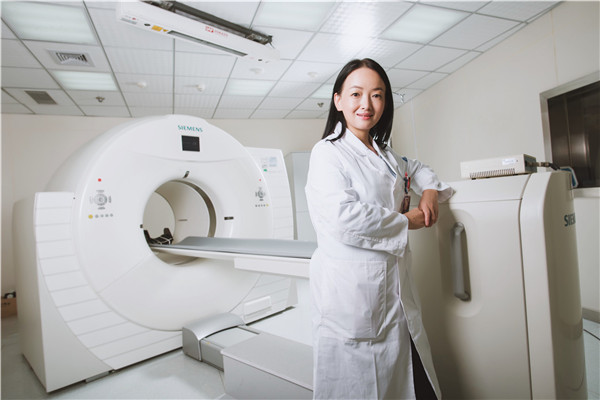
Doctor Tian Mei stands next to a PET-CT scanner at Zhejiang University Medical PET Center. [Photo provided to China Daily] |
Seeing a new major that combines medicine and physics on the syllabus in the 1990s was a tipping point for then-medical graduate Tian Mei. She might have otherwise followed her parents' wish and become either a surgeon or a gynecologist.
"I felt I was born for nuclear medicine," Tian says. "I have always been fascinated by physics and eager to explore the unknown world."
Tian embarked on her academic journey in nuclear medicine and became an admirer of Polish-born French female physicist Marie Curie, a Nobel laureate.
After 12 years of research, the professor of diagnostic imaging and nuclear medicine at Zhejiang University School of Medicine can see a bright future for China's modern medicine.
On Feb 28, in honor of her cutting-edge research in positron emission tomography (PET), a molecular imaging system, the 44-year-old was honored with the China Young Women in Science Award.
Tian's research in the new application of PET in studying injuries to the central nervous system and general brain functions measures up to leading world standards. It has also been applied in a dozen major Chinese hospitals, according to an official video released by the judging panel.
Nine other female scientists also won the award this year. The event, aiming to encourage women in science, was jointly held by the All-China Women's Federation, China Association for Science and Technology, China's National Commission for UNESCO and L'Oreal (China) Ltd.
"Every important moment is a new beginning," Tian said after receiving the award in Beijing. "I have moved from a decade in cancer research and diagnosis to neurology, which is charming and mysterious."
Unlike the traditional imaging techniques CT and MRI, which exhibit people's anatomical structures (location, size, density and so on), PET can focus on underlying biochemical processes such as the metabolic activity of tumors. Two decades ago, China was way behind the game and there was only one PET system in the country.
Seeing PET's potential in clinical diagnosis and treatment, Tian enrolled to Japan's Gunma University to study diagnostic imaging and nuclear medicine.
"What I wanted was to master the technology at a clinical level and come back to serve the country," she says.
Tian's professor Keigo Endo was impressed by her motivation. She became the only international student who had access to one of the four PET scanners in Japan. "I was really lucky to meet such a great professor and to participate in a lot of clinical training."
Tian's rigorous attitude and perseverance in research won her the trust of Endo and other academics in the field. She later became a research fellow at Harvard Medical School and an assistant professor at the MD Anderson Cancer Center in the United States.
"China, Japan and the US have different characteristics in terms of medical systems," says Tian. "Seeing the differences enabled me to absorb the essence and better serve the patient."
In 2011, she came back to her homeland. She was among 143 young experts enlisted in the national global experts recruitment program, the 1,000 Talent Plan.
As one of the first batch of young experts, Tian built everything from scratch.
"Initially, I was the only one on the team at Zhejiang University School of Medicine," she says. "My challenges also included staff recruitment, setting up research facilities and getting funding."
But Tian's dedication and commitment in nuclear medicine and molecular imaging quickly earned her praise.
Meeting Tian at a national conference, graduate student Wu Shuang became an admirer and chose to be Tian's first PhD student.
During her four-year study at Zhejiang University, Wu always saw Tian showing up at the laboratory before 8 am and often working until midnight.
"She is a beacon for my academic endeavors," says Wu, a doctor of nuclear medicine at the Second Affiliated Hospital of Zhejiang University School of Medicine. "She trained us to be accurate and maintain academic integrity as well as to be efficient collaborators."
Wu's paper, written under Tian's guidance, was later published in the Journal of Nuclear Medicine, an international leading publication in the field.
For Wu, Tian is also a good friend who gives her constant encouragement.
"She tells me getting a PhD means confronting various kinds of hardships. But if I keep the momentum I will be able to see a better future and better world," Wu says.
Despite her young age as a female scientist, Tian is now a founding member of her field in China and the director of a leading laboratory.
Tian is convinced that medical molecular imaging will be one of the key technologies for China's "precision medicine", a new approach for disease prevention and treatment.
"In the future, many doctors will combine this technology with bioinformatics and genomics to offer patients a comprehensive diagnosis and treatment plan."
Like many career women, Tian has a family. Her 15-old-year son will soon sit for zhongkao, or senior high school entrance examination. Tian says she sends her son to school every day and tries to spend as much as time possible with him.
"Sometimes I take him to my hospital where he also gets the chance to see what my students have been doing," Tian says. "He told me that he wants to be my PhD student in the future."
Zhang Hong, chairman of the department of nuclear medicine at Zhejiang University, sees Tian as a leading figure in molecular imaging.
"It's more impressive for a female scientist to have such achievements," Zhang says, "as they usually not only need to share the responsibility of teaching, research and treating patients like most male scientists do, but also shoulder immense family responsibility."
Contact the writer at zhangzefeng@chinadaily.com.cn