Comments
  Print
Print  Mail
Mail  Large Medium Small
"The bank is bumpy, watch your step!" says an old woman on a donkey's back.
"Be reassured please!" answers her servant.
The conversation is one of more than 700 simulated dialogues in 54 scenes from the electronic version of the famous Chinese painting Qingming Festival by the Riverside on display in the Palace Museum.
The voice, together with the dynamic effect and painting details in high definition, brings the audience back 800 years. It is an outstanding example of modern technology enhancing the museum experience.
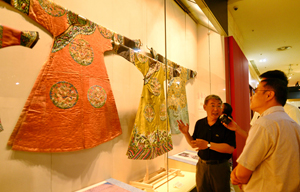
In recent years, digital technologies have not only given new life to ancient works, like the painting, but have become an important bridge between museums and the public.
The Internet, two-dimension codes, 3-D modeling and virtual guiding are playing increasingly important roles in facilitating Chinese museum operations and services.
For example, Tencent, a giant Internet company, recently launched a website that provides vista views of nearly 100 museums in China, giving the viewer a sense of immersion while visiting each museum on the site.
By scanning a two-dimension code, they can also get the address and street view of every museum, and receive navigational help.
The international trend of digitalization for museums began in the mid-1990s. The Palace Museum, the National Museum of China, and Shaanxi History Museum were the pioneers in China.
The "Digital Palace Museum" opened to the public in 2001. Since then, a number of digital museums have sprung up.
Baike Digital Museum, launched on Baidu Baike, a Wikipedia-like platform, has been the biggest and most popular digital museum display platform in China.
It was first launched cooperatively by Baidu Baike and eight Chinese museums in May 2012. About 30 museums have joined.
Since it was launched, the website has recorded more than 5 million visits. It has brought in services like voice introduction, virtual simulation and 3-D display of the exhibits.
According to Wang Huimin, curator of Jinlin Museum of Natural History, the most attractive thing about a digital museum is that it allows people to enjoy exhibitions without going beyond their doors.
Some digital museums, such as that of the Democratic Parties History Museum of China based in Chongqing, provide a "wheelbarrow" viewing experience.
While exploring its virtual exhibition halls, audiences can stop by anytime to get related information of any exhibit by clicking on it - just like taking down your favorite item from a supermarket shelf.
"Digital museums can spark interest and attract people to the museums to see the real pieces," says Huang Moqiao from the Palace Museum's Research Institute of Digital Application.
Digitalization also makes it possible to display some relics that are normally unable to be seen by the public, according to Huang.
It is estimated that 12 million heritage pieces have been collected by different Chinese museums, and every year a considerable amount of relics are excavated. Only a small portion of them can be displayed due to limitations of space and preservation condition.
Many lower-level museums have also sought to make use of the fast-developing mobile Internet and related technology.
For example, Nanjing Municipal Museum has been providing two-dimension code guiding since November 2012. Audiences can access pictures and a written introduction of its more than 40 first-class heritage pieces by scanning the codes with smart phones.
Likewise, Guangdong Provincial Museum has launched a public account on Weixin (an instant-messaging app) earlier this year.
By typing in a serial number of an exhibit, audiences can get a detailed voice, picture or video introduction of it. They can also get other information, such as the museum's opening time, ticket, exhibitions, traffic, on the platform.
Currently, most Chinese museums have tried to provide basic digital services like micro blog message delivering; some of them have established online exhibition halls.
However, limited by the considerable funds and digital professionals needed, few smaller museums can afford to develop their own apps, Weixin services or digital museum.
|
|
|

Copyright 1995 - 2010 . All rights reserved. The content (including but not limited to text, photo, multimedia information, etc) published in this site belongs to China Daily Information Co (CDIC). Without written authorization from CDIC, such content shall not be republished or used in any form. Note: Browsers with 1024*768 or higher resolution are suggested for this site.
License for publishing multimedia online 0108263 Registration Number: 20100000002731