Comments
  Print
Print  Mail
Mail  Large Medium Small
|
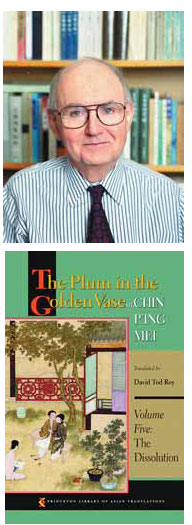
Top: David Tod Roy, professor of Chinese literature at the University of Chicago. Above: The cover of the fifth volume of The Plum in the Golden Vase, a Chinese classic literary work from the 16th century. The book has been seen as erotic and banned in China for a long time. Photos Provided to China Daily |
In an office littered with thousands of notes inscribed on stacked paper flash cards, David Tod Roy has labored on what he calls his "life's work" for three decades.
Painstakingly poring over a 16th-century novel that in woodblock form ran more than 3,000 pages, the University of Chicago professor of Chinese literature has devoted the bulk of his career to the translation and annotation of Chin P'Jin Mei, or The Plum in the Golden Vase.
Written anonymously, the work focuses on a corrupt mobile merchant and his harem of six wives and concubines. While the book is most often recognized for its erotic realism, The Plum in the Golden Vase is a landmark book not only in the history of Chinese literature but world literature, Roy says. Its role in shaping the later (and arguably most famous of all Chinese novels) A Dream of Red Mansions is undeniable, he says.
"It's an extremely significant book," he says. "Every time I've taught this book, I've become more convinced of its importance and impressed by its rhetorical sophistication. Some people have viewed it purely as an erotic novel, but at the time it circulated among members of the educated elite and the literary avant-garde, who all recognized it for being a work of literary genius."
He first became aware of the novel as the teenage son of Presbyterian missionaries in Nanjing and Shanghai, where he studied at the Shanghai American School with his brother, former US ambassador to China J. Stapleton Roy. He later taught the work at Princeton University and the University of Chicago.
The Plum in the Golden Vase was groundbreaking for its focus on ordinary life in a middle-class family; earlier Chinese literature had focused only on emperors, powerful officials or figures in mythology. The book's incredibly detailed descriptions of daily life, dress, cuisine, legal malfeasance and yes, sexual activity - all make it a "rich sourcebook for any student of 16th-century society", Roy says.
As a language resource, the book is also remarkable for having documented the era's vernacular, from the refined speech of the elite to street slang and cuss words, he says.
But in keeping with a tradition that is entirely Chinese, the novel is more than the story at its surface, Roy says.
In Chinese literature, poets and novelists have often veiled their criticisms by not only changing the time period depicted in their work, but also through the use of metaphor and allusion. In The Plum in the Golden Vase, the merchant at the center of the plot likely stands for the emperor at the time the author was writing, Roy says. The six women of his household represent the six bureaus at the head of the imperial bureaucracy.
"The ancient Confucian belief was that if an emperor led a moral life, that would have a favorable effect on all of society, with the opposite being equally true: If the emperor was immoral, that would have a bad effect on the morals of the entire society, and you see that in smaller form with this family in the book," Roy says. "The author clearly believed that Chinese society at the time was corrupt from top to bottom, but employed criticism by indirection, as many writers did."
Although the novel was previously translated by Clement Egerton in 1938 (under the title The Golden Lotus), that version appeared partially in Latin (due to the sexual nature of the novel) and was more of a paraphrase of the book. With this translation, Roy has attempted to remain faithful to the original novel's text.
In the New York Review of Books, critic Jonathan Spence wrote: "Roy has made a major contribution to our overall understanding of the novel He has annotated the text with a precision, thoroughness and passion for detail that makes even a veteran reader of monographs smile with a kind of quiet disbelief."
David Rolston, a professor of Chinese literature at the University of Michigan who studied with Roy at the University of Chicago, noted the translator's mastery of both Chinese and English vocabulary and style.
"He is incredibly successful in finding dynamic equivalents between the languages," he said. "He has a magnificent control of language that you don't find in younger generations. This book has been a constant companion for him, and it's truly amazing to see someone whose entire career has been focused on one work at this level. Additionally, he has an enormous knowledge of previous literature."
The thousands of pop culture and literary references that appear in the original novel were mostly uncited. Roy traced and documented the original sources in a way that illuminates the book further than any other study has done, Rolston said. Those sources appear in Roy's translation as footnotes.
Roy compared the author's use of earlier works to the manner in which an artist might create a mosaic, and noted that the author James Joyce also injected his work with songs and references of his time.
He is extremely pleased with the increased interest in Chinese literature among Western readers, he says. He says that when he was a student, there were only four or five universities in the US with China programs.
"Things have changed very radically in the last half century, and needless to say, that's a very good thing," he says.
|
|
|

Copyright 1995 - 2010 . All rights reserved. The content (including but not limited to text, photo, multimedia information, etc) published in this site belongs to China Daily Information Co (CDIC). Without written authorization from CDIC, such content shall not be republished or used in any form. Note: Browsers with 1024*768 or higher resolution are suggested for this site.
License for publishing multimedia online 0108263 Registration Number: 20100000002731