Comments()
  Print
Print  Mail
Mail  Large Medium Small
The research she undertook uses a transnational theoretical framework and comparative methodology to analyze a cross-cultural and cross-media phenomenon.
She uses open-mindedness, tolerance and curiosity to overcome the cultural barriers she encounters as a newcomer to the field.
Related: Let's learn Chinese
"With these, you are willing to learn to get to know one another," she says.
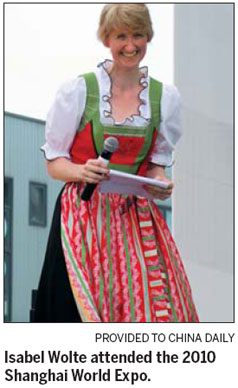
"Talk to people. Individual people in China, as well as in Austria, are generally very friendly and considerate. Once you think of people as individuals, it becomes more difficult to develop stereotypes, more difficult to discriminate against anyone. For foreigners in China, I suggest they try to learn some Chinese: even just a few words in Chinese can make all the difference."
Wolte is blunt about the positives and negatives of China's "thriving" film industry.
"More and more films are being produced, the budgets are larger than ever and the number of cinemas and screens is increasing day by day," she says.
"But, at the same time, development is scattered and inconsistent, the quality of both high-budget and low-budget productions is varied, and the system is not clearly defined.
"In particular, the distribution for smaller budget or art house films is not guaranteed in any way, and many of the films produced are never shown in public. This is a shame."
Sino-Austrian film cooperation is another task she is committed to. To this day, there have only been two genuine Sino-Austrian co-production films, she says, to which both sides contributed financially and creatively to the project.
The first, Children of the World, was made in Shanghai in 1941 by the Chinese director Fei Mu and Austrian film pioneers Luise and Jakob Fleck.
"Throughout their lives, Luise and Jakob Fleck contributed tremendously to the development of Austrian and German cinema from its early stages," she says.
Since Jakob was Jewish, they had to flee to Shanghai in 1939, the Shanghai International Concession being one of the only places left that Jewish refugees could be safe. There, they met Fei Mu and encouraged him to cooperate with them.
"The film Children of the World is a reminder of the strength of some individuals, and it tells a universal story of helping one another, sacrifice and, in the end, hope," she says.
The second Sino-Austrian co-production, On the Other Side of the Bridge, directed by Hu Mei, was released in 2003. Isabel and her mother are actively working to initiate new co-productions. They currently have two scripts in the preparatory stage.
"In general, co-production in the real sense is difficult because it requires understanding and compromise from both sides, while, at the same time, trying to achieve universal standards with a story of universal interest," she explains.
"This is very difficult to do, but when successful, certainly worth all the effort. Also, on a personal level for all people involved, this can be a truly valuable experience."
Last year, Wolte started giving lectures at both the University of Vienna and Beijing Film Academy.
In Austria, she teaches classes on Chinese cinema.
It is rewarding because Chinese cinema history isn't well known, and the films are enjoyable and accessible means of understanding another culture, she says.
"My classes vary every year, so, during preparation, I also learn more about certain aspects of Chinese cinema," she says.
"For example, starting in November, I will teach a class specifically devoted to the Fourth Generation of filmmakers in China and their beautiful, warm style."
In China, she teaches a regular English class to PhD students at Beijing Film Academy. This gives her the opportunity to get to know scholars of Chinese film.
"We have very interesting discussions in class," she says.
"I have also taught a class on intercultural communication at Beijing Foreign Studies University, which was similarly rewarding."
Contact the writer at zhanglei@chinadaily.com.cn.



Copyright 1995 - 2010 . All rights reserved. The content (including but not limited to text, photo, multimedia information, etc) published in this site belongs to China Daily Information Co (CDIC). Without written authorization from CDIC, such content shall not be republished or used in any form. Note: Browsers with 1024*768 or higher resolution are suggested for this site.
License for publishing multimedia online 0108263 Registration Number: 20100000002731