Comments()
  Print
Print  Mail
Mail  Large Medium Small
 |
|
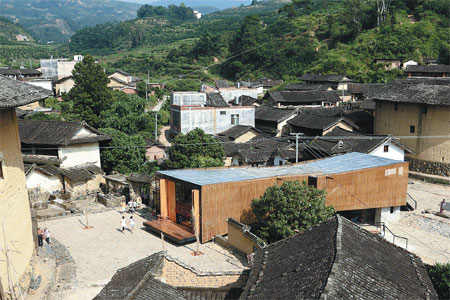
The "bridge school" has become a new landmark at Xiashi village in Pinghe county, Fujian province. Photos by Lan Tianyi / for China Daily |
 |
|
Slim timber slats are used to cover the steel frame of the "bridge school" to filter light and air. |
Challenged to restore a sense of harmony between warring clans, an architect's team spanned a deep creek with a structure where people could study and read, Sun Li and Hu Meidong report in Zhangzhou, Fujian province.
Local taxi drivers in Pinghe county, Zhangzhou, Fujian province are surprised that visitors to the county's Qiling township are not just coming for the honey pomelo, the well-known specialty fruit of the region.
Instead, the latest attraction is a modern building known as the "bridge school", in the tranquil Xiashi village divided by a steep-banked creek.
Traversing the winding stream, the two-level structure was recently been shortlisted by Britain's Guardian newspaper as one of "the world's greenest projects". It forges a link between two tulou, the fortress-like earthen communal houses of the Hakka people that are some 300 years old.
The only Chinese work in the Guardian's picks of the most innovative sustainable architecture worldwide, the bridge school has a pair of airy and bright classrooms on top, and a Z-shaped narrow pedestrian bridge suspended from steel cables at its base.
Designed in 2008 by Li Xiaodong, an architecture professor at Tsinghua University, the 28-meter-long and 8.5-meter-wide unit, which covers 240 square meters, took the construction team one year to complete and cost only 650,000 yuan ($104,260).
Li says the project's uniqueness lies in its style and function.
"In contrast to the local courtyards and tulou, the steel frame wrapped in a veil of slim timber slats that filter light and air is an entirely contemporary take on the archetype of an inhabited bridge," Li says.
It connects two ancient buildings from across the creek. It is a place for primary-school children to read and study, and is also a playground when class is over. One classroom with an accordion door can be transformed into a stage, after the desks are removed.
"Although the space is limited, it's multifunctional," Li says.
According to the architect, the whole project started when one of his friends wanted to donate some money for a charity project.
But the idea to locate the project in Xiashi village came from one of Li's students, Chen Jiansheng, who later supervised the construction.
Chen, now an architect based in Zhangzhou, suggested that Li build it in Fujian province, the home of many traditional tulou.
Born in a tulou in a town near Qiling, Chen has been dedicated to preserving the structures since he learned that the one he grew up in had become so dilapidated that it collapsed.
"The initial idea was to use tulou as the background of the project, to offer an architectural solution to sustain an old community," Chen says.
After months of field research, both Li and Chen were attracted by the Xiashi village site.
It turned out that two rival clans, one surnamed Lin, and the other Shi, had once lived in tulou on opposite sides of the creek. They had held a grudge against each other for centuries, and a structure connecting the two sides of the creek would forge a new sense of harmony.
"With economic development, people moved out of tulou and lived in new houses. The village's former public space in tulou is gone," Li says, adding that he had attempted to rebuild a public space and reinvigorate the village.
Based on the premise that the young represent the future of society, Li finally came up with the idea of designing a bridge school so that the project would be rich in symbolic meanings that blend the past, the present, and the future.
Despite financial support from the donor and the county government, the project still faced obstacles, Chen recalls.
First, the planners didn't engage the residents.
"The local villagers knew nothing about the project and thought we were a bunch of real estate developers," Chen says.
Some public toilets blocked the way for delivering materials. They needed to be demolished and rebuilt somewhere else, but a few villagers boycotted the demolition.
"I had to explain to them time and time again," Chen says, adding he called for help from the county government so frequently that the officers were probably tired of seeing him.
Given the limited budget, Chen made a serious plan to cut expenses. Most materials, including wood and stone, were obtained right in Xiashi village. Chen also hired local villagers as construction workers.
The painstaking efforts paid off: In 2010, the bridge school received Aga Khan Award for Architecture, a prestigious honor in the architecture field.
The award's website referred to the structure as "the physical and spiritual center of what was a declining village".
Shi Maohuo, a local villager who helped with the project's logistics and now operates the bridge school, says he feels it has breathed new life into the village.
"I was glad to see children take lessons amid chirping birds and the murmuring of the creek," the 73-year-old says.
At the end of 2011, all the children of the village were sent to the school in Qiling, and the classroom turned into a library filled with books ranging from literature, history to agriculture - all donated by the county government.
"Even when school is over, the educational function continues," Shi says. "Not only children, but also adults, come here to read books."
Due to the award and the Guardian's recognition, the bridge school has begun to attract tourists and architecture buffs. Shi says he is now pleased to be playing the new role of interpreter.
Qiu Shi, a teahouse runner based in Zhangzhou and a member of an online backpacker club, visited the bridge school on Nov 18.
He says it's amazing that one can feel the gentle breeze in the library and listen to the sound of running water underneath.
Li Xiaodong says it is acceptable for the bridge school to become solely a tourist spot someday.
"The function of architecture with vitality will evolve with time. When it is no longer a school, it will show yet another facet of value," Li says.
Contact the writers through sunli@chinadaily.com.cn.



Copyright 1995 - 2010 . All rights reserved. The content (including but not limited to text, photo, multimedia information, etc) published in this site belongs to China Daily Information Co (CDIC). Without written authorization from CDIC, such content shall not be republished or used in any form. Note: Browsers with 1024*768 or higher resolution are suggested for this site.
License for publishing multimedia online 0108263 Registration Number: 20100000002731