Comments()
  Print
Print  Mail
Mail  Large Medium Small
Few Chinese authors have had the chance to compete for the Nobel Prize for Literature because of the lack of nominations from China, says Kjell Espmark, a Nobel Committee member.
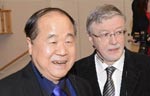
Espmark visited Shanghai to launch his novel in Chinese, on Oct 24. Amnesia, Espmark's first volume of seven in a collection called Age of Oblivion, has just been published in Chinese by Shanghai Century Literature Publishing House.
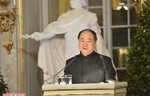
As one of the five members of the Nobel Committee, Espmark shared his observation about the world's most prestigious literary award, the latest Nobel laureate Mo Yan, and literature in general.
The 82-year-old has been one of 18 members of the Swedish Academy since 1981, which annually decides the winner of the Nobel Prize for Literature.
All literature professors, pen clubs, writers' unions and previous Nobel laureates have the right to nominate.
"We've been sending letters to China's Writers' Association every year, but they never made a nomination," Espmark says.
The first Chinese author to be considered for the Nobel Prize for Literature was Lu Xun (1881-1936). Swedish explorer and writer Sven Anders Hedin asked Lu Xun about it, but the writer declined the proposal, saying, "I don't want it. I'm not worthy of it." He died soon after that, in 1936.
Another Chinese writer "very close to winning it" was Shen Congwen (1902-88). "He was the favorite of the judges," Espmark says. "If he hadn't died during the process, he could have won it."
Espmark explains the decision making process of the Nobel Prize for Literature. After receiving nominations, the Nobel Committee will see if there are any great contemporary authors left off the list.
"If there are gaps, we five members of the Nobel Committee will add more names to fill them up."
By the beginning of February when the nomination is completed, there are about 200 names on the list, all good contemporary authors.
Then, Espmark and his four colleagues of the Nobel Committee will narrow down the nomination list to five or three authors, after which the academy members read their works, before September, when the Swedish Academy will meet and discuss.
"The five of us, we propose. The academy of 18 members discuss and decide," Espmark says. "The saying that any single member can decide who will win the prize, is nonsense."
Espmark says it was a coincidence that he visited China right after the first Chinese citizen won the Nobel Prize for Literature, as his plan to visit was made as early as March.
He was surprised to find many people were angry about Mo Yan winning, and he went on to explain the Swedish Academy's comment about Mo Yan's work, which said "with hallucinatory realism (Mo Yan) merges folk tales, history and the contemporary".
"It was an intentional choice to avoid using the phrase 'magical realism', which was a worn-out term, and the literary wave has passed," he explains. "We didn't want to give Mo Yan the wrong associations with Latin American Magical Realism writers."
Mo Yan has referred back to the literary traditions of China, that of storytelling, and old fairy tales. Then he combined the tradition with modern realism. The combination of the fantastic and realism was his own invention.
"He concentrated many landscapes in the world - desert, high mountains, which don't exist in the actual Gaomi county of Shandong province, making it universal geography, concentrated in this book. And history too, is concentrated in his novels. As a result his people are not only villagers in a remote county, but universal people.
"To my mind, the work of literature is to create a small world, which will then have its own value, and readers will experience it at its own conditions. At the same time, literature also has a double function. It forces reality to show its face. That's the real importance of literature," Espmark says.
The Nobel Prize for Literature is free of political influences, though an important international prize always has political effects, he says.
Thanks to the Nobel Prize, more people know about Mo Yan and his works, and the interest in contemporary Chinese literature is growing rapidly, says Chen Maiping, translator of Espmark's latest published works in Chinese.
zhangkun@chinadaily.com.cn



Copyright 1995 - 2010 . All rights reserved. The content (including but not limited to text, photo, multimedia information, etc) published in this site belongs to China Daily Information Co (CDIC). Without written authorization from CDIC, such content shall not be republished or used in any form. Note: Browsers with 1024*768 or higher resolution are suggested for this site.
License for publishing multimedia online 0108263 Registration Number: 20100000002731