Comments()
  Print
Print  Mail
Mail  Large Medium Small
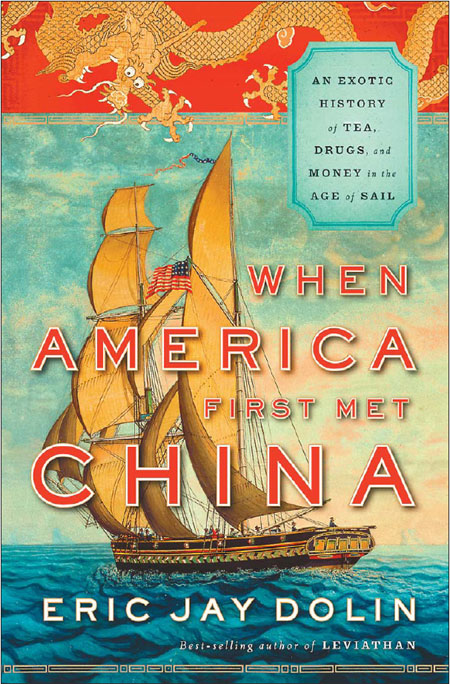
A US author examines China's trade with his homeland from the time of colonial America. Kelly Chung Dawson reports in New York.
After the colonists of New Netherland introduced tea to what would eventually become New York, the import spread quickly through the American colonies.
By the 1770s, Americans were estimated to have been drinking up to 1.3 billion cups a year.

A burgeoning trade relationship with China helped feed that demand, which - along with a Chinese desire for sea otter pelts and sandalwood - fueled further exploration and trade between the two cultures.
In When America First Met China, author Eric Jay Dolin traces the history of that relationship, which began when the Empress of China set sail on Feb 22, 1784, with a crew of 42 men under captain John Green. In the century that followed, trade with China was vital to US economic growth, Dolin argues.
"It helped create the nation's first millionaires, instilled confidence in Americans in their ability to compete on the world's stage and spurred an explosion in shipbuilding that led to the construction of the ultimate sailing vessels - the graceful and exceedingly fast clipper ships," Dolin writes.
In those years, the United States bought tea, silk, porcelain and other exotic items from China. The Chinese wanted sea cucumbers, furs and, strangely, a less potent (and less expensive) form of ginseng grown in New England's mountains and forests.
In response to China's increasing visibility today, the author set out to write a thorough history to provide context for what he views to be the most important relationship in US foreign policy, he says.
"Our relationship with China did not begin 40 years ago," Dolin says.
"It goes back to the origins of our country. It has been a long relationship and, in most ways, a positive one. We should understand that this fixation on China was in the beginning an exclusively economic interest - we looked at them as a way to pump up our economy and to get the goods that we wanted.
"I find that fascinating because, despite the greater connections we have now, those economic ties are still, to some extent, what the relationship is defined by. We had a trade deficit back then, and we have it now. The US' long-held dream about China becoming this enormous marketplace for American goods still remains unrealized."
A fundamental problem that still exists, he argues, is that China was largely self-sufficient. Despite encouraging trade, it has remained less dependent on US goods than vice versa, he says.
And until the British introduction of opium to the Chinese market, that power dynamic defined early US-China interactions.
"The Chinese looked down on foreigners as uncivilized barbarians," he writes.
"That didn't mean, however, the Chinese eschewed contact with foreigners. In fact, they welcomed it and encouraged it. But that contact had to take place within the larger context of Chinese exceptionalism. In other words, the barbarians had to know their place, which was well beneath that of the Chinese."
This led to a series of clashes between the two cultures on Chinese territory in the early years of the relationship.
But the growth of the opium trade, and the subsequent Opium Wars of 1839-42 and 1856-60, which resulted in the Treaty of Nanking and the ceding of Hong Kong to Britain, fundamentally changed the balance of power, he writes.
"China was for thousands of years the premier country or empire in the world, but by the end of the 1700s and the early 1800s, that imperial structure began to crumble," he says.
"When the Americans went over, they didn't witness the highest level of imperial Chinese splendor. They had a jaundiced and condescending view of the country."
Dolin first became interested in the history of US-China trade while researching his 2011 book Fur, Fortune and Empire: The Epic History of the Fur Trade in America.
That history included details of early business transactions between Native Americans and American traders, who sold seal and sea otter pelts to eager buyers in China's Canton (now Guangdong's provincial capital Guangzhou).
"That was my first inkling that there was something interesting about trade relations between China and the US," he says.
"Whenever I write a book, I almost always pick a topic that I don't know a lot about. I want to remain interested and excited, so that not only is the reader surprised by the material, but so that I am also continually surprised."
What startled him most was the history of American involvement in the Opium Wars, he says. The details of those wars are common knowledge in China, and yet the average American knows "next to nothing" about that history, he says.
"Americans were very involved in nurturing the drug trade and were in the thick of it during the wars," he says.
"But here in the US, we don't learn about them. That was just a total surprise to me and one of the most dramatic parts of the book to write because it's a very dramatic story."
And it's one that he feels bears lessons for Westerners in dealing with China, he says.
"It's important that we acknowledge that this traumatic period of history took place," he says.
"Modern China does not have amnesia when it comes to the 1800s. I am not Chinese, but I've heard several people make the argument that when Westerners are very aggressive in their relations with the Chinese, Chinese might, to some extent, view those actions through the lens of the Opium War.
"It's a painful history for China, so the Chinese might be particularly sensitive to being bullied or pushed around by the West. It's important to understand that. How a businessman or politician might internalize that to make decisions is up to them.
"My objective is only to illuminate history so that people today can take that background and put it in their own framework to better understand the people they're dealing with today."
Dolin's research was drawn from hundreds of books, articles and archives that were often available online.
In the closing chapter of the book, Dolin writes: "Although America and China still often view each other unfavorably, and many issues still profoundly divide the two nations, perhaps a respective (and respectful) backward glance over our historic shoulders to see where we have been will enable us to focus more clearly on how far we have come since we first met - and to travel more hopefully into the future."
Although some might write that sentiment off as "Pollyanna gobbledygook", his intentions are earnest, he says.
"We're going to be dependent on each other for many years to come, and I'm genuinely hopeful that we will be partners in the future."
Contact the writer at kdawson@chinadailyusa.com.



Copyright 1995 - 2010 . All rights reserved. The content (including but not limited to text, photo, multimedia information, etc) published in this site belongs to China Daily Information Co (CDIC). Without written authorization from CDIC, such content shall not be republished or used in any form. Note: Browsers with 1024*768 or higher resolution are suggested for this site.
License for publishing multimedia online 0108263 Registration Number: 20100000002731