Comments()
  Print
Print  Mail
Mail  Large Medium Small
 |
|
The ancient wisdom of Laozi is frequently re-interpreted in publications like this one displayed at a bookstore in Yichang, Hubei province. Liu Junfeng / Asia News Photo |

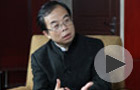
His vision is a world that better understands China. His mission is to start with building bridges in the United States. Zhao Qiguang shares his dreams with Cang Lide.
For the last two decades and more, Chinese-American Zhao Qiguang has given countless talks and lectures on Chinese culture in the United States where he is Burton and Lily Levin Professor of Chinese at Carleton College, Northfield, Minnesota.
To Zhao, international cultural exchanges are no less important than bilateral trade, and he feels there is a definite deficit at the moment.
While China exports more commodities than it imports, the opposite is true when it comes to culture. At the moment, China imports more than it exports and it absorbs more foreign influence at home than it manages to spread its own culture abroad.
That's why Zhao feels it is his responsibility to let the world know more about the rich cultural heritage that China commands from thousands of years of history and philosophy.
Born in Beijing, the 64-year-old Zhao comes from a family with a talent for science - his parents were both physics professors. One year after he obtained a master's degree at the Chinese Academy of Social Sciences in British and American literature in 1981, he went to the US, where he earned another MA and a PhD in comparative literature at the University of Massachusetts Amherst.
Since he started returning to China, he has been a frequent guest on Chinese television and a visiting professor to some Chinese universities, speaking on culture and international relations. For instance, his discussions on Taoism and the philosophy of Laozi on Shanghai and Shandong television were very well received.
These days, "soft power" has become a buzzword in international relations. In Zhao's view, soft power is the international currency of a country that will convince others of its worth.
"You cannot use military or economic influence to force other people to believe what you believe," he says, and China's rich culture, culled from a long and continuous history, is part of that soft power.
"When we say Chinese culture, it seems we often refer to Confucianism only. There are other aspects, such as Taoism, which emphasizes harmony between human and nature, and harmony within man himself.
"It can be very convincing to people outside China because both confront universal problems of modernization, and we all have anxiety when we are faced with the stress of rapid industrialization," he says.
Zhao adds that his American students are deeply curious about Taoism.

"When we practice tai chi, they can feel the inner strength of this philosophy, and they need not be forced into believing. So this is a very typical form of soft power."
Zhao believes the revival of Laozi's philosophy will insert a thundering crescendo into the symphony of the New Age.
As a philosopher who lived in the 4th century BC, Laozi was first in many things. He dealt with universal truths about people's understanding of the world from a special point of view.
For example, in his masterpiece Tao Te Ching, he does not mention a specific person, a specific event or place. He represented man talking with nature, and in this aspect, he is unparalleled.
According to Zhao, Laozi was the first in his time to accord respect to women, and was a precocious forebear of today's feminism. He spoke highly of the power of the yin, the weak, and put forward the belief that the weak, the female, can take over the stronger male.
"He was the first to talk about dialectics, realizing that everything goes into the opposite. Hegel and other philosophers found this out 2,000 years after him."
The professor calls himself a "practical Taoist".
Among his published works in recent years is something named Do Nothing & Do Everything - a summary of the course he teaches in the US.
He tells his readers that tai chi is not only body movement but also mental inspiration.
"So people follow the course of nature, understand the harmony between human beings and nature, and establish a healthy mind. This is the way to understand Taoism, and it is also the Taoist way to health and longevity."
Zhao says like any ancient Chinese wisdom, Taoism is of universal value and may offer answers to modern problems.
"Confucius emphasizes social structure, success, consequence - if you work hard you'll be paid; if you raise good children you'll get filial piety; if you are loyal and a good scholar you'll be recognized by the emperor. Good. The Chinese used this for thousands of years for success," he says.
But Zhao says we should not focus only on success.
"If we focus only on success all the time, we'll pay a great cost because we ignore other things, such as health, harmony, and interpersonal relationships."
He says modernization has also damaged the environment.
"Laozi tells us to respect nature. We don't want to conquer it but to appreciate and coexist with it. So Laozi is the first environmentalist. There is a lot that the world can learn from him today."
In Zhao's view, China must step up cultural exchanges with major world partners, such as the US.
"When two big powers like the US and China coexist, we must have a flow of ideas, of knowledge, of personnel, of capital. People live on ideas. Material things disappear but ideas last.
"You add love to a house and it becomes a home. You add truth to a school and you have education. You add ideas to the world and you have civilization. You put all of them together and you have a future."
That is his dream, that he can build cultural bridges between the two countries, between the East and West.
"I believe Taoism is a universal ideal and that China can present its ideals of nature, harmony and beauty to the world, and the world will listen.
"I believe I can contribute by teaching about how we think, and I believe this is the peaceful way to spread Chinese soft power."
Contact the writer at canglide@chinadaily.com.cn.



Copyright 1995 - 2010 . All rights reserved. The content (including but not limited to text, photo, multimedia information, etc) published in this site belongs to China Daily Information Co (CDIC). Without written authorization from CDIC, such content shall not be republished or used in any form. Note: Browsers with 1024*768 or higher resolution are suggested for this site.
License for publishing multimedia online 0108263 Registration Number: 20100000002731