Comments()
  Print
Print  Mail
Mail  Large Medium Small
 |
|
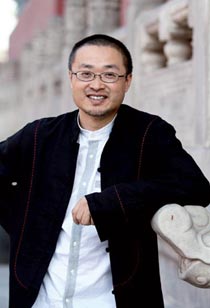
Zhou Bing, director of documentary The Emperor's Secret Garden. Provided to China Daily |
Related: Qianlong's secret garden, Perfection is part of the process
Zhou Bing still feels moved when he recalls entering the long-sealed-off retirement lodge of Emperor Qianlong (1711-99) - Juanqinzhai, the most mysterious and best preserved of Forbidden City structures, which remains off-limits to the public.
Zhou says the only thing more inspiring is being able to share this with the world in his newest documentary, The Emperor's Secret Garden.
Juanqinzhai was Qianlong's retirement gift to himself.
Its construction conscripted the best craftspeople of the time, making it the period's crown jewel of interior design.
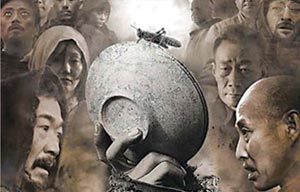
Zhou's documentary records the repair of Juanqinzhai by the Palace Museum and the World Monuments Fund (WMF).
It aired on Sky TV in the United Kingdom and was shown at the Palace Museum in April. China Central Television (CCTV) and Beijing Television will show it in the coming two months. The DVD will be released after the broadcasts.
Shooting began in 2007, a few years after the restoration began.
But Zhou had been filming the imperial palace since 2003, when he began preparing his 12-episode documentary, The Forbidden City, which was a nationwide hit in 2005.
He believes his latest documentary was fateful.
"The first scene I shot for The Forbidden City was right outside Juanqinzhai," the 44-year-old recalls.
Zhou was familiar with the building but was excited to experience some of the behind-the-scenes action, which provided him with knowledge he "had no way of knowing if not for shooting the documentary".
He was especially intrigued by the Palace Museum's efforts to find the handful of unknown craftspeople, who sustained dying forms of craftsmanship used in Qianlong's lodge, or were able to revive previous practices.
"People from older eras spent many years on one task without commercial purpose," Zhou says.
"We've lost that spiritual quest in this age. I'm glad to see it again in the restoration."
And the documentary is based on the same principle, he says.
"It's a matter of conscience," he says.
"I consider it my mission to visually document China's achievements for future generations."
Zhou also praises the museum's cooperation with the WMF - its first large-scale engagement with the West.
"The Palace Museum has provided an open platform to welcome the most advanced experience and opinions from other countries to help better preserve world heritage," he says.
"The restoration of Juanqinzhai symbolizes cross-cultural exchange and exemplary cooperation in cultural heritage conservation. The project was to bring to life some of the most exquisite arts and crafts created during Emperor Qianlong's reign," says Ted Lipman, CEO of the Robert H. N. Ho Family Foundation, a Hong Kong-based NGO that promotes Chinese arts and culture and is one of the documentary's co-sponsors.
Matthew Hu, project operation director of The Prince's Charities Foundation (China) - the other sponsor - says: "It is our foundation's core notion that these traditional (forms of) craftsmanship are the essence of human civilization and should be passed down to future generations. Not only in China, but globally, it is an integral part of people's cultural identity."
He also points out: "The systematic documentation of this project will not only provide a solid foundation for future research but also help to revive some of the most authentic traditional (forms of) craftsmanship. We hope that experiences learned from this best practice can be followed by many other heritage restoration projects throughout China."
The documentary's executive producer, Andre Singer, says the ability to save such traditional craftsmanship for future generations is a "wonderful achievement".
Zhou says The Emperor's Secret Garden is merely a glimpse at the vast amount of footage he and his crew have shot throughout the years.
He plans to use undistributed footage from previous shoots to create another documentary that will run for at least three episodes, he says.
"The new one will zoom in on details and show the restoration's every step," Zhou says.
"It will also include a strong narrative."
It's expected to air on CCTV and other local channels after it's finished by year-end.
"My spiritual conversation with the Forbidden City will continue," Zhou says.
"It nourishes me."
zhangzixuan@chinadaily.com.cn



Copyright 1995 - 2010 . All rights reserved. The content (including but not limited to text, photo, multimedia information, etc) published in this site belongs to China Daily Information Co (CDIC). Without written authorization from CDIC, such content shall not be republished or used in any form. Note: Browsers with 1024*768 or higher resolution are suggested for this site.
License for publishing multimedia online 0108263 Registration Number: 20100000002731