Comments()
  Print
Print  Mail
Mail  Large Medium Small
 |
|
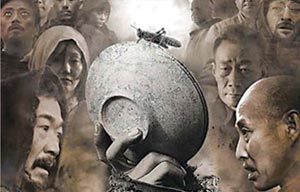
An 1877 music box, far left, with Chinese airs that may have inspired Puccini. Above, the Metropolitan Opera's "Turandot" in New York. Tune sheet for a circa 1877 Swiss musical box with Chinese melodies. Marty Sohl / Metropolitan Opera; center and below, Morris Museum, Morristown, New Jersey |

On a visit last winter to the Morris Museum here, I lingered in the room where the Swiss music boxes are displayed. As I listened to one box, a harmoniphone from around 1877, equipped with a reed organ and able to play six Chinese tunes from a cylinder, I suddenly realized I had stumbled onto the key to a musicological mystery.
It is known that Giacomo Puccini used Chinese tunes in his opera "Turandot" (set in China and left incomplete on Puccini's death in 1924). But scholars have been puzzled by the origins of two "Japanese" tunes in his "Madama Butterfly" (set in Japan and first performed in 1904).
What I had found were Chinese sources for two major themes in "Butterfly" and a surprising connection between the two operas.
Was it possible that Puccini had heard this very box in Italy and that it provided inspiration for "Madama Butterfly"?
We know he heard a "Chinese" music box in 1920 at the Bagni di Lucca home of Baron Edoardo Fassini- Camossi, a veteran of the 1900 Boxer Rebellion in China. The baron probably acquired this box and other souvenirs in China at the notorious "loot auctions" that followed the suppression of the Boxers.
Opera lovers have long known that three tunes from the Fassini music box, now in the private collection of Lionello Ghiotti in Italy, were featured in "Turandot." The most famous Chinese song, "Mo Li Hua" ("Jasmine Flower"), signals the seductive and glorious aspects of the Chinese princess Turandot; another accompanies the entrance of the three ministers; a third serves as an imperial hymn.

The box at the Morris Museum, from the Murtogh D. Guinness Collection, includes two of the "Turandot" melodies but also includes a principal theme from "Madama Butterfly." Puccini used several popular Japanese tunes in "Butterfly," but the Guinness box reveals that around 1901 he apparently used Chinese music as well.
For decades, scholars have been stitching together bits of published Japanese songs that Puccini might have seen. Fortunately the Guinness box includes its original tune sheet, listing the song titles in Chinese and in transliteration. The main theme for Butterfly, a geisha, is labeled "She Pah Moh." Cornelius C. Kubler and Ping Wang, Chinese-language scholars, helped identify the tune as "Shiba Mo," or "The 18 Touches." This folk song celebrates 18 parts of a woman's body in explicit detail.
The melody appears prominently in "Madama Butterfly" as Butterfly presents herself to her lustful American bridegroom, Lieutenant Pinkerton, suggesting Puccini knew what the song was about. She sings the whole melody, in the same key as on the Guinness box. The tune also appears at the climax of the Act I love duet.
Puccini's setting of "Shiba Mo" can best be described as sounding like a music box. This is especially true when the tune is heard at a fast clip, as dawn breaks in Act II with Butterfly anticipating Pinkerton's return.
The second musical motif closely associated with Butterfly - heard most prominently when reference is made to her father's death - has also inspired a hunt for its Japanese source. This motif appears in two of the Chinese melodies on the Guinness box. It seems to have gone unnoticed that this mystery motif in "Madama Butterfly" appears in slightly different form in "Turandot" as part of the Emperor's hymn. So the same motif represents an exotic father in each opera.
The opening measures of "Turandot" seem to pick up exactly where the final measures of "Madama Butterfly" left off. How likely is it that Puccini heard the box now at the Morris Museum? Letters made available to me by a descendant of the Fassinis indicate Puccini had known the family long before his 1920 visit. Mounting evidence indicates that the box may also have been owned by the Fassinis and heard by Puccini before he drafted "Butterfly."

The tune sheet on the box bears the name of a Shanghai department store that carried Swiss music boxes in the late 19th century. The title list in Chinese corrects the transliterated order of the last two tunes to match how they actually appear on the cylinder, indicating that someone in China inspected this box. Finally, the name and address of a repair shop in Rome on the tune sheet reveal that unlike most other Swiss-made music boxes exported to China, this one returned to Europe and was even owned in Italy. Mr. Guinness acquired the box by the early 1960s.
Arthur Cunliffe, president of the Musical Box Society of Great Britain, says that in the registry of more than 10,000 music boxes compiled over 30 years, only 13 are listed as playing Chinese tunes. This indicates that few boxes returned to the West. Of those that did, few had the combination of melodies that appeared in Puccini's operas, and fewer still would have passed through Italy. Only the Guinness box presents all the right clues suggesting an encounter with Puccini.
W. Anthony Sheppard, who teaches music history at Williams College, is currently at the Institute for Advanced Study.
The New York Times



Copyright 1995 - 2010 . All rights reserved. The content (including but not limited to text, photo, multimedia information, etc) published in this site belongs to China Daily Information Co (CDIC). Without written authorization from CDIC, such content shall not be republished or used in any form. Note: Browsers with 1024*768 or higher resolution are suggested for this site.
License for publishing multimedia online 0108263 Registration Number: 20100000002731