Comments()
  Print
Print  Mail
Mail  Large Medium Small
 |
|
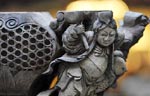
Above: Tang Chuansong, 68, works on an iron picture in his workshop at Wuhu Arts and Crafts Factory. Below: An iron replica of one of Xu Beihong's famous horse paintings. Bottom: Chu Tieyi shows off an iron work he created. Photos by Wang Kaihao / China Daily |


The high aesthetic value of iron pictures has attracted collectors for 300 years. But the unique art form of Wuhu, Anhui province, is losing its luster. Wang Kaihao finds out more.
Sparkles splash at the tip of a strange-looking tool as Tang Chuansong strikes it skillfully against a slender piece of iron in a staccato rhythm. A first-time spectator would probably mistake him for a blacksmith.
But the result of his painstaking hammering is an amazing three-dimensional picture of a leaf, so real, that the veins appear alive. The leaf even moves when the wind blows. It's only a small part of Tang's entire Chinese landscape painting, made from wrought iron instead of drawn using a paintbrush.
This art form is called "iron picture", a craft unique to Wuhu in Anhui province.
"Use the iron as the ink, and use the hammer as the pen," Tang quotes the famous saying in this industry to describe iron pictures, one of the first items listed as a national intangible cultural heritage in 2006.
According to records, the first iron picture was created by blacksmith Tang Tianchi, during the Qing Dynasty (1644-1911). His masterpiece was of flowers. Tang, who lived next to a painter, was inspired by his neighbor's creativity and incorporated art into his ironworks. He later worked together with a painter and printmaker Xiao Yuncong (1596-1673) to refine this art form and like the saying goes, the rest is history.
For 68-year-old Tang Chuansong, artistic talent runs in his blood although it was only recently that he found out he belonged to the same clan as the iron picture creator, when researching his ancestor line.
He says it was by chance that he entered the industry more than 50 years ago.
"I never saw iron pictures before I came to the factory and took the job merely to make a living," Tang says in his 10-square-meter workshop at Wuhu Arts and Crafts Factory. The exhibition hall in the factory is a world of iron landscape paintings and calligraphy works.
Tang says traditional iron pictures mimic the Xin'an School of Painting, which was popular in Southern Anhui in the 17th century. The painting uses simple lines and colors to create a desolate feeling.
"You can never underestimate the simple-looking lines because each one is different and we have to scrutinize the details," Tang explains.
There are, however, some pictures that are iron replicas of masterpieces such as Xu Beihong's (1895-1953) famous horse paintings.
The process of the artistic miracle begins from a picture but, Tang says, the picture is not cast in stone. The artisans are free to use their creativity when creating the iron pictures.
For example, Tang spends much energy on the vivid leaves and branches of his picture, which brings out the individuality of the product.
He also reveals some trade secrets: "For an iron picture, 70 percent is made of forging, but 30 percent is off-fire. When drawing horses, for example, we continue beating the iron slightly till it looks like muscles."
Iron pictures were first introduced to Western countries in the late 19th century by missionaries and won wide recognition in museums worldwide, but at home, years of social unrest took a toll on the amazing creation.
When the local government wanted to re-establish this tradition in the mid-1950s, there were only a handful of skillful artisans left. And, old-timers only impart the skill to their family members.
Chu Yanqing (1902-74), one of the most prominent iron picture artists of his time, had to learn the skill secretly.
"My father was an apprentice to an artisan. To learn the art, he dug a hole in the attic to observe his master who worked on the pictures at night," says 67-year-old Chu Jinxia, Chu Yanqing's daughter.
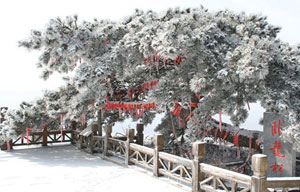
Chu Yanqing started a factory in 1956 and spread the art form nationwide with six works. These include Guest Greeting Pines, a portrait of a famous tourist site in Huangshan Mountain, Anhui, for the Great Hall of the People.
Chu Jinxia says when her father asked her to join the industry, she was reluctant because of the dusty environment but she eventually fell in love with the pictures.
One of the challenges of the trade is attracting new blood. Chu Jinxia says there are less than 70 iron picture artisans left and their average age is 45. In recent years, very few young people have joined the field.
"It takes many years of training to become a skillful artisan. Young people these days prefer a quick pace of life."
Another reason is the unattractive pay. Song Liangguo, 39, quit his job in the jewelry field to work on iron pictures a decade ago. But he laments that his salary has remained stagnant in the last 10 years. Song usually takes two days to finish a work and earn 100 yuan ($16) for each piece.
"You really think this is art? For me, it's just to make a living," he says.
The industry also faces quality issues. About 10 factories in Wuhu have different standards and some factories now use machines to manufacture parts for the iron pictures.
"Be it for my father's sake or for the sake of the public, I cannot let iron pictures die in my generation," says Chu Jinxia, who started her own company Chushi Iron Picture in 2002.
Chu has developed a new quenching technique to dye the iron instead of using black paint to better preserve the metallic appearance. But she stresses that new themes and forms are still paramount.
Chu Jinxia's nephew, Chu Tieyi, whose name means "iron arts", has designed some new styles using diverse backgrounds and lines, for a contemporary look to suit modern houses.
Another artisan, Yang Minglei, is experimenting with Western oil painting elements in his iron picture.
"The classic themes have to be preserved, but we need to have more modern elements to meet the demand of today's society," Chu Jinxia says.
She regrets that the interest in iron pictures is dwindling although the art form is listed as a national intangible cultural heritage.
"There should be classes in colleges to impart the skill to more people. If we fail to sustain the art, we should be ashamed to face our ancestors."
Contact the writer at wangkaihao@chinadaily.com.cn.



Copyright 1995 - 2010 . All rights reserved. The content (including but not limited to text, photo, multimedia information, etc) published in this site belongs to China Daily Information Co (CDIC). Without written authorization from CDIC, such content shall not be republished or used in any form. Note: Browsers with 1024*768 or higher resolution are suggested for this site.
License for publishing multimedia online 0108263 Registration Number: 20100000002731