A Hong Kong odyssey
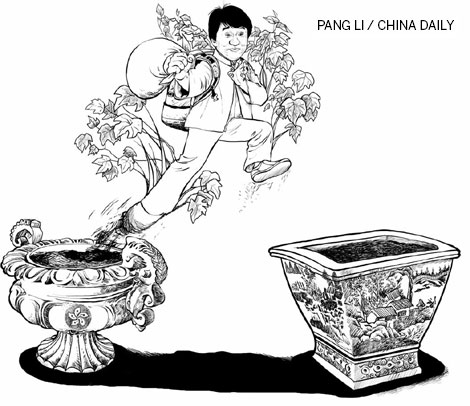
Hong Kong cinema is merging into the larger Chinese cinema, gaining strength and at the same time losing its own identity.
Hong Kong cinema used to be one of the three largest in the whole world, ranking behind only Hollywood and Bollywood in productivity. In absolute terms, mind you. Per capita, it could well have been larger than every film industry on the face of Earth.
Like all industries, Hong Kong's goes through business cycles. When I got hooked on Hong Kong movies in the late 1980s - in San Francisco's Chinatown no less, the industry was growing into the apex. A Better Tomorrow (1986) by John Woo whipped up a frenzy among movie fans, even in that small Chinese enclave in the city by the bay. An Autumn's Tale (1987), a sweet story about Chinese diaspora in New York's Chinatown, found a long queue snaking into the neighboring Italian community for its midnight premiere. "Women are trouble", Chow Yun-fat's chauvinistic putdown that disguises his affection for the female lead, turned into a catchphrase as he pronounced "trouble" in broken English, effectively changing it to "Women are teapots".
The die-hard fan base of Hong Kong cinema in the Chinese mainland did not get their informal education from Chinatown screenings as I did. They got it from round-the-clock video shows in dilapidated halls in county towns across the country. The exposure was both intensive and extensive, cramming decades of movie watching into just a few years.
By the 1990s, many of Hong Kong's movies were shot on the mainland, using the country's larger and cheaper pool of labor and vast choice of locations. Nominally these were co-productions, but the mainland partners chipped in nothing but the licenses, which only State-owned studios possessed at the time. Movies like A Chinese Odyssey (1995) were purely Hong Kong-made in the creative sense.
But the Stephen Chow spoof of the Monkey King story did not become a viral hit until mainland college students started watching it on pirated discs and squeezed subversive interpretations out of it. People viewed it with such religious fervor that many lines turned into code words among the young generation.
Throughout the 1990s, however, the Hong Kong film industry was in a nosedive, hitting its nadir in 2003 when the epidemic SARS struck the Special Administrative Region. Partly as a result of this disaster and pleas from the industry and the Hong Kong government, the central government included Hong Kong's film industry in its package of economic incentives, officially known as Closer Economic Partnership Arrangement, or CEPA for short.
Under the new policy, Hong Kong films are no longer categorized as imports and therefore not bound by the quota (20 films a year at that time and now expanded to 34). As domestic productions, they are subject to the same level of censorship for content.
Nevertheless, censorship poses only half the problem, the other being Hong Kong filmmakers pandering to the mainland audience. The unique sensitivity implicit in many Hong Kong films was thought to be part of the local culture, understood by only those who share the Cantonese dialect and could not travel beyond the Pearl River Delta. It was given up for an embrace of the larger market.
Hong Kong filmmakers became highly employable in the early CEPA years, but a truly integrated cinema did not emerge for a long time. A mainland film, such as World Without Thieves, may cast a Hong Kong superstar (Andy Lau in this case), but it essentially remains a mainland work. On the other hand, Hong Kong movies give more and more token roles to mainland actors. Squabbles on movie sets between the two sides occasionally surfaced in the press, a result of conflicting work styles and work ethics.
Hong Kong film artists began to feel the constraints embedded in the enlarged market. Gangster and horror movies, two genres that are known for their easy return on investments and serve as training for new talents, are off-limit because they usually fall into the realm of the forbidden. Trickier than genres are certain details that may run foul with censors.
Being shrewd businessmen, Hong Kong filmmakers are quick to gauge the regulatory environment and rarely complain in the name of artistic expression. Peter Chan's Warlords (2007) was supposed to be a remake of Blood Brothers (1973), but that would associate it with the real-life assassination of a Qing Dynasty official and, for reasons nobody could explain, would be irksome to some in power. So, the story was further fictionalized.
By 2008, when Painted Skin was released, it was hard to distinguish the origin of a Chinese-language movie. Gordon Chan's ghost story was based on a literary classic, thus tiptoeing around the no-superstition rules. The unified vision behind the period drama transcends any local limitations, and the fact that the director is from Hong Kong seemed to be irrelevant. Well, the sequel, which is coming out soon, is helmed by Wuershan, a newcomer from the mainland.
Still, there are lingering questions why Hong Kong films tick. Amidst the rush to gain a big slice of market share, the cinematic charm of Hong Kong is lost - until someone again tells quintessential Hong Kong stories and inadvertently stumbles into broader appreciation. Ann Hui's The Way We Are (2008) and Alex Law's Echoes of the Rainbow (2010) did not attempt to break into the mainland market, yet the ordinary lives of people in Hong Kong, as depicted in these small art-house movies, resonated with a vast swath of mainlanders.
Besides, a few Hong Kong filmmakers have stayed behind to preserve their artistic vision - or out of necessity. Johnnie To, known for his gangster films rich in political overtones, has so far resisted toning down his trademark violence and innuendos to crack the market to the north. Others have found a new niche in genres too hot for the mainland to touch. The erotic genre may see a small revival after 3D Sex and Zen: Extreme Ecstasy (2011) attracted hordes of mainland tourists who made catching the self-claimed, highly lifelike rendering of sex scenes, an essential part of their Hong Kong tour.
Other taboo genres that flourish only in Hong Kong include openly and graphically homosexual stories such as Amphetamine (2010) and Permanent Residence (2009).
For those who understand spoken Chinese, one sign whether a film is a Hong Kong picture or a broader Chinese one is the dialogue. If something interesting is lost when viewed in Mandarin, this could mean the film is Hong Kong-made, even though it may be shot entirely in Beijing or Shanghai. Pang Ho-Cheung's Love in a Puff (2010) and its sequel Love in the Buff (2012) deal with a couple of youngsters from Hong Kong who fall in love during cigarette breaks and later migrate to Beijing. Instead of searching for commonalities that underpin most urban romances, Pang uses local differences as a palette to color his on-again off-again love affair. The side plot of a plain Jane from Hong Kong ending up with a mainland prince charming is simply and subversively hilarious. The story could also be taken as a parable for the evolving HK-mainland relationship, as many HK pictures subtly imply.
As more Hong Kong filmmakers make their home in Beijing, Hong Kong as a film capital of the East has ceased to exist. Its expertise and resources have injected Chinese cinema as a whole with much professionalism and vitality. Beijing is now indisputably the center of Chinese-language filmmaking, but Hong Kong may retain its status as a stronghold of innovation and tolerance, cinematic or otherwise.??