Brazen heights
Updated: 2012-04-05 13:25
(China Daily)
|
|||||||||


 |
|
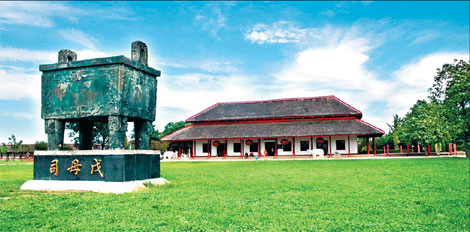
A sculpture of Simuwuding, one of the country's most famous bronze antiques, stands in front of Yinxu's Archeological Museum. Photos provided to China Daily |
 |
|
Models of sacrificial horses, slaves and chariots are on display at the museum. |
 |
|
A jade figurine unearthed in Yinxu |
 |
|
A bronze ware unearthed in Yinxu. |
In Shang Dynasty, bronze was the most valued metal - a metaphor of power and artistic achievement. Liu Xiangrui and Li Yuefeng visited the palace ruins in Yinxu, Henan province, to find out more.
For a history fan like me, forever pining for a vivid vision of ancient life and culture, going down the passage leading to Yinxu's Archeological Museum was a chance to connect with what lay buried in the past, quite literally.
The museum was built under the earth, so as to not tamper with the natural landscape above it. Walking into it felt like traveling back in time. I suddenly found myself surrounded by antiques from more than 3,000 years ago.
The ruins of the palaces of late Shang Dynasty (16th-11th century BC) in Yinxu offer a unique and overwhelming view of the ancient kingdom and its society. Numerous relics and the imperial tombs were unearthed here.
Yinxu, in Anyang city, Henan province, is today a lush green field, dotted by structures built on the lines of ancient architecture. The landscape hardly indicated that this was where luxurious palaces stood. For some 255 years this used to be a thriving capital city.
It was only after the excavations, begun in the 1920s - about 3,000 years after the palaces were burnt down when the kingdom lost a critical war - that people's curiosity about this lost kingdom was reignited. Yinxu relics were listed as a World Cultural Heritage in 2006.
Walking into the museum, I was immediately taken by the variety of bronze wares - weapons, sacrificial vessels, musical instruments and artistic ornaments. A lot of these displayed delicately carved, mysterious emblazonry.
Unlike ancient Egyptians who fancied gold, people living in the Shang period cherished bronze wares.
"The delicate bronze wares were symbols of power, and were more often related to religious etiquettes and sacrifices rather than people's daily use," explained Yang Yanmei at Yinxu's management office, who gave me a guided tour of the premises.
Simuwuding, a vessel on four legs dug out by a farmer while tilling the fields in 1939, is undoubtedly the most famous bronze piece unearthed in Yinxu.
Now preserved in the National Museum of China as a national treasure, the vessel is 133 centimeters high and weighs 833 kg - the largest and heaviest bronze antique ever unearthed.
It is elaborately decorated with patterns of Chinese mythical animals, with trellis designs in the background. Simuwuding is believed to have been commissioned by a king to pay respects to his late mother.
Bronze wares in Yinxu, especially the Simuwuding, represented the highest achievements of casting in metal by the ancient Chinese, according to Tang Jigen, a renowned archeologist in China.
Meanwhile, I got to sample a slice of people's daily lives during the Shang Dynasty. A cleverly designed system of underground water pipes, intricate food containers, cooking steamers, agricultural tools, fine bone ornaments, and bunched seashells - used as currency - were laid out as exhibits for curious onlookers like me.
The nobility's strong affinity toward alcohol was evident in the huge variety of wine vessels, which came in various shapes, sizes and were made of different material. Even wine remains in bronze containers had been excavated.
Yang cracked a joke, saying certain people in the surrounding area seemed to have inherited the Shang nobleman's "affinity for wine". "A wine culture is rather prevalent nowadays," she said.
In the museum, human and animal shapes carved in precious stones were on display, a testimony to the craftsmen's outstanding skills. Experts said in the Shang period, most of the natural jades would be extracted from Xinjiang and Liaoning regions, both thousands of kilometers away.
Yinxu is best celebrated as the "cradle of Chinese characters", for tons of oracles bones have been excavated here since the late 19th century. The precious divination records inscribed on them offer an interesting and unique resource to studying China's ancient history.
It was fun to read the meticulously carved words on the bones. Many of them resembled drawings. I tried guessing what they might mean. I could imagine the people belonging to the Shang period set great store by these divinations!
In fact, the archeological pieces preserved in Yinxu proved it was both a time of shining civilization and brutality. There was no denying that the Shang rule had a dark side to it.
If the human skull - which was proved to have been boiled in the bronze vessel where it remained - was merely a small hint of the atrocities indulged in by the powers that were, what followed was even more macabre.
Shang aristocracy built their palaces and houses over bodies of human beings who were buried alive, as they believed that would keep the evil spirits away, Yang said.
It was astonishing to see the twisted skeletons of warriors, as if standing with weapons in hand, in some of the pits. These skeletons would keep a vigil beside the palace gates. Infants were found buried in jars on which pillars were constructed.
"Slaves and war prisoners were owned by the nobility. And like animals, they were often killed, treated as sacrificial and funerary objects," Yang said.
The placid Huanhe River separates the palaces from the imperial mausoleums. The models of sacrificial horses, slaves and chariots preserved inside the grand mausoleum might shed some light on people's ideas about the afterworld during the Shang period.
People then didn't know what death was and they just wanted to take their belongings to the other world, Yang said.
The tomb of Fuhao, a king's beloved concubine, was, as a matter of exception, buried in the palace area. It was the only Shang Dynasty royal tomb never raided.
Fuhao was, according to historical records, China's first woman general. She once led more than 13,000 soldiers during an expedition and conquered over 20 neighboring smaller states. A large number of precious funerary items, including weapons with her name on these, were unearthed from her tomb in 1976.
Experts inferred that she might have been buried in the palace area as her husband, Emperor Wuding, wanted to be near her - mourn her passing whenever he missed her.
Now that's a touching love story.
Contact the writers at liuxiangrui@chinadaily.com.cn and liyuefeng@chinadaily.com.cn.