Comments()
  Print
Print  Mail
Mail  Large Medium Small
 |
|
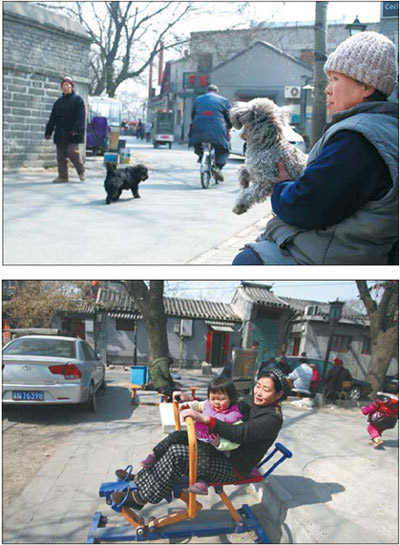
The Drum and Bell towers area is among the capital's most important historical residential communities and is where visitors can still get a glimpse of the traditional hutong lifestyle. Photos by Wang Jing / China Daily |


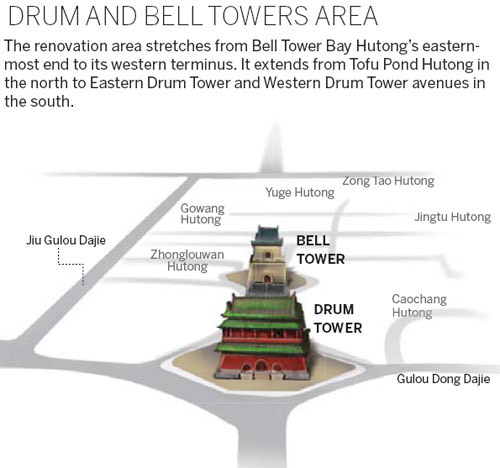

Editor's note: Fierce controversy has built up around the planned demolition and renovation of the area surrounding Beijing's Drum and Bell towers. Some residents, especially those living in poor conditions, can't wait to be relocated. Others say they will resist. The complexities surround concerns about the remoteness of resettlement locations, compensation and the disintegration of longstanding communities. This special report examines the various dimensions of the demolition and renovation.
Building new lives or demolishing old bonds? These are the questions facing planners and residents who live near Beijing's Drum and Bell towers. Cheng Anqi, Zhang Zixuan and Han Bingbin report in Beijing.
The Geng family can't wait to move out of their miserable living conditions. Li Lihong's folks do not plan on going anywhere if they can help it. These households represent, perhaps, the spectrum of sentiment among residents to be relocated from the area surrounding Beijing's Drum and Bell towers. Residents will be moved to the city's fringes by government order to clear the way for redevelopment by a private company that intends to transform the residential area into a cultural industry and tourism zone. The first phase will relocate 146 households. The 66-year-old matriarch of the Geng household, who refuses to give her surname, says she has been waiting for the renovation since plans were announced in the 1950s.
Her seven-member family, which spans three generations, crams into a 12-sq-m space with a 2-sq-m separate space that serves as a kitchen.
Geng is tired of being rained on while transporting food from the kitchen to the living area.
"I use three rooms to prepare lunch," she says.
Because there is no gas line, she operates a homemade rig to cook. The family placed buckets of water on the roof to heat them for summertime showers until an electric water heater made showers in their house possible in the warmer months. The family then hikes the chilly distance to the public shower, which is difficult for Geng's son, who has a leg disability, and has often made her granddaughter sick.
Her 45-year-old son, who refused to be named, strongly opposes many experts' views that the government should keep the hutong as they are.
"These experts probably have several houses, so they don't really get to understand our pain," he says.
But money is his first question about the relocation.
"It all depends on how much compensation we get. If the government gives us 20 million yuan ($3.17 million), I would be happy even if they relocate me to Hebei province."
But aside from price, he says the family needs at least three 20-sq-m apartments.
If the relocation is aborted again, he suggests the government convert homes into courtyards. He would be happy with a 70-sq-m courtyard, he says.
Li's public rental home, which costs the family slightly more than 100 yuan a month, is 20 sq m, plus a 10-sq-m room built for her son and his wife.
"The relocation team asked how much we would accept in compensation the day they came to measure our houses," Li says.
"I won't even think about it. We're not leaving. Those who want to leave have bad living conditions or want big compensation."
The 58-year-old says she has heard the neighborhood will be renovated into luxury courtyards for foreigners. She says this angers and confuses her.
"I don't understand why people who have long lived in the city's heart should be pushed to the outskirts," she says.
There are practical reasons for wanting to retain their current hukou (residency permit).
"My son doesn't have a job now, but there are even fewer opportunities in the suburbs. What about my grandchildren's lives? If they're born in the suburbs, they'll miss out on better education and healthcare options available in the city."
Li says her mother recently died after moving into a high-rise. She blames the lack of exercise that came with her new housing.
Her family believes a massive renovation, rather than relocation, of the residential areas would help residents. But the government has so far only pressed for relocations rather than offer to renovate, and it also forbade residents from improving their properties, Li says.
Retired bus driver Bai Changyong has religious reasons for not wanting to live far away. He and his father worship at the nearby Deshengmen Mosque.
Moving away would tear them from the city's Muslim community. About 2,000 Muslims are concentrated near the city's center.
"It would be really hard for us to move away from our community. We'd hate to leave the halal food areas. Pork is the preferred meat in the rest of the city's butcher shops."
Bai believes developers will build new courtyards to sell to the rich.
Zhang Jiayu believes relocating would place financial strain on the neighborhoods' residents.
"Hutong dwellers don't have deep pockets," the 56-year-old says.
Just a few blocks southeast is the Heizhima Hutong Elementary School, a reputable 89-year-old public school where many parents compete for a seat for their children by offering "out-of-district fees" of at least 50,000 yuan ($7,904).
"We don't have to pay the fees because we live in the district. The school is a 10-minute walk for my granddaughter. What could be more convenient?" he says.
And Zhang's house is a two-minute walk from the Gulou Hospital of Traditional Chinese Medicine, where Zhang's 90-year-old father was snatched from the jaws of death.
Timing was everything when his father developed a brain infection.
"We need to live close to the hospital. No one can be certain there will be the same service in the new place."
He points out Beijing's gridlock often causes a drag on emergency vehicle response times.
And moving would transform their lifestyles.
Zhang walks his bird in a cage every day because he loves the excitement of neighbors' mahjong rounds.
"I don't play but love to interact with neighbors," he says. "I don't think I'll get to see it anymore after we move into a high-rise."
While four generations occupy his two-story, 50-sq-m traditional home in Zhongluowan Hutong, moving into a larger home isn't better, he says.
For the first of the three phases, Li Xiangyu's home - shared by her husband, daughter and son-in-law - on Tanggong Hutong is safe.
But she believes the demolished area will be turned into new courtyards, and green and parking areas that will expel the locals who have lived there for generations to create luxury residences for wealthy outsiders.
She hopes to see a renovation.
Her daughter and son-in-law don't like using the public toilet. And the narrow roads are always crammed with tourism buses, which makes going out "scary".
Her father died defending his house from demolition elsewhere years ago.
"Every demolition takes human lives," she says. "It is not only houses that are torn down but also family bonds."
Erik Nilsson contributed to this story.



Copyright 1995 - 2010 . All rights reserved. The content (including but not limited to text, photo, multimedia information, etc) published in this site belongs to China Daily Information Co (CDIC). Without written authorization from CDIC, such content shall not be republished or used in any form. Note: Browsers with 1024*768 or higher resolution are suggested for this site.
License for publishing multimedia online 0108263 Registration Number: 20100000002731