Fossils fuel illegal excavations
 |
|
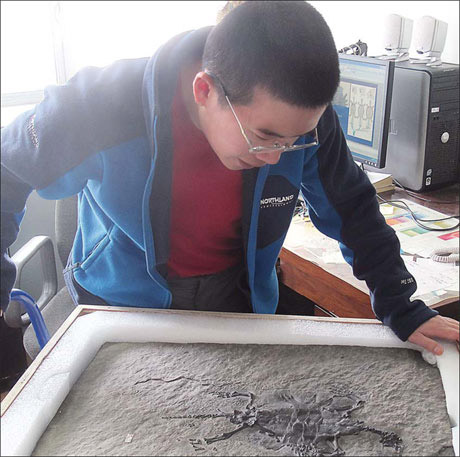
Paleontologist Li Chun has a closer look at a turtle fossil in Beijing. Photos by Wang Kaihao / China Daily |
 |
|
The mountainous area around Xinpu township is a major site for marine reptile fossils in Guanling, Guizhou province. |

Related: Digging deep for a career in science
Guizhou's Guanling is well known for its fossils but faces a race to preserve them as they are illegally plundered. Wang Kaihao in Beijing finds out more.
Paleontologist Li Chun believes fate guided him when he discovered the oldest turtle species fossil. His car had broken down on a mountainside in Guizhou province and the garage owner showed him some "strange fish" fossils that matched two he had purchased from a Beijing antiques shop.
The 37-year-old, who works at the Chinese Academy of Sciences, says it was tracing the fossils' origins that led him to Guanling in southwestern Guizhou, in 2007. The area is well known for its marine reptile fossils.
"I was amazed when I realized it was the same animal as the fossil I found in Beijing," he says of the "strange fish" fossils he was shown.
Li published an article in Nature in 2008 to make his claim for the discovery of Odontochelys semitestacea, the oldest known extinct species of turtle, which lived 220 million years ago during the late Triassic Period, from about 200 to 250 million years ago.
Despite his success, the paleontologist is concerned.
"The situation regarding fossil protection here is not good," he says.
Li Shunying, from Xinpu township, a major fossil site in Guanling, says she found fossils in rocks while building a cabin, but she didn't realize what they were.
"We even found some fossils in the villagers' hog lots," says Wang Liting, who came to Guizhou in 1964 after graduating from Peking University and has worked at the provincial bureau of geology and mineral exploration since then.
Fossils were first found in Guanling in the 1920s, and many fossil formations were almost intact when Wang first visited the area during a geological investigation in 1977.
However, digging for ammonite and crinoid fossils started happening in the 1980s, and this activity increased when marine reptile fossils were found in 1998.
"It takes scientists a long time to cautiously extract a fossil and maintain the integrity of its structure," Wang says. "But the large number of illegal plunderers dig carelessly and quickly, seriously damaging the fossil formations."
Official data shows the average annual income in Xinpu township is 3,000 yuan ($476), while Guanling was listed as one of the "national poverty counties" by the Ministry of Civil Affairs in 2008.
Li Shunying lives with six family members and they can earn about 10,000 yuan a year, barely enough to make ends meet. As a result, many villagers started digging fossils in the 1990s. "A well-preserved fossil can sell for tens of thousands of yuan," Wang says. "That's much more profitable than farming."
"It sounds ironical, but there would not have been many important discoveries here if there was no plundering," says Guanling Geopark Administration chief Cai Tao. The national geopark was established in Xinpu township in 2006.
"But the situation must change."
A first sign of improvement was in 2002 when Guanling issued China's first county-level paleontological fossil protection rule.
Luo Jinliang leads a five-people squad that patrols the 200-sq-km park. It takes three days for his team to finish one tour of duty of the park.
Asked whether they have caught any fossil thieves, Luo appeared to be embarrassed.
"It is hard to eradicate theft. The area is so large and we don't have enough money. Merely 60,000 yuan ($9,500) is allocated to us every year to do the job, but it can hardly cover the oil and office costs," he says.
"We are not the police and we don't have search warrants, though I am sure there are many fossils in the villagers' homes."
According to the national paleontological fossil protection law released in 2011, an individual faces a fine of at least 200,000 yuan for excavating fossils without legal permission.
"Do you think poor villagers can afford that much money?" Luo says. "In most cases, we can only fine thousands, and sometimes even less."
Luo's squad ferreted out a 60-sq-m crinoid fossil in 2007, which Luo says is the biggest haul of his career so far. This piece is now exhibited at the entrance of a 1,720-sq-m fossil museum, which was opened in 2009, in the central part of the geopark.
However, Li Chun and Wang are not impressed.
"This big fossil is a combination of several separate pieces," Wang says. "So, its scientific value is low."
When villagers dig for fossils, they usually combine different fossils and even add some artificial parts to make it look more complete.
Wang estimates over half of the fossils in Guanling are not genuine and Li claims this figure is even higher.
"This could be a time bomb if the problem is not solved," Li says. "When the general public's scientific spirit rises, they will abandon Guanling because of its fake fossils."
Cai, the park chief, confesses the scientific value of fossils in Guanling has been degraded.
He says the central and provincial governments have allocated 30 million yuan to Guanling for fossil protection in the past five years. But most of it was spent on infrastructure work such as the museum and roads in the geopark.
The museum attracted 20,000 visitors in 2011, and earned just 200,000 yuan in ticket revenue. "Money is a problem," Cai says. "Maintenance costs will rise in the following years, and I don't know whether we can make ends meet then."
Yang Haiming is an ecotourism planner from Beijing-based Tsinghua University and says: "If the park could switch its target market to high-end natural science enthusiasts, it would make more money."
But Cai says funding from the provincial government to build a 4D theater and a small theme park called Triassic Park will provide a boost.
"I hope tourism could lead to a boom in the local economy. When the villagers get richer, they won't rely on plundering fossils."