Unleashing hope
|
 |
|
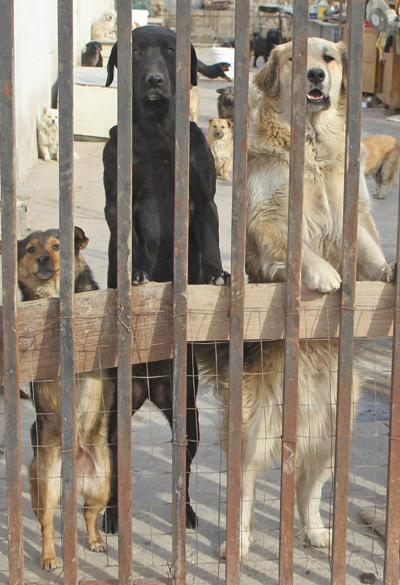
Top: Dogs at CSAPA's compound get excited when seeing people around. Above: Volunteers from China Small Animals Protection Association feed dogs at the association's compound on the outskirts of Beijing. Photos by Feng Yongbin / China Daily |
Canines rescued from slaughter still face uncertain fates. Eric Jou reports.
A truck carrying dogs was stopped on the Jingha Expressway's Beijing section on April 15, 2011. The driver wasn't doing, or carrying, anything illegal, and the person stopping the car wasn't a police officer but rather a concerned citizen After hours of arguing and the arrival of more volunteers, the dogs on the truck were bought for 100,000 yuan ($15,800). The incident has become known as the "415 incident". "The dogs were in terrible condition," a volunteer, who only gives his surname Zhang, says. "They were cramped and stacked atop one another. Some dogs were covered in feces, and the smell was terrible. Some of the dogs died during the move from the truck. Many others were sick."
About 80 dogs died during the relocation that lasted well into the night because of the poor conditions and various diseases.
The remaining 400 plus dogs were sent to the China Small Animals Protection Association (CSAPA), a nongovernmental animal protection group.
Many dogs that appeared sick and malnourished were sent to animal hospitals across Beijing for treatments against such viruses as canine parvovirus and distemper.
"The problem right now is there aren't any regulations to help and protect small animals, such as cats and dogs," Zhang says.
"China has a history of dog meat consumption. We cannot change that in the short term," the 32-year-old explains.
"What needs to be done is changes need to be made in transportation laws, such as banning the inter-provincial transport of animals. This can help slow the dog meat trade."
Regulations pertaining to the transport of small animals, such as dogs and cats, are unclear and loosely enforced, animal rights groups say.
Currently, 200 dogs from the "415 incident" are in CSAPA's care, while an unknown number are living in various animal hospitals and animal rights groups' facilities across Beijing.
After about three months of medical care, volunteers adopted about 40 dogs. The volunteers had become attached to the animals after spending so many days and nights caring for them.
Volunteer Xiao Xiong adopted one of the dogs from the original 520.
The 40-year-old, who wishes to be identified by her online name, says her dog Ah Niu has been a treat to have around.
She got involved with the "415 incident" dogs through the Sina Weibo micro-blogging service. What she saw online compelled her to reach out to the CSAPA, she says. The woman has had Ah Niu spayed.
"It feels like these dogs knew that if the truck wasn't stopped, they were going to be slaughtered. So now that they're alive, they are much more appreciative. Our dog Ah Niu is even better mannered than my 'pet' dogs."
Unfortunately, the number of adopted dogs is low, 34-year-old full-time CSAPA volunteer Wang Qi says.
There are many rules regarding dog ownership in Beijing. Owners must register their dogs. Residents living within the Fourth Ring Road are not allowed to keep dogs that sit higher than 35 cm from paw to shoulder.
Most of the dogs from the "415 incident" exceed the height limit, which cuts potential adopters by more than half.
Another obstacle to the adoption of the "415" dogs is the fact that they are mostly 2-year-old mutts. Wang and Zhang both say people in Beijing prefer to raise puppies or dogs with pedigrees.
Debt is another difficulty the CSAPA faces.
It costs about 3,500 yuan ($550) a day to feed all 700 dogs in the CSAPA compound, before land rental and labor. The CSAPA and many other affiliated animal rescue groups also suffer from immense debt from medical treatments.
American Chris Barden, founder of the Beijing-based animal adoption and rescue group Lingyang Xiaopu, currently has 20 dogs from the "415 incident". When medical debt is mentioned, the 45-year-old chuckles nervously and says, "Oh, man".
Barden owes about 50,000 yuan in medical bills to various animal hospitals and clinics across Beijing.
"A single dog is like having a child, so it is easy to accumulate the debt," Barden says.
"If there was a proper SPCA (Society for the Prevention of Cruelty to Animals), then they would have their own medical team and service the animals."
Money aside, the dogs living with CSAPA dwell in a compound about half an hour from north downtown, near the Sixth Ring Road's outskirts.
The 1.2-hectare compound is home to more than 700 dogs of all breeds and sizes. Volunteers and animal lovers fund the dogs' living expenses.
The CSAPA runs completely on donations from the public and benefactors.
Wang and Zhang say people are starting to forget about last year's incident. There has been a decline in the number of volunteers and donations.
"Many people jumped onto the '415 incident'. Volunteers were just coming out of the woodwork," Zhang says.
"Unfortunately, after a while, the number of volunteers started to decline. Now, only the hardcore are still working with the dogs."
Wang says it's hard to ask people to commit more to these animals, especially when many volunteers have day jobs and families. So, the association is working to get more visitors to come to the compound to care for and play with the dogs.
"The dogs are always happy to see people. They get very excited," Wang says, as two playful pooches pounce on him.
"We need more volunteers to come and help the dogs get better adjusted to people. The more people know how loving and caring these dogs are, the easier it is for them to be adopted."
In the end, however, Wang says the dogs' fates are uncertain, as the area around the CSAPA is undergoing development. The compound may have to relocate by year-end, he says.