Animation is booming, not blooming
Updated: 2012-01-29 17:01
By Huang Ying (China Daily)
|
|||||||||


 |
|
Cosplay attracts visitors during the ninth China International Digital Content Expo in Beijing in October. Wang Jing / China Daily |
 |
|
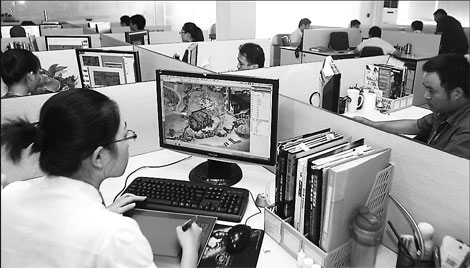
Designers at an animation workshop in Ningbo, Zhejiang province. Zhang Heping / For China Daily |
BEIJING - China's animation industry is still in its infancy but it's a very chubby baby, fed by investors pouring in capital and by favorable government policies.
It has been productive, too. In 2003, the industry turned out 12,000 minutes of original cartoons. In 2010, the volume was more than 220,000 minutes, according to data from the State Administration of Radio, Film and Television.
Last year's total production is expected to surpass 240,000 minutes.
But analysts say little remarkable progress has been made. They blame a lack of clear guidelines for development of the industry and blind investment in expectation of huge returns.
While more than 10,000 animation enterprises are operating in the market, few have made a profit or found the right way to run their business, said Li Yang, director of the expert committee on the industry's development under the State Council.
And among the nearly 22 weeks' worth of original cartoons produced in 2010, "there have barely been any really excellent ones, which actually turns out to be a huge waste of money, time and manpower", he said.
He based his conclusion on the calculation that the average cost of one minute of cartoon is about 10,000 yuan ($1,585), which put the 2010 total cost at 2.2 billion yuan.
Money in
Starting in 2004, both the central and local governments released a series of policies to support the development of animation as an industry. Incentives included offering subsidies and tax reductions to animation enterprises, setting up funds earmarked for the industry and increasing the broadcast channels for cartoons.
Animation revenue in China in 2010 was 20.8 billion yuan, of which 5.5 billion came from broadcasting channels. EntGroup Consulting Group, a domestic entertainment consultancy, estimates that total revenue will reach 200 billion yuan in 2015.
Despite the lack of animated masterpieces, investors still see great potential.
Creative clusters
Along with rapid expansion of animation companies came the emergence of animation industry parks and bases, where companies set up shop for a cluster effect.
The parks fostered different development models based on regional industrial features and legacies.
The Shenzhen National Cartoon & Animation Industry Base opened in May 2006 and is certificated by the State Administration of Radio, Film and Television. To date, 82 companies are stationed there, and their focus is largely on original business.
The entry threshold requires an enterprise to hold independent intellectual property rights in at least one of its products.
"Original and creative power is what we value most," said Peng Taimin, office director at the base. "In recent years the proportion of sales revenue directly generated from copyright increased from 5 percent to 20 percent, which demonstrates the improvement of original brands quality."
Annual revenue at the base reached more than 600 million yuan in 2010, and is expected to approach 1 billion yuan when last year's numbers are in. Eighty percent of the total comes from downstream on the industrial chain, through derivative products such as toys and T-shirts based on cartoon characters.
"In the next three years, the figure will continue to rise as the market condition grows better and more projects are being developed by the enterprises in our industry base," Peng said.
Broadcasting of animated films and cartoons will become more prevalent, Peng said, bringing increasing attention to their producers, more deals and more revenue.
Local support
If the animation industry is flourishing in Shenzhen, local government's support is part of the reason. The municipal government provides up to 2 million yuan to finance production and market promotion of a single animation project.
To attract and retain high-end animation talent to the city, local government started in 2006 to offer registered permanent residency to top recruits and to give their children access to local schools.
Many former toy producers and exporters in Shenzhen transformed themselves into original animation makers, and their businesses are growing faster than their peers in other regions. These companies include Puzzle Animation Studio Animate China Technology and stock exchange-listed Guangdong Alpha Animation and Culture.
Alpha's revenue in the first three quarters of 2011 rose 40.41 percent year-on-year to 727 million yuan, according to its corporate financial report.
Peng ascribed the rapid growth to the rich overseas commercial resources these companies accumulated over their years in the toy trade.
Other approaches
Most enterprises stationed at Guangzhou Huachuang Animation Industry Park in Panyu produce game consoles. The park opened in March and was closing in on 100 businesses at the end of the year.
The game consoles produced in Panyu hold more than 60 percent of market share at home and 20 to 30 percent globally.
Xing Xing Digital, an animation and special effects company based in Beijing, chose another path to grow.
Most of its business is related to the overseas market. More than half of its sales revenue comes from outsourcing, and the balance from original animation productions.
"In the long term, Xing Xing will mainly focus on its original content business as it is the core competitiveness in the industry, without which it's difficult to make a lasting presence in the market," said Zheng Fei, marketing director and assistant to the CEO.
"The current animation market in China is experiencing a period of disorder and confusion, just like that of many developed countries years ago, and finally a dozen major corporations will survive the market competition, making the industry giants."
Zheng expects something like 90 percent of the country's 10,000 animation enterprises will be eliminated by the market in two or three years.
Areas of weakness
Insiders pointed out problems they have seen in the search for the right way to propel the industry's development.
Peng from the Shenzhen base mentioned some joint contributors to the industry's immaturity, including a severe shortage of top animation talent and inadequate capital injection in the upstream, creative segment.
Liu Peiwen, president of Guangzhou Huachuang park, said, "The game console industry is centered in Panyu of Guangzhou, Guangdong province, but the absence of an industry association which plays the bridge role between government and those enterprises hinders the development of the whole industry."
A large crowd of investors jumped into the industry just for the government's favorable policies and interest, said Li Yang, the expert committee's director. "They have little knowledge of running the animation companies and some even purchase the land in the name of building an animation park but actually undertake the property business," he said.
Li said the proportion of investors and entrepreneurs with a genuine passion for animation is rather small.
Against the absence of excellent Chinese animated productions, two foreign animated films - Rio and Kung Fu Panda 2 - reaped great profits in China last year. Panda, for example, drew more than 470 million yuan in box office in its first three weeks on the Chinese mainland.
In contrast, figures from EntGroup showed that Chinese animated movie Kui Ba took in only a bit over 3 million yuan in its first 21 days.
Li said that animation requires significant investments of time, capital and talent, and because of the industry's nature, it takes a long time to get returns. The Chinese films operate in a far smaller scale of time and money, he said.
"Although there are huge government grants into the sector every year, all the money is scattered nationwide, without a dozen entities as the primary objects of support," Li said.
Zheng from Xing Xing Digital said, "I hope that government and investors from the financial sector will be able to identify the really promising enterprises in this industry and then help them to grow to the fullest."