New historical dimensions
Updated: 2012-01-04 10:46
By Liu Zhihua (China Daily)
|
|||||||||


 |
|
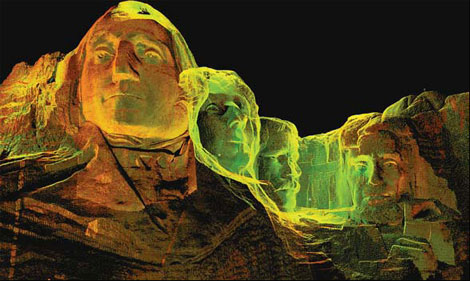
The sculptures of former US presidents on Mount Rushmore are scanned. Photos Provided to China Daily |
 |
|
The 3D scans of the sculptures on Mount Rushmore by the Scottish 10 project. |
 |
|
A grand hall in the Eastern Qing Tombs complex in Zunhua, Hebei province. |
Advanced 3D scanning technology used to chronicle heritage sites will digitally archive the Eastern Qing Tombs. Liu Zhihua reports.
A type of 3D digital archiving technology used to preserve archeological and cultural heritage after the Taliban blew up the Bamian Buddhas in Afghanistan in 2001 will be used to archive the Eastern Qing Tombs in Hebei province's Zunhua city.
The technology comes from the company of Ben Kacyra, an Iraqi expatriate in the United States, who invented the three-dimensional laser scanner and point cloud software (think sonar but with lasers instead of sound).
It was the destruction of the Afghani Buddha that led Kacyra and his wife to found the nonprofit CyArk, which stands for Cyber Archive, in 2003, to use the 3D scanning technology to document heritage.
On Dec 5, 2011, the Chinese State Administration of Cultural Heritage (SACH) signed an agreement with the Scottish heritage agency Historic Scotland to work on the Scottish 10 project.
The five-year project will digitally document Scotland's five United Nations Educational, Scientific and Cultural Organization (UNESCO) World Heritage Sites and another five international heritage sites, including the Eastern Qing Tombs.
Historic Scotland, the Glasgow School of Art and CyArk initiated the project in July 2009, as part of CyArk's goal of digitally recording 500 World Heritage Sites.
"We have been working closely with the Chinese government to identify a suitable location for some time," First Minister of Scotland Alex Salmond says.
"We are confident this work will help our Chinese partners maintain and enhance (their) understanding of this hugely impressive heritage site. I hope that this is the start of a long partnership between Scotland and China in the field of cultural heritage protection. The experience will add to the scanning team's knowledge and expertise."
Located about 125 km northeast of Beijng, the Eastern Qing Tombs are an imperial mausoleum complex built during the Qing Dynasty (1644-1911).
Surrounded by mountains and a river, which are believed to create auspicious feng shui, the tomb complex serves as the final resting place of five emperors, 15 empresses, 136 imperial concubines, three princes and two princesses.
"The Eastern Qing Tombs were selected from a shortlist of more than 20 cultural heritage sites in China because they're unique," deputy director of the site's cultural management department Wang Zhaohua says.
"They comprise China's largest, most complete, best preserved and the most famous imperial tomb complex."
Wang heard in March that the SACH would cooperate with Scottish experts to digitally record some cultural heritage sites. Scotland's first minister had discussed the potential for one of China's most celebrated sites to become part of the Scottish 10 project when China's Vice-Premier Li Keqiang visited Scotland last January.
In April, Wang was informed the Eastern Qing Tombs had been chosen.
"The tombs stand out in a way that meets five out of the six UNESCO world cultural heritage selection criteria," Wang says.
"I wasn't surprised."
Ancient Chinese rulers believed their mausoleums not only affirmed their authority during their lifetimes but also influenced the fate of their afterlives and dynasties. So they attached great importance to their final resting places' locations, layouts and buildings, Wang says.
The imperial tombs, which stretch over 80 sq km, feature richly decorated stone statues and carvings, and tiles with dragon motifs, all of which testify to Qing funerary architecture's development.
Xiaoling - the site's most elaborate mausoleum, which belonged to the first Qing emperor, Shunzhi (1638-1661), and exerted profound influence on later mausoleums - will be a focus for the project.
Jingling, the tomb of Emperor Kangxi (1654-1722), who is widely considered the greatest Qing emperor, will also be recorded.
A team of about 10 Scottish experts will start about three weeks of fieldwork, toiling for about 12 hours a day, in October 2012, conditions allowing.
"Our work uses very specific and precise equipment, from the laser scanners to digital photography," the team leader and head of visualization at the Glasgow School of Art's digital design school Doug Pritchard says.
"For the project in China, we are capturing and dimensioning the actual, as-built condition - the physical conditions of the buildings."
Working in concert with photography, scanners can pick up very small details, such as cracks and incidental items like a flower in a room, Pritchard says.
The technology to be used in China has created 3D renderings of sites as varied as Scotland's St Kilda and Neolithic Orkney, India's Rani Ki Vav and the United States' Mount Rushmore.
The way it works is relatively simple.
A laser is shot from the scanner, hits the buildings' surfaces and bounces back. As the speed of light is fixed, the time required for the light to hit the subject and bounce back is divided by two, and that measurement creates a point.
As the scanner rotates and the laser travels across surfaces to return many data points, a point cloud is generated.
Software is then used to mesh the scans taken from different locations to create a complete 3D form of the entire object.
"Our team is well versed in operating in various situations," Pritchard says.
"The obvious challenge (for the project in China) will be the size of the tombs."
Various laser scanners will be used during the surveys, because different types are ideal for different fieldwork requirements in terms of range and accuracy.
Time-of-flight scanners will be used for buildings and landscapes. These operate at ranges of about 300 meters and can cover a 360-degree rotation, and negative 45-degree to positive 90-degree vertical measurements, in a singe scan.
Phase comparison scanners will be used to measure rooms and interiors. These have a medium range of about 70 meters and an accuracy of roughly 3 mm to 5 mm.
Triangulation scanners are most efficient for reading carvings and small objects' details.
They can work at a distance of up to 2 meters and have sub-millimeter accuracy.
And 360-degree photographic technology will also be used, Pritchard says.
It will take months after the scanning to create the site's final 3D rendering.
The patent on all the data and all three-dimensional content belongs to the site. Permission for using the information for commercial use, such as filmmaking, will belong to the tombs' management.
The Eastern Qing Tombs' management will cooperate with the Scottish team and provide logistical assistance. Some of its employees will be trained to use the data.