Bad Boy Architects & China's New Face
Updated: 2011-10-17 09:46
By Liu Yujie (China Daily)
|
|||||||||


 |
|
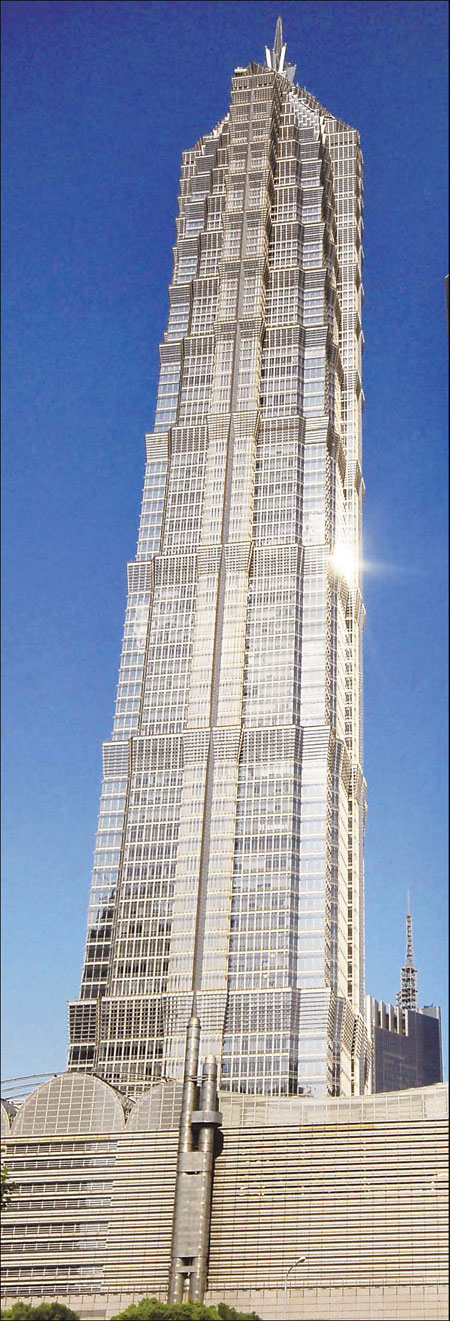
The high-rise Jin Mao Tower in Shanghai draws inspiration from Suzhou architecture. Provided to China Daily |
Many domestic architects finger two landmark buildings as antithesis of the case in point: One is the Jin Mao Tower in Shanghai and the other is the CCTV Tower in Beijing's CBD. These two landmarks represent the best and worst in blending East with West, ancient and modern, and form and function.
Designed by SOM architects from Chicago, the Jin Mao skyscraper imitates an elegant Suzhou ancient tower and is highly functional at the same time, a fact lauded by experts and appreciated by Shanghai residents.
In contrast, design critics say the new CCTV building by Dutch master Rem Koolhaas has "humiliated the Chinese" by its irreverent resemblance to a pair of boxer shorts, and its exorbitant price tag of five billion yuan ($783.80 million).
"China is not so rich that we do not need to count the cost. We need real and practical solutions," says Wu. "I hope none of my students will ever propose such irresponsible designs for a developing country."
Some Chinese architects have heeded the clarion call to rediscover traditional architecture influences.
Liu Xiaodu of Urbanus Architects created an urban tulou (earth fortress) in Guangzhou, modeled after the circular fortified structures built by the Hakka people in Yongding, in neighboring Fujian province.
His work successfully addressed how the old vernacular can provide inspiration for modern low income housing that has a strong communal focus, and improves the lives of migrants in urban enclaves in China today.
Wu Xuefu, a professor of design at the Communications University of China, has been traveling with his students all over the country, taking pictures of traditional Chinese residences, and researching and defining Chinese-style aesthetics.
"We believe it is time for China to stop worshipping foreign things and to 'export' the best we have to the world. But first, we need to know ourselves better."
But in the midst of nationalistic indignation, there is also the other side of the coin. Foreign architects bring maturity of experience and technology. The so-called "foreign invasion" also instigates local talents to take a good look at what they can offer.
Wang Shu, professor of architecture at the China Central Academy of Fine Arts (CAFA), succeeded in wresting the design of the Ningbo Museum from GMP Architects from Germany years ago.
"In the past, Chinese architects did not have the confidence to take up big projects like museums and performing centers. By cooperating with foreign partners, we have taken a big step forward. It is good to have competition so we can grow and look for our own distinctive characteristics," Wang says.
While building design as a profession has existed for more than 500 years in the West, it has a relatively short history of a mere 30 years in China.
In Asia, we can perhaps look toward Japan, where western-style architecture arrived during the Meiji Restoration of the late 1860s and changed the physical landscape. Although the Meiji rulers began to use Western architects, Japan was careful to keep its culture and strived to preserve that in its modern construction. That paved the way for generations of exceptional Japanese architects such as Kenzo Tange, Kisho Kurukawa, Tadao Ando, Toyo Itob and Kazuyo Sejima.
Wang is optimistic Chinese architects, too, will take their place in international building design, although there is a lot of ground to till. First, there is the age-old question of the education system.
Wang says it is good to see architectural faculties attract more students in recent years, "but increasing the number is not enough, we need to set up our own aesthetic system and educational methods".
In his classes at the CAFA, Wang emphasizes the importance of Chinese calligraphy as well as Western drawing techniques. His explanation is that "through calligraphy we grasp the Chinese way of perceiving and manipulating space and form".
He has also called for the government to set up a system of fair competition to allow domestic and foreign design firms equal opportunities.
"Renowned architectural studios from abroad are favored. China cannot cultivate its own talents if such preferences are not abandoned." And finally, Wang says, the media should stop highlighting odd-looking buildings and give them publicity and attention.