Birthplace of China's last dynasty
Updated: 2011-10-13 11:05
(China Daily)
|
|||||||||


 |
|
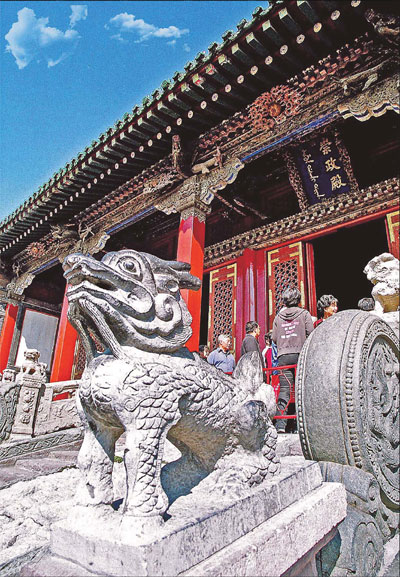
Shenyang Imperial Palace, modeled after the Forbidden City in Beijing, is full of Manchu influences. Hu Jibin / Asia News Photo |
 |
|
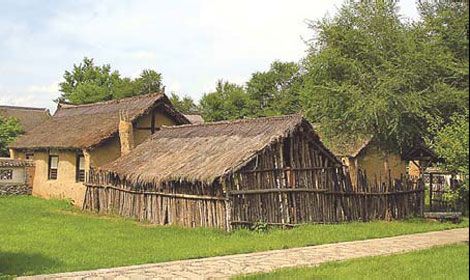
Hetu Ala, the birthplace of Qing's first emperor, Nurhachi. Tiffany Tan / China Daily |
Despite having completed six years of Chinese history classes at high school, Shen Di had to once again bury her nose in history after signing up as a tour guide at the Old City of Hetu Ala. Her mission: to delve deeper into the birth of China's last imperial dynasty.
"We didn't study this in such detail in school," the 21-year-old Shen says, during a tour through a 500-meter-long covered walkway, its walls painted with scenes depicting the rise of the Qing Dynasty (1644-1911), as well as its traditional Manchurian culture.
Hetu Ala, in eastern Liaoning province, is Manchurian for "flat ground on a hill". It is, you might say, the ground on which Manchurian chieftain Nurhachi (1559-1626) established the foundations of the Qing. It became the dynasty's first capital after Nurhachi declared himself "emperor" of the state of Manchuria in 1616.
Hetu Ala features a replica of Nurhachi's yamen, the original of which was built between 1601 and 1602, when he began consolidating the power of various Manchu tribes before eventually overthrowing the Ming (1368-1644).
The yamen was where he issued orders, studied military strategy, received envoys and rewarded princes and ministers.
It's now basically empty, but if you open a red wooden door on the right side of the building's base, you'll behold the structure's original, 400-year-old foundation of piled rocks.
Five minutes away on foot is where Nurhachi's home once stood. Now you'll find a reproduction of the thatched cottage and its contents, including the kang (bed stove) where Nurhachi was born in 1559, and a small altar that tells of the Manchus' traditional practice of shamanism.
In the yard, there's a feeder pole for crows, birds the Manchus consider lucky since they, according to legend, had saved the life of a young Nurhachi. Next door stands the actual yamen once used by Nurhachi's son and the second Qing emperor Huang Taiji.
Four kilometers away from the Old City are the Yongling Tombs, which house the remains of six Qing ancestors, including Nurhachi's father, grandfather, great grandfather and great-great grandfather. In 1648, Emperor Shunzhi, Nurhachi's great grandson, conferred on these men posthumous titles of emperor.
The five emperors that succeeded Shunzhi all came here to pay homage, even though the trip from the capital Beijing at the time lasted 190 days. It's interesting to note that the elaborately designed mausoleums - containing bas-reliefs of dragons, sculptures of bixi, a mythological creature that's a cross between a dragon and a turtle, and inscriptions in Chinese, Manchu and Mongolian - do not actually contain the remains. They're buried at the back end of the lot, in accordance with Manchu custom, and are marked by huge mounds overgrown with weeds and vines.
The burial ground, chosen for its good feng shui, is framed by mountains, hills and a river. In 2004, it was listed as a UNESCO World Heritage site.
Two decades before Nurhachi's descendants captured Beijing in 1644, they began constructing in Shenyang a palace modeled after the one the Mings built in the imperial capital - a reflection of the Manchus' growing political ambition.
The Shenyang Imperial Palace, which consists of 114 buildings, is only a tenth the size of Beijing's, but it is rich with Manchu influences.
For instance, the ceremonial Hall of Great Affairs, on the eastern wing, is lined on both sides by four pavilions, each representing the Manchus' eight banner units used to oversee military and administrative affairs.
The sign at the library entrance is written in both Chinese and Manchu, but the Manchu script is placed on the left side, the position of greater importance. Green is also a big part of the palace's color scheme, to commemorate the grasslands where the Manchu tribes originated.
The imperial palace, a UNESCO World Heritage site, showcases collections of Qing-era porcelain and cloisonne, as well as the royal toilet used by the seventh Qing emperor, Qianlong, during his visits. One unusual structure in the complex is a ground-level chimney used to heat the floor of the palace's living quarters, as winters in Northeastern China are famously frigid.
It was apparently from the Shenyang Imperial Palace that Emperor Shunzhi ordered his troops to invade Beijing and bring down the Ming Dynasty.
Ironically, the Qing Dynasty also ended where it began: After the founding of New China in 1949, the last Qing emperor, Pu Yi, was imprisoned in the city that encompasses Hetu Ala.
Liu Ce contributed to this report.